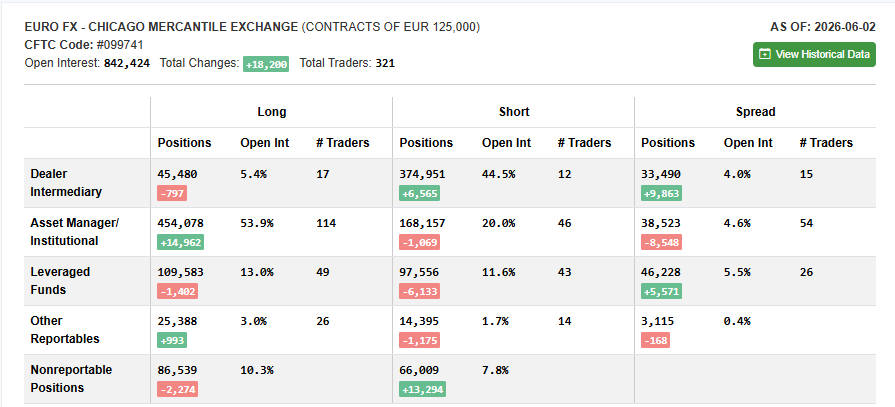
Let's conduct a detailed analysis of the recent COT report on euro futures on the Chicago Mercantile Exchange for the reporting date of June 2, 2026. The data was published on June 5, with open interest rising to 842,424 contracts, which is 18,200 contracts higher than the previous reporting date. The number of traders increased to 321. The report's structure is presented by types of participants, which is much more informative than just the Non-Commercial and Commercial dichotomy. There are four main groups highlighted: dealers and brokers, asset managers and institutional investors, leveraged funds, as well as other reporting and non-reporting participants. Let's start with the largest group - asset managers and institutional investors. This category often acts as long-term strategic players. They hold a massive long position of 454,078 contracts, accounting for 53.9 percent of the total open interest. Over the week, their long positions increased by another 14,962 contracts, while their short positions decreased by 1,069 contracts. The net long position of this group is plus 285,921 contracts. This is a powerful bullish signal. Asset managers are increasing their bets on the euro's rise and already control over half of all long positions in the market. The number of traders in this category is 114 long versus 46 short, confirming the consensus. Now let's look at dealers and brokers. These are classic hedgers, market makers, and banks that provide liquidity and hedge risks. Their position is the opposite of asset managers. Dealers hold a short position of 374,951 contracts, which is 44.5 percent of the open interest. Over the week, their short positions increased by 6,565 contracts. They have a small long position of 45,480 contracts. Therefore, dealers' net short position is minus 329,471 contracts. This is a significant bearish hedge. Dealers are on the opposite side of institutional investors, which is normal for the futures market structure. Note that dealers also increased their spread positions by 9,863 contracts, indicating an increase in arbitrage strategies. The third important category is leveraged funds, which are funds using borrowed funds for speculation. This group holds a more balanced position. Their long positions amount to 109,583 contracts, while short positions are at 97,556 contracts. The net long position is around plus 12,027 contracts. Over the week, leveraged funds reduced both long and short positions: longs decreased by 1,402 contracts, shorts by 6,133 contracts. This means they are reducing overall activity and slightly shifting towards a long position by actively closing shorts. Their spread positions increased by 5,571 contracts. The number of traders is approximately equal: 49 long versus 43 short. Other reporting and non-reporting participants play a minor role. Other reporting participants hold a small long position of around 11 thousand contracts. Non-reporting participants, i.e., small traders, are in a long position of 86,539 contracts and a short position of 66,009 contracts. Their net long position is around plus 20,530 contracts, which is quite significant for this category. Over the week, small traders reduced long positions by 2,274 contracts and increased short positions by 13,294 contracts, meaning they started closing longs and opening shorts, acting against the main trend set by asset managers. Now let's compare this data with the previous report from May 12 and the price dynamics. In mid-May, we saw a net long position of speculators of around 40 thousand contracts, and the balance zone was defined in the range of 1.15659 - 1.15059. In the new report from June 2, the picture has changed drastically. Asset managers, being the largest group, increased their long position to 454 thousand contracts. This is a completely different order of numbers. The net long position of this group alone is almost 286 thousand contracts, significantly exceeding the total position of all speculators in the previous report. Speaking of price, during the period from mid-May to early June, the euro first tested the lower part of the balance range and then turned upwards. The current positioning shows that institutional investors have bet on growth and actively increased it precisely when the price was near support. Dealers, on the other hand, increased their short hedge, which is their natural function. Leveraged funds reduced activity but remained in a net long position. The main takeaway from this report is as follows. The euro futures market is under the control of asset managers and institutional investors, who hold a record long position. Dealers are on the opposite side with a comparable short position. This creates a stable structure where large money is betting on the euro's rise. Leveraged funds and small traders play a minor role. It is important to understand that such a high concentration of long positions in one group creates potential for a correction if institutional investors start taking profits. But for now, this is not happening; on the contrary, the position is increasing. The key signal for the market will be when asset managers start reducing their long positions.
*Analisis pasaran yang dipaparkan di sini hanya bertujuan untuk meningkatkan kesedaran anda, tetapi bukan sebagai petunjuk untuk anda melakukan perdagangan
 Bahasa Malay
 Русский
 English
 Bahasa Indonesia
 ไทย
ไทย Español
 Deutsch
 Български
 Français
 Tiếng Việt
 中文
中文 বাংলা
বাংলা हिन्दी
 Čeština
 Українська
 Română
