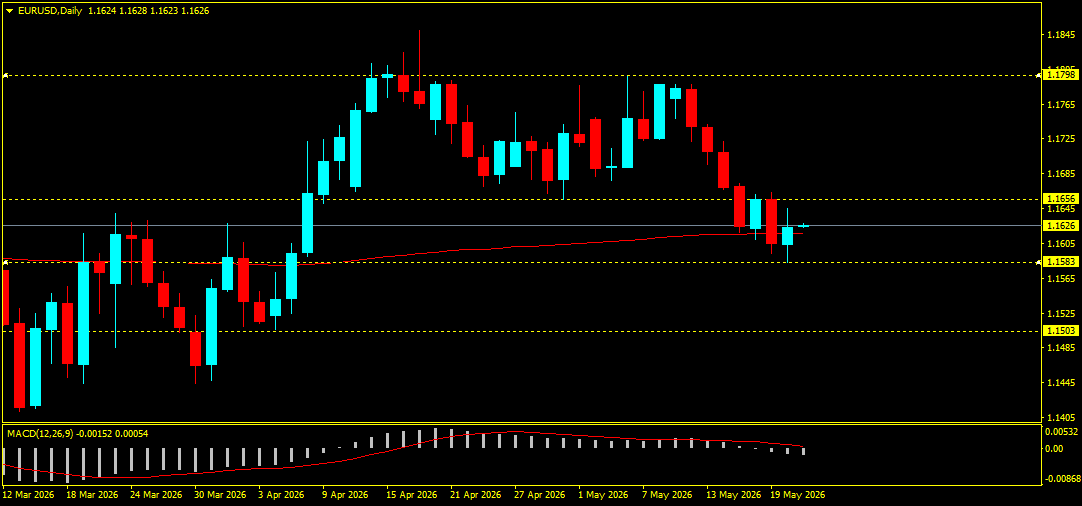
 EUR/USD Analysis
 The EUR/USD currency pair is currently navigating a highly volatile trading environment as deep macroeconomic shifts dictate global capital flows between the Eurozone and the United States. In today's session, the spot price is actively trading at 1.1626, capturing a distinct short-term bullish momentum that has developed over the preceding twenty-four hours. This micro-rally materialized after a brief period of structural consolidation, signaling that buyers have stepped in to absorb supply at key intra-week levels. The daily high has been established at 1.1632, representing an immediate ceiling formed by resting buy-side liquidity, while the daily low sits at 1.1583. The resulting intraday trading range of 49 pips reflects a balanced yet sensitive environment, highly typical for a mid-week trading session where large institutions prefer to position themselves defensively ahead of major economic data releases. Because the current price is pressing closely against the absolute ceiling of this daily range, the market is displaying robust relative strength for the Euro, largely supported by an unwinding of short-term US Dollar long positions. Analyzing the last-hour candlestick formation provides an insightful look into localized institutional order flow and short-term market psychology. The most recent one-hour candle closed as a stark bullish rejection candle, featuring a remarkably long lower wick and a thick, positive real body situated at the top of the structure. In classical retail technical analysis, this would be labeled a textbook hammer or pin bar; however, through the lens of institutional order flow tracking, this pattern signifies a clean liquidity sweep of internal sell-side stops. The long lower wick extending down toward the 1.1610 region demonstrates that a brief wave of selling pressure was aggressively met by institutional buy-limit configurations resting just below the previous hourly support structure. Because the candle closed with almost no upper shadow, it implies that the buyers maintained absolute structural control right up to the final seconds of the hour. This transfer of inventory from weak hands to strong hands has left an inefficiently filled price void—often called a Fair Value Gap—on the lower M5 and M15 charts, suggesting that price faces very little resistance on its path to test the daily high at 1.1632 and potentially expand further up. Looking forward, the upcoming economic calendar is heavily packed with tier-one data releases that will act as the direct fundamental triggers for the next directional expansion in the EUR/USD pair. Market participants are keeping a laser focus on the impending Flash Manufacturing and Services PMI data coming out of Germany and the wider Eurozone. Because purchasing managers' data acts as a highly sensitive leading indicator of economic vitality, an upside surprise will heavily reinforce the European Central Bank's restrictive monetary stance, driving aggressive capital allocations into the Euro. On the other hand, a missing reading will rapidly deflate this bullish structure. Simultaneously, the US economic docket presents a twin threat with the weekly Initial Jobless Claims and the Philadelphia Fed Manufacturing Index. If the US employment data indicates cooling labor conditions via higher-than-expected claims, algorithmic trading systems will aggressively price in a more aggressive rate-cut trajectory from the Federal Reserve, applying sharp downward pressure on the US Dollar Index and sending EUR/USD into an extended rally. Scheduled speeches from key ECB and Federal Reserve officials later in the day are set to amplify this volatility, making tight execution mandatory. A comprehensive multi-timeframe analysis reveals a highly fascinating technical landscape where macro-level bearish historical structures are actively colliding with emerging micro-level bullish reversals. On the long-term Weekly chart, the underlying macro trend is fundamentally governed by the relationship between the 50-week Simple Moving Average and the 200-week Simple Moving Average. Currently, the 50-week moving average remains positioned comfortably below the 200-week moving average, maintaining a long-term bearish alignment that has locked price action down for many months. However, the macro price action has successfully carved out a resilient structural bottom directly above historical multi-year demand zones, and the current weekly candles are actively climbing toward the declining 50-week moving average line. Shifting to the Daily timeframe, a massive structural shift is explicitly visible: the daily spot price has cleanly crossed above both the daily 50-period and 200-period moving averages, marking a definitive transition from a bearish regime to an emerging medium-term bullish phase. The daily moving averages are beginning to flatten out completely, with the faster 50-period average curving sharply upward, hinting at a potential Golden Cross formation if price holds these levels. As we drill down into the shorter-term intraday execution timeframes, such as the 4-Hour and 1-Hour charts, the bullish trend structure becomes entirely dominant and clear. On the 4-Hour chart, a bullish moving average crossover has already completed, with the 50-period moving average trading completely above the 200-period moving average, creating an environment where institutional algorithms are heavily programmed to buy corrective pullbacks. The 1-Hour chart further underscores this momentum, showing the spot price trading comfortably stretched above both tracking lines, with the hourly 50-period moving average functioning as a strict, ascending dynamic floor that has cushioned multiple minor pullbacks over the past 48 hours. This integrated moving average matrix demonstrates that while the absolute higher-timeframe macro view is still confronting legacy resistance, the intermediate and immediate short-term trend dynamics are heavily supporting higher price extensions, rendering counter-trend short positions highly dangerous until a major structural failure is confirmed. To accurately gauge the velocity of this trend, we look to the primary momentum oscillators, specifically the Moving Average Convergence Divergence (MACD) and the Relative Strength Index (RSI). On the Daily chart, the MACD line is trading well above its designated zero line and its corresponding signal line, showing a wide and expanding histogram spread that confirms strong, sustainable buying interest without any signs of bearish divergence. On the 4-Hour timeframe, the MACD recently underwent a healthy convergence phase during the mid-week consolidation but has just printed a fresh bullish crossover, signaling that a new wave of capital has entered the market. The Daily RSI is currently registering a highly constructive reading of 63, which shows powerful buyers' control while remaining safely below the overbought threshold of 70, which usually prompts automated profit-taking. The 1-Hour RSI is slightly more elevated at 68, reflecting the raw intensity of the latest hourly push. While a short-term pause or a shallow corrective dip may occur on the hourly view due to this near-overbought state, the total lack of bearish structural divergence across all major timeframes indicates that any upcoming decline will be viewed by institutions as an accumulation opportunity rather than a trend reversal. Utilizing the principles of Smart Money Concepts (SMC) and institutional order flow, the technical layout for EUR/USD points toward a highly optimized long execution plan. The recent structural expansion above the local swing highs has delivered a clean intraday Break of Structure (BOS) to the upside. By anchoring our Fibonacci Retracement tool from the key intraday swing low of 1.1583 to the current session high of 1.1632, we map out the exact institutional premium-to-discount parameters. The Optimal Trade Entry (OTE) zone is mapped out precisely between the 61.8% retracement level at 1.1602 and the 79% retracement level at 1.1593. This discount price array perfectly aligns with a highly visible 1-Hour Bullish Order Block spanning from 1.1595 to 1.1605, which represents the final down-close candlestick sequence before the explosive upward expansion that broke the local market structure. Furthermore, this Order Block is heavily confluenced by a 4-Hour Breaker Block—a prominent former bearish supply zone that was broken with high volume and has now flipped into a strong underlying demand pillar. The primary execution blueprint requires patient waiting for a liquidity-seeking pullback down into this OTE discount pool before triggering any entry. The optimal entry limit orders should be layered between the 1.1600 and 1.1605 levels, allowing traders to enter directly at the source of institutional buying. The structural invalidation level, or Stop-Loss, must be placed strictly at 1.1575, which sits safely below the daily low of 1.1583; a breach of this level would fundamentally violate the bullish order flow model. The primary take-profit target is set at 1.1655, a major daily resistance level and a psychological magnet where massive buy-side liquidity is resting. The secondary ultimate target is mapped directly to the 1.1695 level, which represents the -27% Fibonacci extension of the master swing. This trade profile yields a spectacular Risk-to-Reward ratio well exceeding 1:3. The strong underlying market momentum is fully validated by the aggressive expansion vectors seen in recent price delivery and the concentration of high-volume institutional buying blocks at the lower boundaries of the current daily range. To maintain perfect risk management, we must establish a clear Alternative Trading Opportunity based on a sudden bearish structural failure. If the upcoming macroeconomic data heavily favors the US Dollar, causing EUR/USD to completely lose its upward momentum, we must monitor the absolute invalidation point at 1.1575 with extreme care. If price action aggressively breaks through the 1.1575 support level with high volume and registers a full 1-Hour candle close below it, the local bullish market structure will be completely broken, shifting the market bias to bearish via a Change of Character (CHoCH). In this alternative scenario, the previous 1-Hour Bullish Order Block will instantly flip into a Bearish Mitigation/Breaker Block. Traders would then immediately pivot to a short-selling strategy, waiting for a low-momentum, corrective retest back up into the 1.1595 to 1.1600 zone from underneath. Short positions would be opened upon confirmation of lower-timeframe rejections inside that flipped zone, with a strict Stop-Loss placed at 1.1620. The downside targets for this short trade would be set at 1.1540 and 1.1500, targeting massive sell-side liquidity pools resting below the weekly accumulation lows. This complete bidirectional tactical plan ensures full readiness to capitalize on whichever path institutional order flow validates.
*The market analysis posted here is meant to increase your awareness, but not to give instructions to make a trade
 Português
 Русский
 English
 Bahasa Indonesia
 Bahasa Malay
 ไทย
ไทย Español
 Deutsch
 Български
 Français
 Tiếng Việt
 中文
中文 বাংলা
বাংলা हिन्दी
 Čeština
 Українська
 Română
