 USDJPY Daily Forecast USD/JPY Forecast: Intervention Shock Leaves Pair Vulnerable as Key Support Faces Pressure
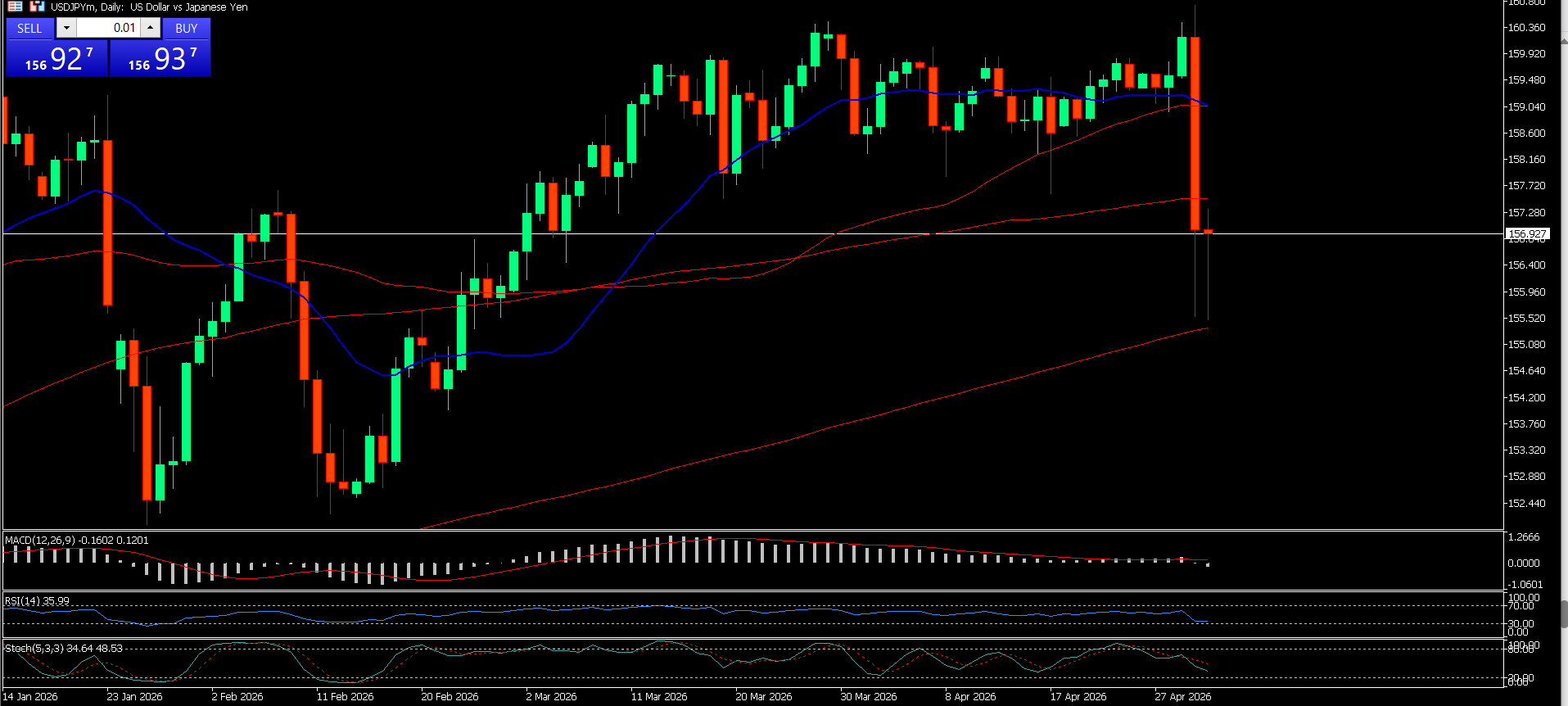
 USD/JPY has entered a more delicate phase after a sharp, policy-driven pullback disrupted what had been a steady bullish climb. The pair is now hovering near 156.70, struggling to regain direction after dropping to 155.48 in the wake of aggressive intervention from Japanese authorities. That move was not subtle. It sent a clear message to the market that officials are willing to act decisively when yen weakness accelerates beyond comfort levels, particularly above the 160.00 threshold. Since then, price action has flattened, reflecting hesitation rather than stability. The trend structure has shifted noticeably. Before the intervention, the pair was comfortably trending higher, supported by strong US yields and a persistent policy gap between the Federal Reserve and the Bank of Japan. That narrative is still partially intact, but the technical picture has changed. The recent drop broke short-term bullish momentum and pushed price below a key moving average cluster near 158.60. This zone had been acting as dynamic support. Now, it has flipped into resistance, and that transition often carries weight in defining the next phase. At the same time, the broader uptrend has not fully collapsed. Price is still holding above a longer-term ascending trendline, currently intersecting around the 155.20 region. This creates a layered structure. Short-term pressure is pointing lower, but the medium-term foundation is still intact. Markets tend to become more reactive in such conditions, as traders look for confirmation on whether the trend will resume or reverse more deeply. Momentum indicators add to this cautious tone. The Relative Strength Index is sitting near 37, drifting lower but not yet reaching oversold territory. That suggests sellers are gaining traction, though the move is not exhausted. There is still room for further downside if pressure builds again. The lack of a strong bounce after intervention also hints that buyers are not fully committed at current levels, at least not yet. On the fundamental side, the story is becoming more complex. Intervention risk is now a constant factor. Traders are no longer just trading interest rate differentials or economic data; they are also pricing in the possibility of sudden policy action. This tends to suppress volatility in one direction while increasing it in another. Upside moves, especially toward 160.00, may face resistance not only from technical sellers but also from fear of renewed intervention. Meanwhile, the US backdrop remains supportive for the dollar. Economic data continues to show resilience, with manufacturing activity holding steady. Federal Reserve commentary has also leaned cautious, with policymakers highlighting inflation risks linked to rising energy prices and geopolitical tensions. The idea that rates may stay elevated for longer, or even rise if inflation persists, is still very much alive. That underlying support for the dollar prevents a full bearish shift in USD/JPY, even as intervention caps gains. From a levels perspective, resistance is clearly defined. The first barrier sits at 158.60, where the moving average cluster is now capping recovery attempts. A break above that would ease immediate downside pressure, but it would not be enough on its own. The descending trendline near 159.20 adds another layer of resistance. Beyond that, the psychological 160.00 level stands as both a technical and political ceiling. Any approach toward that zone will likely be met with heightened scrutiny. On the downside, the 155.20 area is critical. It represents the longer-term rising trendline and has already shown its importance by attracting buying interest. If this level holds, the pair may stabilize and attempt another recovery phase. However, a decisive break below it would change the tone significantly. It would suggest that the broader uptrend is weakening and could open the path toward 153.40, where a deeper structural support level comes into view. The bullish case depends on a delicate balance. Continued strength in US data and yields could support the pair, especially if intervention becomes less frequent or less effective. A move back above 158.60 would be the first step in rebuilding bullish momentum. From there, a push toward 160.00 could follow, though likely with hesitation. The bearish scenario is gaining credibility. If intervention continues or if risk sentiment shifts in favor of the yen, the pair could break below 155.20 and extend lower. Momentum indicators suggest that this path is still open, particularly if upcoming US data fails to reinforce dollar strength. Risk factors remain elevated. Geopolitical developments, especially around energy markets, could influence both inflation expectations and safe-haven flows. Upcoming US data, including labor market figures, will also play a key role in shaping expectations around Federal Reserve policy. At the same time, any hint of further intervention from Japanese authorities could trigger sharp, unpredictable moves. In conclusion, USD/JPY is no longer in a clean trend. It is in a transitional phase, balancing between policy-driven pressure and underlying macro support. The near-term bias leans slightly bearish, but the broader structure has not fully broken down. The next decisive move will likely come from a break of either 158.60 on the upside or 155.20 on the downside. Until then, the pair remains sensitive, reactive, and highly dependent on both policy signals and incoming data.
*The market analysis posted here is meant to increase your awareness, but not to give instructions to make a trade
 Italiano
 Русский
 English
 Bahasa Indonesia
 Bahasa Malay
 ไทย
ไทย Español
 Deutsch
 Български
 Français
 Tiếng Việt
 中文
中文 বাংলা
বাংলা हिन्दी
 Čeština
 Українська
 Română
