 Gold (XAU/USD) Daily Outlook: Range Compression Near $4625 Signals Imminent Breakout Pressure Macro Forces Keep Gold Caught Between Support and Yield Pressure
 Gold is currently trading near $4625–$4640, stabilizing after a modest rebound from the $4560 region, but the broader tone still feels restrained. The recent bounce has been driven largely by US Dollar softness, triggered by Japan’s aggressive intervention in the FX market, which briefly knocked the Greenback lower across the board. That move provided breathing room for bullion, but the upside reaction has been measured rather than impulsive. Fundamentally, the environment remains complex. The cooling of oil prices following Iran’s proposal to the US helped reduce immediate inflation fears, which supported risk sentiment. However, the Federal Reserve continues to lean toward a restrictive stance. Policymakers remain concerned about inflation persistence, especially given the rise in input prices within the ISM Manufacturing PMI data. This creates a ceiling for gold, as higher yields continue to compete with non-yielding assets. Meanwhile, geopolitical tensions around the Strait of Hormuz still linger in the background, adding an underlying layer of uncertainty that prevents a full bearish breakdown.
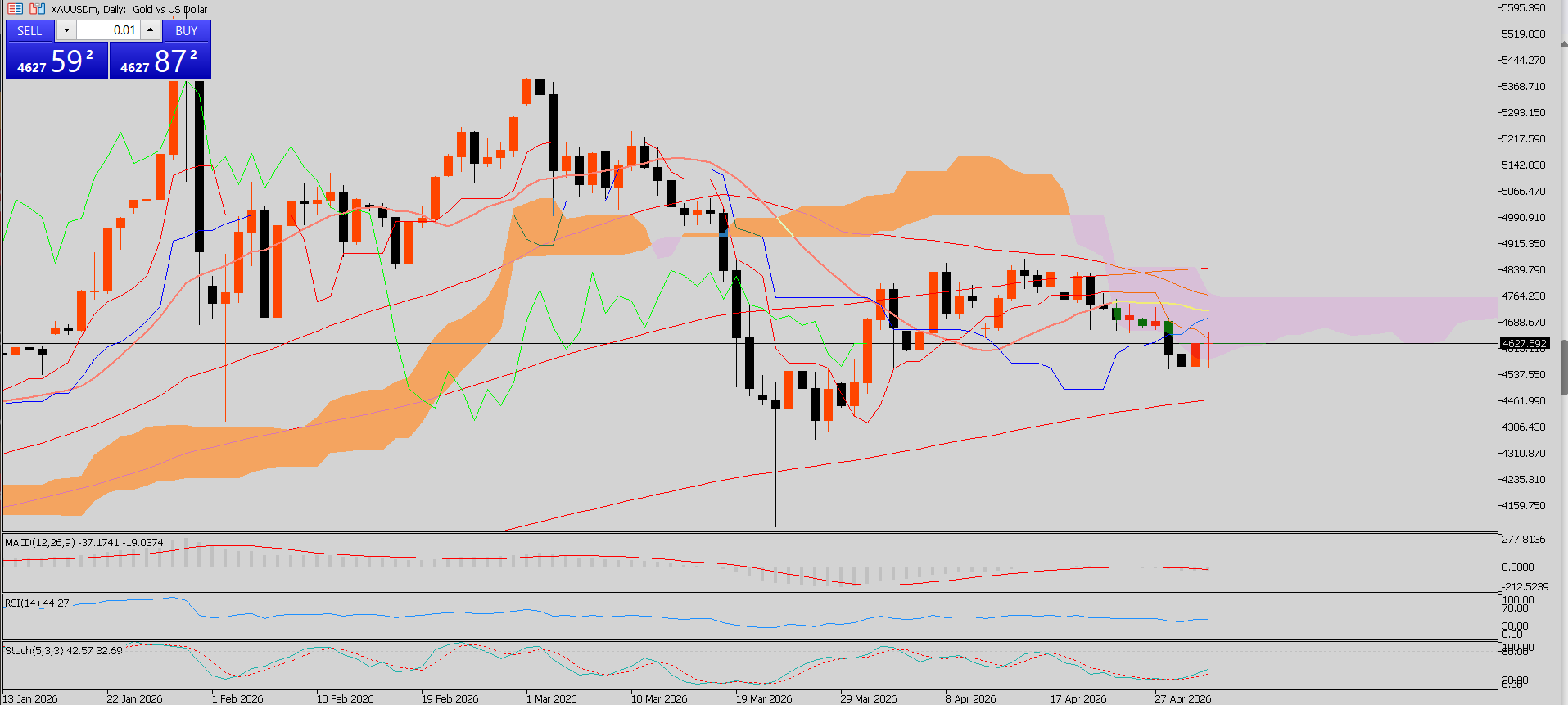
Trend Structure Reflects Consolidation Within a Broader Correction The daily chart reveals a market that is no longer trending cleanly but instead compressing within a defined range. After the sharp sell-off from the March highs, gold attempted a recovery, but that recovery has stalled below the $4700–$4750 resistance region. Price is now trading around the Ichimoku cloud boundary, which typically signals indecision. The cloud itself is relatively flat, suggesting the absence of strong directional conviction. The structure is not outright bearish, but it is also far from bullish. Instead, gold is forming a sideways base between $4550 and $4700. The recent candles show smaller bodies and mixed closes, which reflect a market waiting for a catalyst. Importantly, price is still below the key moving averages and struggling to gain traction above mid-range resistance. This suggests that buyers are present but not dominant.
Critical Support, Resistance, and Breakout Zones The immediate resistance sits at $4680–$4700, which has repeatedly capped upside attempts. A clear daily close above this zone would shift sentiment and open the path toward $4720–$4750, where the next major barrier lies. Beyond that, $4830–$4850 becomes the next upside target, aligning with higher timeframe moving averages. On the downside, first support is seen at $4600, followed by the stronger base at $4560–$4550. This zone has already acted as a floor recently and is crucial for maintaining the current range structure. A break below $4550 would expose $4510, and then potentially $4350, which marks a deeper structural low. These levels clearly define the battlefield. As long as gold remains between $4550 and $4700, the market is effectively range-bound. The breakout from this range will likely set the next directional move.
Indicators and Momentum Signal a Fragile Recovery Momentum indicators are not yet aligned for a strong bullish continuation. MACD remains below the zero line, although the histogram is improving slightly, indicating that bearish pressure is fading but not gone. RSI is hovering near 44–45, which reflects a weak-to-neutral momentum profile. It suggests that sellers still have a slight edge, even though the downside is not accelerating. Stochastic is turning upward from lower levels, showing short-term recovery momentum, but it is not yet in a strong bullish position. The Ichimoku Cloud again plays a central role here. Price is interacting with the cloud rather than trending above it, which reinforces the idea of consolidation. For a stronger bullish signal, gold needs to break above the cloud and hold that level. Otherwise, the current bounce may remain a temporary correction within a broader sideways structure.
Bullish and Bearish Scenarios with Final Outlook The bullish scenario requires gold to break above $4700 and sustain that move. If buyers achieve this, the next targets become $4720–$4750, followed by $4830. Continued USD weakness, easing inflation fears, or renewed geopolitical uncertainty could support such a move. However, the bearish scenario remains equally valid. If gold fails to break resistance and drops below $4600, pressure could build toward $4560–$4550. A decisive break below that zone would likely accelerate selling toward $4510 and possibly $4350. The key risk for bulls remains the Federal Reserve’s stance. As long as policymakers signal higher rates for longer, yields will stay elevated, limiting gold’s upside potential. At the same time, any sharp escalation in geopolitical tensions or further USD weakness could quickly shift sentiment. For now, gold is clearly in a holding phase. The range between $4550 and $4700 is tightening, and price action suggests that a breakout is approaching. The next decisive move will likely come from a catalyst rather than technical drift, making the current consolidation phase especially important for positioning.
*The market analysis posted here is meant to increase your awareness, but not to give instructions to make a trade
 Italiano
 Русский
 English
 Bahasa Indonesia
 Bahasa Malay
 ไทย
ไทย Español
 Deutsch
 Български
 Français
 Tiếng Việt
 中文
中文 বাংলা
বাংলা हिन्दी
 Čeština
 Українська
 Română
