 GBP/USD Holds Near 1.3580 as Dollar Demand Meets Sterling Resilience
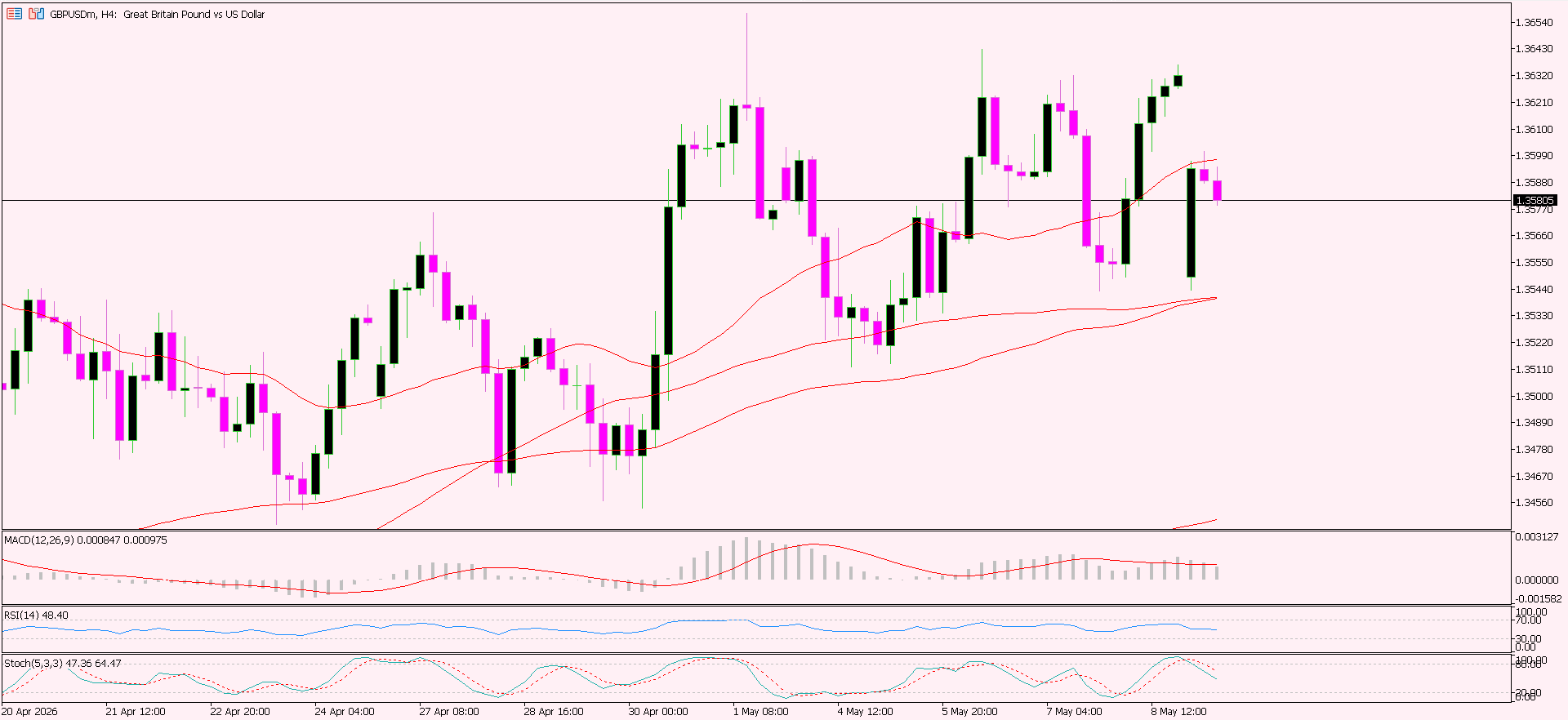
 GBP/USD begins the week with a slightly defensive tone, but the price action is more balanced than the headline weakness might suggest. The pair remains below the 1.3600 handle, where fresh US Dollar demand has capped upside attempts, yet the broader structure on the 4-hour chart does not point to a decisive bearish breakdown. Instead, what stands out is a market caught between two opposing forces: safe-haven support for the Dollar driven by renewed geopolitical tension around Iran and the Strait of Hormuz, and underlying support for Sterling from still-firm UK rate expectations. From the macro side, traders have become more cautious after optimism around a possible US-Iran diplomatic path faded. The return of geopolitical friction has lifted demand for defensive positioning, and that has naturally brought some buyers back into the US Dollar. Oil has also turned firmer, which matters because higher energy prices keep inflation concerns alive. At the same time, the latest US Nonfarm Payrolls report came in stronger than feared, reinforcing the idea that the US labor market remains resilient. That combination has pushed Treasury yields higher and reduced immediate pressure on the Federal Reserve to move toward aggressive easing. In practical terms, it means the Dollar has regained enough short-term support to prevent cable from extending higher without fresh catalysts. That said, Sterling has not exactly rolled over. The Bank of England remains an important counterweight here. Recent comments suggesting policymakers could still act firmly if inflation remains sticky have helped stabilize sentiment around the Pound. Political noise in the UK has also eased slightly after concerns around Prime Minister Keir Starmer failed to evolve into a larger market issue. So while external headlines have given the Dollar a defensive bid, domestic UK fundamentals are preventing the kind of broad-based Sterling liquidation that would normally accompany this sort of geopolitical backdrop. The chart reflects that tension quite well. Looking closely at the 4-hour structure, GBP/USD is trading around 1.3580 after recovering from the 1.3545–1.3550 zone. That rebound matters. Price dipped into that area, found buyers, and then pushed sharply higher before meeting supply again near 1.3620–1.3630. In other words, the market is not trending cleanly lower — it is rotating inside a relatively tight tactical range. The 100-period moving average remains underneath current price action, while the broader moving average cluster around 1.3530–1.3540 continues to provide structural support. That tells me the near-term tone remains mildly constructive even though upside momentum has clearly cooled. Momentum indicators also support a more nuanced read rather than a simple bearish one. The RSI is sitting near 48–49, almost exactly around neutral territory. That usually reflects consolidation rather than trend acceleration. Meanwhile, MACD remains positive but the histogram has been fading. The message here is subtle but important: bullish momentum has weakened, yet it has not fully reversed. Stochastic has also rolled lower from higher levels, which often happens when a market pauses after a short recovery rather than when it enters outright directional liquidation. Put simply, momentum has softened, but price has not yet confirmed a deeper bearish shift. The levels are fairly clean. Immediate resistance sits around 1.3600, followed by 1.3625 and then 1.3640. That upper zone has repeatedly attracted sellers on the chart, so a clean break there would matter. If buyers manage to reclaim that area with conviction, the next leg could reopen toward 1.3660 and possibly higher as short-term shorts get squeezed. On the downside, first support comes in around 1.3550. Beneath that, 1.3530–1.3540 is the more important technical floor because it aligns with moving-average support and recent reaction lows. A sustained break below that region would shift the short-term structure and expose 1.3500, with 1.3475 becoming the next meaningful downside reference. The bullish case remains straightforward. If geopolitical headlines stabilize and the Dollar loses some of its safe-haven premium, Sterling still has room to outperform. The chart has already shown repeated dip-buying behavior, and that is not something to ignore. Buyers are not chasing price aggressively, but they are clearly defending weakness. That often creates the kind of base that can later turn into a breakout if macro pressure eases. The bearish case is equally clear. If Middle East tensions intensify further, oil extends higher, and US yields remain elevated after strong economic data, the Dollar could build a firmer bid. In that environment, the current inability to reclaim 1.3600 could gradually turn into exhaustion. That would put 1.3550 back under pressure and make the 1.3530 region increasingly vulnerable. GBP/USD is not in a clean bearish trend despite the cautious headlines. The chart is actually telling a more balanced story. The pair is holding above its short-term support structure, but it also lacks enough momentum to force a clean upside continuation. That leaves cable in a tactical holding pattern. As long as price remains above 1.3540, pullbacks still look more corrective than structural. But unless buyers reclaim 1.3620–1.3640 with conviction, the market may continue to trade with hesitation rather than direction. Right now, this feels less like a breakdown and more like a market waiting for the next real macro trigger.
*The market analysis posted here is meant to increase your awareness, but not to give instructions to make a trade
 Italiano
 Русский
 English
 Bahasa Indonesia
 Bahasa Malay
 ไทย
ไทย Español
 Deutsch
 Български
 Français
 Tiếng Việt
 中文
中文 বাংলা
বাংলা हिन्दी
 Čeština
 Українська
 Română
