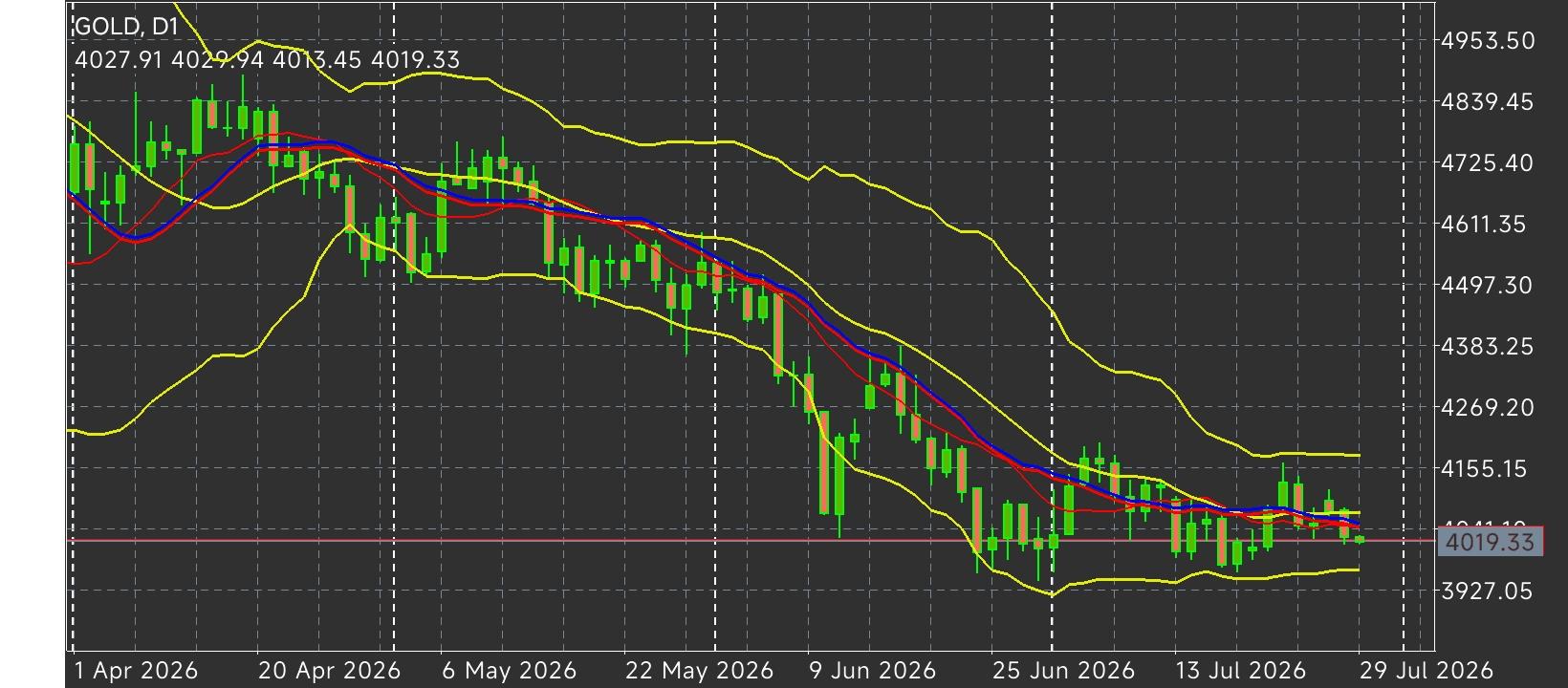
 The Bullion Breakdown: Gold Hits $4,020 as Global "Fear Trade" Migrates to the Greenback Gold (XAU/USD)
 is suffering a decisive breakdown this Tuesday, tumbling
1.4% to trade near the
$4,020 level as the market’s traditional "safe-haven" playbook undergoes a structural revision. Despite a violent overnight equity shock—where the Korean KOSPI plunged nearly 11% and the Nikkei 225 shed 4% on AI-sector skepticism—investors bypassed non-yielding bullion in favor of US Dollar liquidity and duration-heavy government bonds. The failure of Gold to rally amid a global "risk-off" event is a ominous technical signal, confirming that current market psychology prioritizes high-real-yield assets over traditional wealth preservation. With the US Dollar Index (DXY) scaling one-month highs near
101.50 and the USD/JPY approaching the
164.00 threshold, Gold finds itself isolated, discarded by Western institutional allocators even as geopolitical tensions in the Strait of Hormuz persist in a state of suspended animation.
The Real-Rate Reality: Why the Fed is "Killing" the Gold Bid The fundamental narrative driving Gold has narrowed to a singular, binary input: the Federal Reserve’s monetary policy trajectory.
The Policy Trap: Following June’s inflation print—where headline CPI hit 3.5% against a policy upper bound of 3.75%—the real policy rate has flipped firmly into positive territory. For Gold, which yields zero, this is catastrophic; when the "cost of carry" for the Dollar rises, the opportunity cost of holding metal becomes prohibitive.
Hike Tail vs. Cut Fantasy: Markets have aggressively priced out 2026 rate cut expectations. The "hike tail" for September remains near 80%, and even a streak of softer US data—slowing private hiring and cooling consumer confidence—has failed to resuscitate the "pivot" narrative. Soft economic data now functions as a headwind for Gold because it no longer triggers rate-cut speculation; instead, it fuels stagflationary fears that keep the Fed hawkish.
Structural Divergence: The East-West Liquidity War The internal mechanics of the Gold market reveal a profound geographic split that explains the current "range-bound" malaise.
Western Capitulation: World Gold Council data shows that Western-based, physically-backed ETFs shed
$8.9 billion in June, as North American allocators rotated into yield-generating assets.
Asian Accumulation: Conversely, Asian funds absorbed a record
$12 billion in the first half of 2026. This massive bid from the East acts as a "floor-builder" near
$3,950, preventing a total collapse, while Western selling ensures that every rally into the moving averages is met with immediate liquidation.
Technical Trend Architecture: The "Death Cross" Constraint Technically, Gold is trapped in a dominant bearish structure, defined by declining moving averages that consistently cap upside momentum.
The Moving Average Ceiling: The
50-day EMA at $4,200 recently crossed below the
200-day EMA at $4,300, forming a "Death Cross" on the daily chart. This structural setup dictates that rallies into resistance are high-probability selling opportunities.
The $4,000 Support Inflection: Price action is currently testing the psychological
$4,000 handle. A decisive break below this level would strip the market of its last major sentiment buffer, clearing the path toward the multi-month support floor at
$3,950.
Strategic Roadmap: Pre-FOMC Volatility As the market converges on Wednesday's FOMC decision, the technical roadmap is binary:
Immediate Resistance ($4,075 – $4,200): Sellers are congregating at the
$4,075 session high. Any recovery attempt toward the
$4,150 structural barrier—which has capped all July advances—remains a primary target for shorts. A daily close above
$4,150 is required to invalidate the bearish bias.
Bearish Objectives ($4,000 – $3,950): The immediate focus is the
$4,000 support. A breach here targets the late-June low of
$3,950. With the
Stochastic RSI at 63 trending downward, there is significant "downside room" before the market hits oversold conditions. Ultimately, Gold remains a "macro hostage" to the Wednesday FOMC statement. Until the Fed signals a pause in tightening, bullion’s upside will remain anemic, as the market currently trusts the Greenback's yield over the metal's intrinsic store-of-value.
*The market analysis posted here is meant to increase your awareness, but not to give instructions to make a trade
 Italiano
 Русский
 English
 Bahasa Indonesia
 Bahasa Malay
 ไทย
ไทย Español
 Deutsch
 Български
 Français
 Tiếng Việt
 中文
中文 বাংলা
বাংলা हिन्दी
 Čeština
 Українська
 Română
