 USD/CAD Price Forecast: Canadian Dollar Weakens as Geopolitical Tensions Lift Safe-Haven Demand
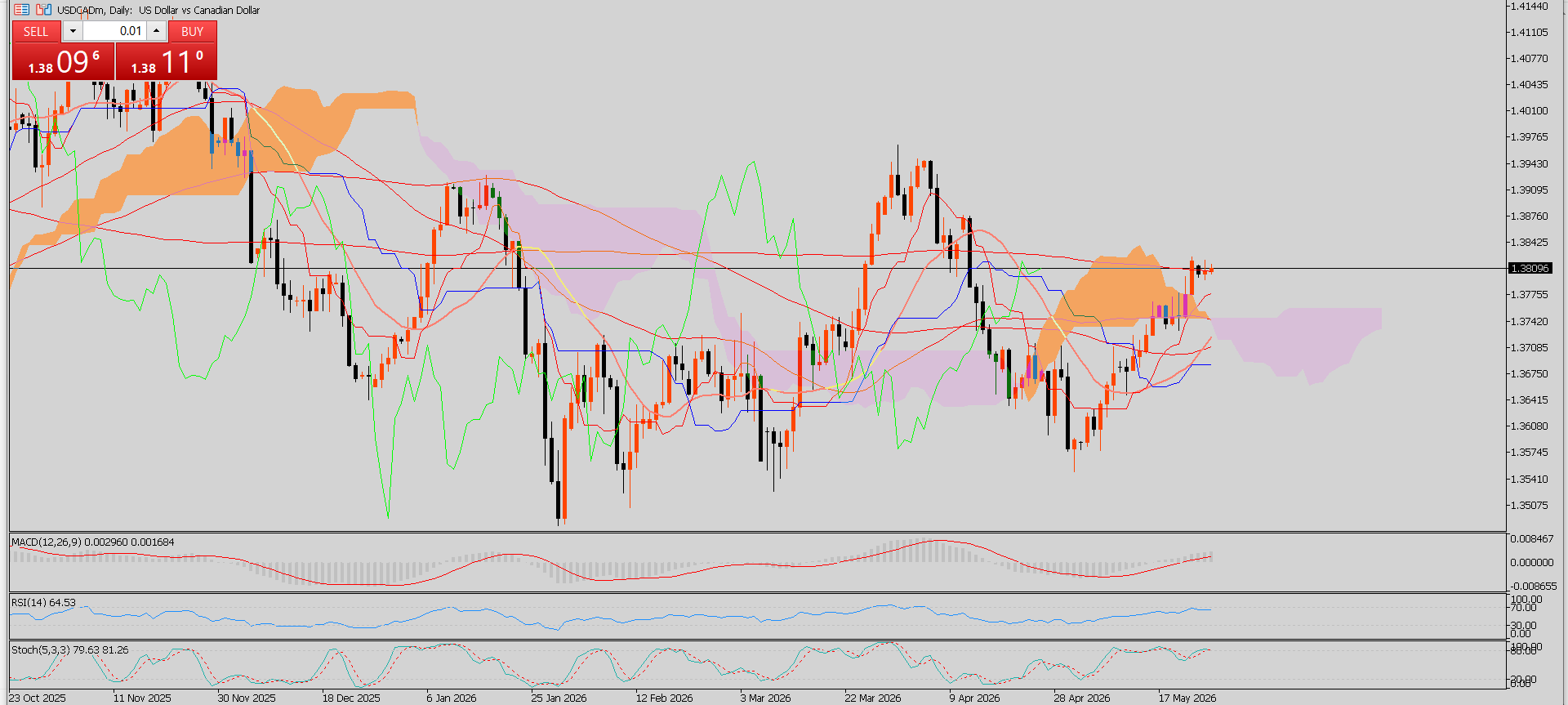
 USD/CAD is trading with a firmer tone near the 1.3810 region during Tuesday’s Asian session after recovering from minor losses recorded in the previous trading day. The pair continues attracting support as geopolitical tensions in the Middle East strengthen safe-haven demand for the US Dollar, while uncertainty surrounding global risk sentiment limits the Canadian Dollar’s ability to fully benefit from rising crude oil prices. Normally, stronger Oil prices provide support to the Canadian Dollar because Canada remains one of the world’s largest crude exporters, but the current market environment is behaving differently. Traders are prioritizing safety and monetary policy expectations over traditional commodity-linked currency flows, which is allowing USD/CAD to remain resilient despite WTI crude rebounding toward the $91.50 region. The daily chart also reflects improving bullish momentum as buyers gradually regain control following the recent recovery from April lows.
Technical Structure Turns Constructive Above Key Support From a broader technical perspective, USD/CAD is showing signs of rebuilding bullish momentum after successfully defending the 1.3570–1.3600 support zone earlier this month. The pair has now recovered steadily toward the 1.3810 area and continues trading above several medium-term moving averages, indicating that the broader recovery structure remains intact. Price action is currently approaching an important resistance zone near 1.3820–1.3840, where previous rejection candles and historical congestion continue creating technical pressure. A successful breakout above this region would likely strengthen bullish sentiment further and expose the next upside target near 1.3900, followed by the March highs around 1.3940. On the downside, initial support remains near 1.3775 followed by stronger protection around the Ichimoku cloud base between 1.3740 and 1.3700. If sellers force a breakdown below these levels, bullish momentum would weaken significantly and could expose the pair toward 1.3675 and eventually 1.3600 again. For now, however, buyers continue holding the technical advantage while USD/CAD remains above key support regions and maintains higher lows on the daily timeframe.
Momentum Indicators Continue Supporting Buyers Momentum indicators are gradually shifting in favor of the bulls as upside pressure strengthens across the daily chart. The Relative Strength Index (RSI) is hovering near the 64 level, reflecting improving bullish momentum without yet entering extreme overbought territory. This suggests that buyers still have room to extend the recovery if resistance levels break convincingly. MACD also supports the constructive outlook as the signal lines continue rising above the neutral area while the histogram prints expanding positive bars. This behavior confirms strengthening upside momentum and reflects growing bullish participation following the recent rebound from lower levels. Meanwhile, the stochastic oscillator remains elevated near overbought conditions, indicating that short-term pullbacks or temporary consolidation phases may still occur before another strong bullish extension develops. The Ichimoku setup also favors buyers overall as price trades above the cloud while future cloud projections continue tilting higher. In addition, the Tenkan-sen and Kijun-sen lines are maintaining a supportive bullish crossover structure, reinforcing the idea that underlying momentum still favors additional upside attempts unless a sharp reversal occurs beneath key support zones.
Oil Prices and Fed Expectations Continue Driving USD/CAD Fundamentally, USD/CAD remains highly sensitive to geopolitical developments, Oil market volatility, and expectations surrounding Federal Reserve policy. Crude oil prices managed to rebound after four consecutive sessions of losses as renewed tensions emerged following US military strikes in southern Iran targeting missile launch sites and vessels allegedly attempting to deploy naval mines. These developments revived supply concerns across energy markets and pushed WTI crude back toward the $91.50 region. Under normal conditions, stronger Oil prices would provide stronger support for the Canadian Dollar, but current geopolitical uncertainty is simultaneously boosting safe-haven demand for the US Dollar, offsetting part of the CAD’s commodity-linked advantage. At the same time, expectations regarding Federal Reserve policy continue supporting the Greenback. According to CME FedWatch data, markets are now pricing in a meaningful probability that the Fed could still deliver another 25-basis-point rate increase before year-end if inflation pressures remain persistent. Traders are therefore closely monitoring upcoming US PCE inflation data for clearer guidance regarding the future policy path. Stronger inflation readings would likely reinforce higher-for-longer rate expectations and strengthen the US Dollar further, while softer inflation numbers could reduce bullish momentum in USD/CAD and allow the Canadian Dollar to stabilize.
Bullish and Bearish Outlook for USD/CAD The bullish scenario remains favored as long as USD/CAD continues trading above the 1.3740–1.3775 support region. A confirmed breakout above the 1.3820–1.3840 resistance zone would likely trigger stronger upside momentum toward 1.3900 and potentially the March highs near 1.3940. Continued geopolitical uncertainty, stronger safe-haven demand, and hawkish Federal Reserve expectations all continue supporting this bullish structure. On the bearish side, failure to break above current resistance combined with softer US inflation data could encourage profit-taking and trigger a corrective pullback toward 1.3740 and 1.3700. A deeper breakdown below the Ichimoku cloud would weaken the broader bullish structure significantly and expose lower support zones near 1.3675 and 1.3600. Overall, USD/CAD continues trading inside a constructive recovery structure where bullish momentum remains supported by both technical indicators and safe-haven Dollar demand. However, with Oil prices recovering and inflation data approaching, volatility may increase significantly during upcoming sessions as traders reassess the balance between geopolitical risk and monetary policy expectations.
 中文
中文 
 Русский
 English
 Bahasa Indonesia
 Bahasa Malay
 ไทย
ไทย Español
 Deutsch
 Български
 Français
 Tiếng Việt
 বাংলা
বাংলা हिन्दी
 Čeština
 Українська
 Română
