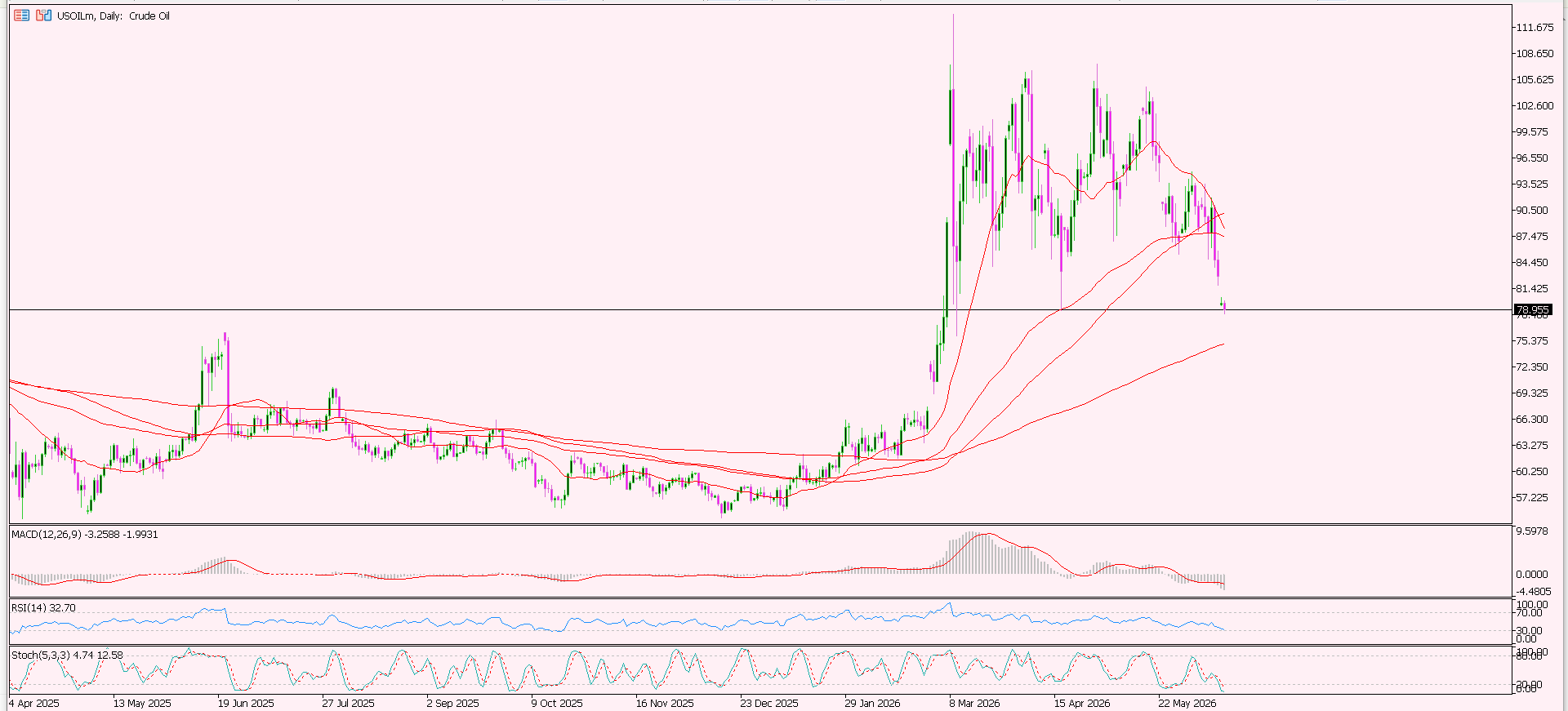
 WTI Crude Oil Crashes Toward Key Support as US-Iran Peace Deal Triggers Heavy Selling Pressure
 West Texas Intermediate (WTI) crude oil remains under intense selling pressure after reports confirmed a breakthrough peace agreement between the United States and Iran, a development that has significantly eased concerns over global energy supply disruptions. The sharp decline has pushed prices toward the $79.00 region, marking the lowest level seen in nearly three months and signaling a dramatic shift in market sentiment. What was previously a market driven by geopolitical risk premiums has quickly transformed into one focused on the prospect of increasing supply and improving trade flows through one of the world's most important energy corridors. Looking at the daily chart, the technical picture has deteriorated noticeably over the past several sessions. Price action has broken below several important moving averages that previously acted as dynamic support throughout the broader uptrend. The failure to hold above the 50-day and 100-day moving averages encouraged fresh selling, while the latest decline has now brought the market directly into a major horizontal support zone near $79.00. This area previously acted as a launching point for the explosive rally that followed the escalation of Middle East tensions, making it a level traders are watching very closely. The fundamental catalyst behind the move is difficult to ignore. News that Washington and Tehran have reached a framework agreement capable of reopening the Strait of Hormuz has dramatically reduced fears of supply shortages. Since roughly one-fifth of global oil shipments move through this critical route, any reduction in disruption risk naturally removes a significant bullish factor from the market. Investors are now beginning to price in a more balanced supply outlook, particularly if sanctions are gradually eased and Iranian exports begin returning to international markets over the coming months. From a momentum perspective, indicators continue to favor sellers despite the market approaching oversold territory. The MACD remains deeply negative and continues to expand below its signal line, confirming that bearish momentum is still dominant. Meanwhile, the RSI has fallen toward the low-30 region, reflecting strong downside pressure but also suggesting that the market is becoming increasingly stretched. This does not guarantee an immediate rebound, though it does raise the possibility of short-covering activity or a temporary stabilization phase near current levels. For bulls, the key objective is defending support around $79.00. A successful hold above this zone could trigger a corrective recovery toward the $82.50 and $85.00 areas, where previous support levels may now act as resistance. Any rebound, however, would likely require confirmation that the market has fully absorbed the implications of the peace agreement and that demand conditions remain resilient. Without those factors, upside attempts could struggle to gain meaningful traction. The bearish scenario remains relatively straightforward. A decisive break below $79.00 would expose the next support region near $75.00, followed by the longer-term moving average zone around $72.00. Given the speed of the recent decline, traders should also remain alert to volatility as markets digest further details surrounding the agreement and the timeline for restoring full shipping capacity through the Strait of Hormuz. For now, the combination of weakening technical structure, falling geopolitical risk premiums, and persistent bearish momentum leaves crude oil vulnerable to additional downside pressure, even if short-term oversold conditions occasionally generate brief recovery attempts.
*Die zur Verfügung gestellte Marktanalyse dient zu den Informationszwecken und sollte als Anforderung zur Eröffnung einer Transaktion nicht ausgelegt werden
 Deutsch
 Русский
 English
 Bahasa Indonesia
 Bahasa Malay
 ไทย
ไทย Español
 Български
 Français
 Tiếng Việt
 中文
中文 বাংলা
বাংলা हिन्दी
 Čeština
 Українська
 Română
