 The Liquidity Takeover Cascade: ETH/USDT Smashes Key Horizontal Fences as Hawkish Fed Tightening Fuels an Institutional capitulation
 The Ethereum (
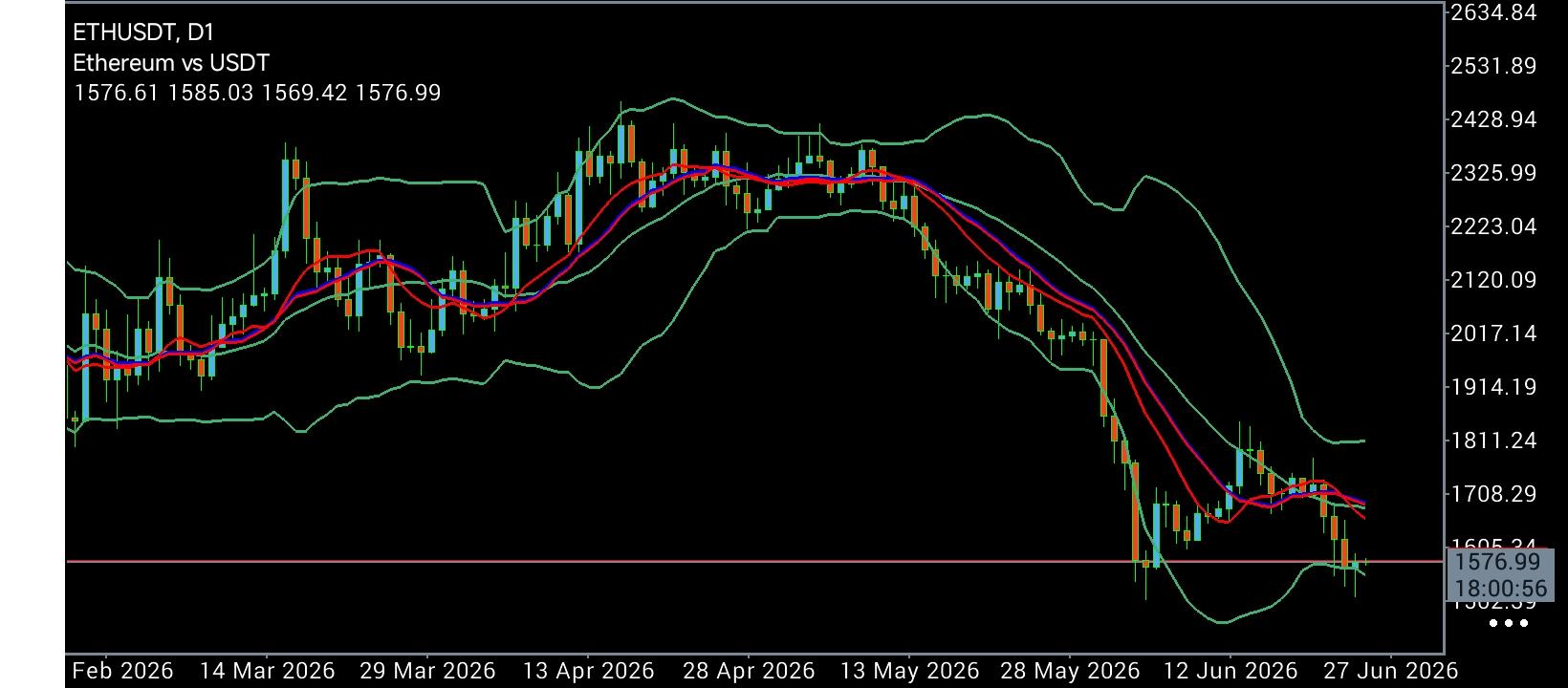
ETH/USDT) daily chart through June 27, 2026, presents a masterclass in macroeconomic regime transitions. The pair completed a full structural rotation—progressing from a highly aggressive five-wave bullish expansion into a distribution top, followed by a severe, cascading markdown phase that has driven prices down to test a critical pivot at
1576.99. The fundamental framework behind this deep value destruction centers around a persistent hawkish transition by the Federal Reserve and an overarching flight to liquid USD collateral. Throughout May and June, global digital asset desks encountered severe headwinds as a stronger greenback, rising treasury yields, and restrictive central bank policy pushed institutional capital out of non-yielding speculative assets. This macro-driven liquidity drainage was accelerated by a sharp slowdown in spot Ethereum ETF inflows, exposing a lack of buy-side conviction on higher timeframes and forcing programmatic trend-following models to step up defensive hedging. As risk-averse sentiment swept across the broader crypto landscape, localized support zones buckled under systemic institutional distribution, transforming previous demand areas into rigid overhead supply walls.
Technical Trend Structure: Descending Distribution Channel Validates Sell-The-Rip Dominance The daily (D1) technical geometry illustrates an organized markdown regime, with price action tightly locked inside a descending structural channel beneath a synchronized cluster of moving averages.
The Bullish Expansion & Distribution (Feb–April): From an objective structural perspective, the initial phase of the cycle was defined by a clean, five-wave impulse tracking above rising moving averages, expanding the upper Bollinger Band toward
2325.99. This momentum culminated in a mid-April peak at
2428.94, where prominent upper wicks signaled exhaustion. The subsequent consolidation from April 28 to May 28 printed equal highs near
2325.99 and higher lows near
2120.09, forming a descending triangle that ultimately resolved via a high-volume breakdown beneath the
2120.09 pivot.
The Accelerated Markdown Phase: The structural break of
2017.14 in late May handed full control to sell-side algorithms. Ethereum collapsed through consecutive support zones at
1914.19,
1811.24, and
1708.29 with large bearish bodies closing near their lows. This sharp decline finally bottomed out near
1605.34, creating a temporary capitulation wick that targeted the lower Bollinger Band. A subsequent mid-June corrective three-wave bounce to
1708.29 was fiercely rejected by the descending moving averages, executing a textbook support-to-resistance flip.
The Immediate Inflection Matrix: Price is currently hovering at
1577.67, compressing right on top of the
1576.99 intraday pivot. Immediate, crucial overhead resistance is locked at
1605.34, where the blue and red moving averages converge. This level represents the ultimate dynamic boundary line: a daily close above
1605.34 is required to shift the short-term market structure to neutral. Conversely, if the immediate floor at
1576.99 snaps, it will expose the main June impulse low at
1502.89. A high-volume daily print below
1502.89 will validate a continuation vector toward the historical macro base at
1400.00.
Strategic Trading Execution Grid: Position Orientation Actionable Entry Trigger Primary Target (TP) Protective Stop (SL) Technical Architecture & Rationale Trend-Continuation Short Daily Close <
1495.00 1405.00 / 1380.00 1560.00 Short entry triggered on a confirmed structural breakdown of the June demand base, riding an unhedged liquidative wave into the lower macro chasm.
Tactical Reversal Long H4 Breakout Close >
1615.00 1705.00 / 1790.00 1565.00 Mean-reversion long executed on a high-volume breakout past the converged EMA ceiling, targeting a short-covering squeeze to the middle Bollinger Band.
*Die zur Verfügung gestellte Marktanalyse dient zu den Informationszwecken und sollte als Anforderung zur Eröffnung einer Transaktion nicht ausgelegt werden
 Deutsch
 Русский
 English
 Bahasa Indonesia
 Bahasa Malay
 ไทย
ไทย Español
 Български
 Français
 Tiếng Việt
 中文
中文 বাংলা
বাংলা हिन्दी
 Čeština
 Українська
 Română