 English
 Русский
 Bahasa Indonesia
 Bahasa Malay
 ไทย
ไทย Español
 Deutsch
 Български
 Français
 Tiếng Việt
 中文
中文 বাংলা
বাংলা हिन्दी
 Čeština
 Українська
 Română


The European currency continued its strengthening against the US dollar on Tuesday, August 29. Good support for the euro in the first half of the day was provided by data on sentiment in Germany, as well as on the growth of consumer spending in France.
According to the report of the German research institute GfK, the consumer confidence index rose in September this year. So, the leading index of consumer confidence rose to 10.9 points in September against 10.8 points in August this year. Economists predicted that the consumer confidence index will be at the level of 10.8 points.
In France, the growth in consumer spending in July this year will have a positive impact on economic performance in the third quarter. Consumer spending rose in July after a major drop in June this year, when the decline was 0.7% (revised estimate from 0.8%).
According to the statistics agency, consumer spending in France in July 2017 increased by 0.7%, while compared to the same period in 2016, growth was 2.1%.
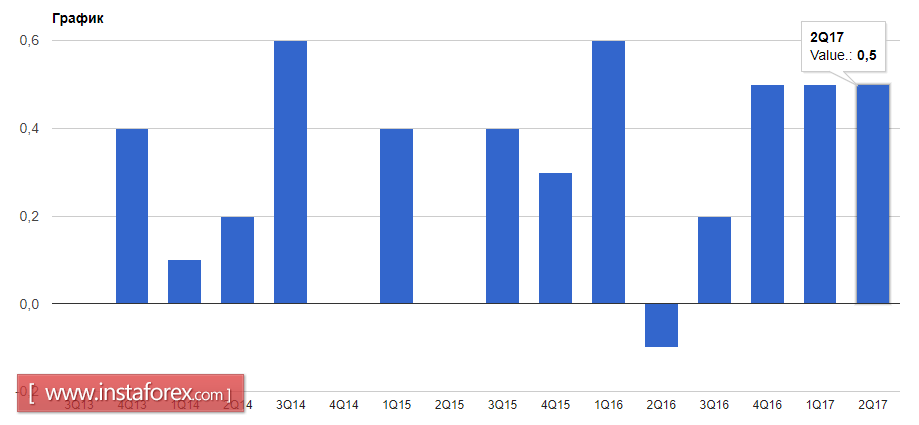
The economy of France maintains a steady growth rate for the third consecutive quarter.
According to the report, France's GDP grew by 0.5% in the second quarter of this year compared with the first quarter, when growth was also 0.5%.
Compared to the same period in 2016, GDP grew by 1.7%. Quarterly indicators were fully in line with the forecasts of economists, whereas in comparison with the previous year the GDP was expected to increase by 1.8%.
The pre-election promises of the new French President Emmanuel Macron and the specifics of their implementation can seriously affect the economic growth indicators in the 3rd quarter already, while in the second quarter Macron's election victory was one of the key drivers of growth.
The US dollar rebounded slightly against the euro and the pound in the afternoon.
Data on housing prices did not significantly affect the quotations. According to the report, the national housing price index rose in June of this year by 5.8% compared to the same period of the previous year. Economists had expected that in June the index will increase by 5.7% compared to the same period of the previous year.
The Canadian dollar fell significantly against the US dollar amid falling commodity prices, as well as after data on producer prices, which in July showed a significant drop.
According to the report of the National Bureau of Statistics of Canada, the producer price index fell by 1.5% in July this year, while economists expected the index to decline by 0.7%. In comparison with the same period of the previous year, prices increased by 1.3%.