 English
 Русский
 Bahasa Indonesia
 Bahasa Malay
 ไทย
ไทย Español
 Deutsch
 Български
 Français
 Tiếng Việt
 中文
中文 বাংলা
বাংলা हिन्दी
 Čeština
 Українська
 Română


The European currency and the British pound, apparently, took some breathing space, which led to a corrective growth of the US dollar. The support yesterday provided good data on the US consumer confidence indicator, which in August this year increased significantly, being much better than the forecasts of economists.
According to the Conference Board report, the consumer confidence index in the USA in August 2017 increased to 122.9 points from 120 points in July. Economists had expected that in August, the figure would be 120.7 points.
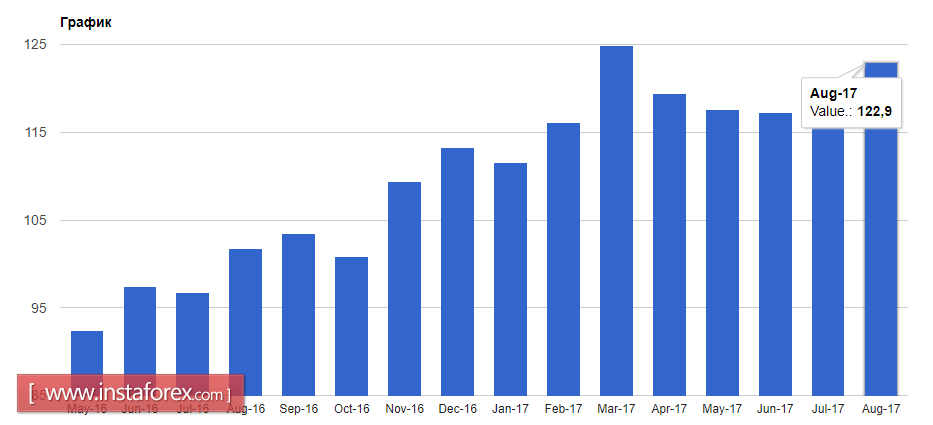
A good assessment of current conditions by American consumers continues to have a positive impact on consumer confidence, which in the future will lead to a rise in a number of other economic indicators.
Despite a small strengthening of the US dollar, most likely, the pressure on it will continue. Many investors fear that the Fed can raise rates at a slower pace than expected. Also, the problem remains the ceiling of the national debt in the US, which is putting pressure on the US dollar recently.
The support for risky assets, on the contrary, is predicted by economists, according to which the European Central Bank will soon begin to wind down the quantitative easing program.
Important data by the end of this week will be on the US labor market, but we will talk about them later.
As for the technical picture of the EUR/USD pair, it is likely that the breakdown of the interim support of 1.1950 could lead to an increase in short positions, as well as fixation of profit in the European currency, which will collapse the trading instrument to the area of the larger levels of 1.1910 and 1.1880. Judging by the monthly schedule, August should close in the vicinity of the level of 1.1880-1.1900, as the large psychological level of 1.2000 is unlikely to be passed from the first time. Such a closure will indicate the equality of forces between buyers and sellers, and the further direction of the market will directly depend on the actions of the European Central Bank.
If the regulator does not go to the measures to wind down the bond repurchase program, one can expect an increase in the pressure on the European currency and a larger downward correction for the euro already in the 3rd and 4th quarters of this year.
If, however, the buyers of the euro manage to close the month in the region of highs and above the level of 1.2000, this will serve as a strong impetus for the further build-up of long positions by large investors, which will lead the euro to the levels around 1.2170 and 1.2260. This situation is unlikely to be satisfied with the European Central Bank, which has repeatedly expressed concern about the rapid strengthening of the European currency, which could negatively affect the growth rates of inflation and euro zone GDP.