 English
 Русский
 Bahasa Indonesia
 Bahasa Malay
 ไทย
ไทย Español
 Deutsch
 Български
 Français
 Tiếng Việt
 中文
中文 বাংলা
বাংলা हिन्दी
 Čeština
 Українська
 Română


Today, the United States celebrated a national holiday (Columbus Day), so the American trading floors are closed, and almost all dollar pairs are in a state of suspended animation. The exception is the pound, which paired with the dollar is trying to return at least part of the lost positions. However, in this case, the activity of traders is connected only with the British events, or rather with the beginning of the fifth round of negotiations on Brexit. Despite the volatility ,today it is not recommended to trade the pound/dollar pair, as well as other dollar pairs. A "thin" market can provoke unexpected (and most importantly unpredictable) price surges.
But some cross-pairs can be considered. For example, a very interesting situation has developed in the AUDCAD pair. The Australian dollar has recently experienced problems, in fact, like the Canadian currency. However, combined, the Australian dollar loses noticeably, especially against the backdrop of mixed statistics from China. Particularly, the growth rate of business activity in the Chinese service sector (according to the research version of the business publication Caixin) in September was the weakest in the last 20 months. The indicator fell to 50.6, dangerously approaching the key line signaling a slowdown in the economy in this area. Such figures contrast with the fairly confident data on the growth of China's GDP in the second quarter of this year, so the reaction was quite chaotic.
However, the role of first instigator in the decline of the Australian currency was not played by China. Unpleasant surprise was presented to traders by the officials of the Reserve Bank of Australia, Jan Harper, who did not exclude the possibility of interest rates being adjusted downward. A member of the Australian regulator expressed extreme concern that the incomes of the population do not show growth, which affects the consumer activity and as a result - the rate of inflation. Indeed, the level of real wages in Australia (Wage Price Index), after a period of decline, is already the third consecutive quarter at the same level of 1.9.
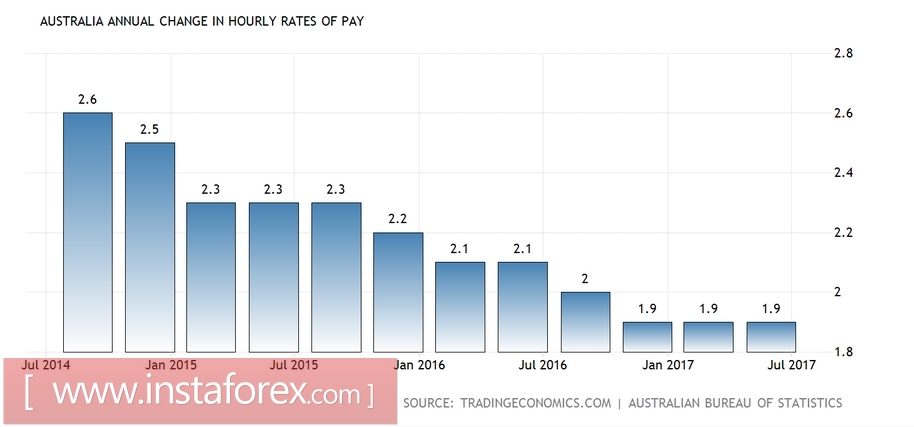
This nuance triggered a "domino effect": first, retail sales fell, and the consumer price index also weakened, both in quarterly and in annual terms. Inflation in Australia slowed to 0.2% (q/q) and 1.9% (y/y), respectively.
Naturally, this state of affairs did not please traders, but almost no one expected that the RBA could resort to mitigating monetary policy. Indeed, most recently, on October 3, the Australian regulator held its meeting, where it took a fairly neutral position, noting that the growth of the national currency rate. Moreover, in the accompanying statement of the RBA there is a phrase that the regulator is in favor of maintaining the current policy of monetary policy, since it "corresponds to achieving sustainable economic growth and a target inflation rate."
And now, a week after this meeting, a member of the Board of Governors of the RBA Harper said about the existing probability of a rate cut. In particular, he said that if the consumer impulse completely loses its validity, then "the response through interest rates can be fully justified." Such a definitive statement indicates that further slowing of inflation will be very painfully perceived by the Australian dollar.
The Canadian currency is also going through hard times: the oil market has stalled its growth, and the head of the Bank of Canada disappointed the bulls with his wait-and-see attitude. After the impetuous growth of the economy at the beginning of this year, in the second half of the year, Canada's GDP growth slowed. After that, the members of the Canadian central bank softened the tone of their comments, reducing the likelihood of a rate hike in the coming months. Nevertheless, unlike the their Australian counterparts, officials of Bank of Canada did not exclude the possibility of further rate hikes. Canadians are now studying the consumer reaction to a double rate hike to make sure of the safety and effectiveness of their actions. This process may take some time, but, according to analysts surveyed by Reuters, the central bank of Canada will return to tightening monetary policy in the first quarter of next year.
In other words, the dissolution of the monetary policies of the Reserve Bank of Australia and Bank of Canada will put pressure on the cross-currency AUDCAD pair, leaving the Canadian dollar in a more advantageous position. This pressure will be strengthened if Australian inflation data continues to show a decline or stagnation. Thus, for any more or less large-scale price spikes, a cross-pair should be sold - as a medium-term and long-term trading strategy.
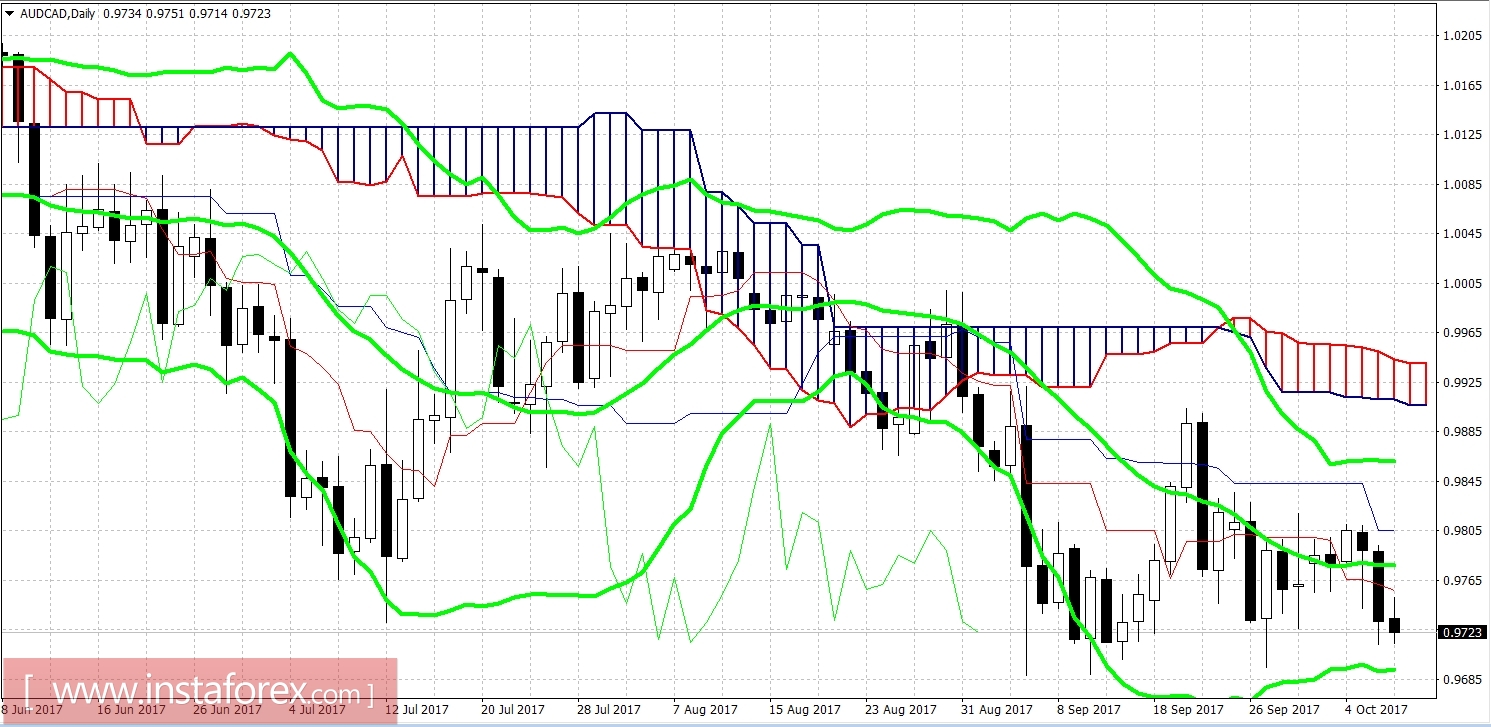
If we talk in more detail about price levels, then the focus should be directed towards to technical picture. On the technical side, the pair on the daily chart is between the middle and bottom lines of the Bollinger Bands indicator and under all lines of the indicator Ichimoku Kinko Hyo, which formed a strong trend signal (in our case - bearish) " Parade Line". Thus, the pair is aimed at testing the bottom line of the Bollinger Bands indicator, which corresponds to the price of 0.9695. If the fundamental background will have a corrective movement, then the first correction level will correspond to the level of 0.9760 (this is the Tenkan-sen line of the indicator Ichimoku Kinko Hyo).