 English
 Русский
 Bahasa Indonesia
 Bahasa Malay
 ไทย
ไทย Español
 Deutsch
 Български
 Français
 Tiếng Việt
 中文
中文 বাংলা
বাংলা हिन्दी
 Čeština
 Українська
 Română


The "Zero Hour" is drawing near for commodity currencies, when the results of the meeting of OPEC+ in Vienna will be announced. On the eve of the important date, the market is actively discussing possible scenarios for the development of events. Insider information, as a rule, comes to journalists from "anonymous sources", so no one answers for its reliability. Nevertheless, the circulating rumors have a significant impact not only on the oil market, but also on the pool of commodity currencies. The Canadian dollar is among them, so the prospects for further movement of USDCAD depend solely on the position of the negotiators.
The nervousness of the situation affects the price dynamics: a barrel of Brent crude oil tries to hold in the 63-dollar area, while the Canadian currency became cheaper for the third day in a row. Confidence that the participants of the agreement will "automatically" prolong it until the end of the year, gradually decreases. Increasingly, insider sound signals that the parties at the end of the meeting can declare their agreement in principle regarding the extension of the deal, but without specifying the time frame. Although last week the scenario of the nine-month extension (after March 2018) was a "working" option.
Today, the participants of the meeting themselves are not sure of this. In particular, Russian Energy Minister Alexander Novak said hours ago that "there are several options for future prospects for the deal." These options are already discussed with Saudi Arabia, but all details are kept confidential.
In general, the market is actively exaggerating information about Russia's disinterest in the long-term extension of the deal. In the opinion of the supporters of this concept, Russian exports feel the negative consequences of the strengthening ruble. And if Brent in the long term gets to 70 dollars, this "discomfort" will manifest itself to a greater extent. Further restriction of production may also hit Russian oil producers. According to some experts, in this case, the process of development of new deposits will slow down against the backdrop of growing competition from those countries that are not part of the deal (for example, Norway).
These statements are very controversial and controversial, although there is a rational grain in it. In any case, it should be noted that now the Russian side does not sound any temporary targets. But, according to The Wall Street Journal, between Russia and Saudi Arabia (which is the main supporter of the prolongation of the deal before the end of 2018), there were very serious differences.
According to the WSJ, for Saudi Arabia, the "comfortable" level of oil prices is 83-85 dollars per barrel. In turn, for Russia this level is somewhat lower - in the region of 70-74 dollars. This price range will allow, on the one hand, to cover budget expenditures, on the other hand -it will slightly "hurt" the country's export sector.
Different price targets of the countries lead to different positions regarding the term of the extension of the agreement. Experts believe that Russia will insist on a phased extension: first until the next OPEC + summit, then until the fall and then until the end of the year. Naturally, an "automatic" extension is not the topic: decisions will be made based on the current situation. Thus, Russia leaves a kind of control mechanism, whereas the Saudis want to "preserve" these agreements before the end of next year.
It should be noted that Saudi Arabia has its own, purely "mercantile", interests for this. The fact is that the Saudis are preparing the national oil company Saudi Aramco to enter the stock market in the form of an IPO operation. The seriousness of this process is evidenced by the fact that Donald Trump even asked the King of Saudi Arabia to place the company's shares on stock exchanges in New York. In his opinion, this will be the "largest share placement".
So, the proceeds from the placement of 5% of shares in Saudi Aramco will depend on the total market capitalization of the company. In turn, capitalization directly depends on the value of oil at the time of the IPO operation. The date of the IPO has not yet been determined, but it will be exactly after March 2018, when the current deal expires.
However, this factor can be called "specific", as the continuing rise in oil prices will significantly strengthen the economy of Saudi Arabia and allow for painless implementation of the large-scale reforms initiated.
Thus, now everything depends on finding a compromise between two key players. In my opinion, a "Solomonic solution" will be adopted: the parties will announce the extension of the deal, but only until the next OPEC + summit. In this case, oil prices , like all commodity currencies, will decline, and the USDCAD pair will continue its upward movement.
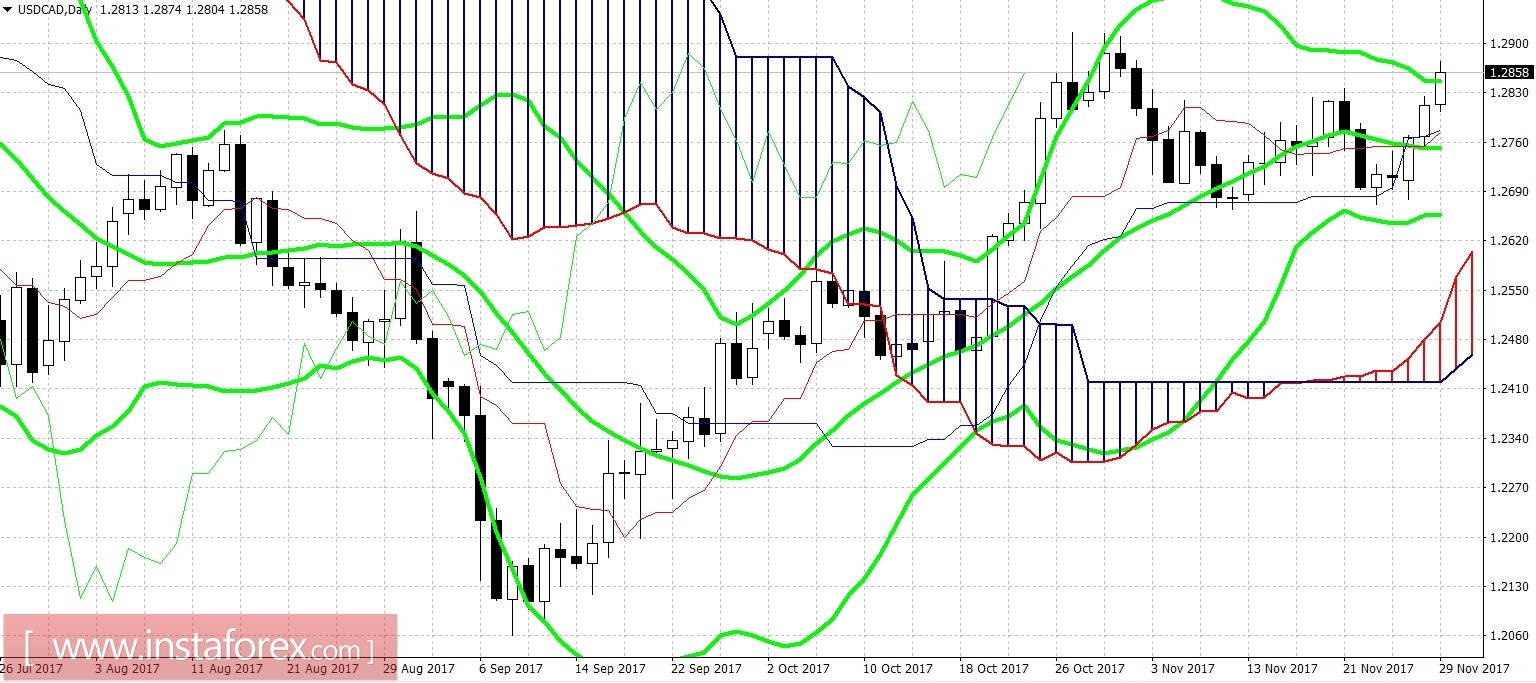
The technical picture of this pair also speaks in favor of the upward movement. On the daily chart, the pair is above the Kumo cloud of the Ichimoku Kinko Hyo indicator and above all its lines. The bullish "Parade Line" signal indicates the potential for further price growth. In addition, the pair is located on the top line of the Bollinger Bands indicator. This also indicates the bullish sentiment of traders.
One can consider the mark of 1.2945 as the immediate target of the upward movement - this is the resistance level and the top line of the Bollinger Bands indicator on the timeframe W1. Stop-loss can be located in the support level area - this is the middle line of the indicator Bollinger Bands (price 1.2755) on the daily chart.
Ирина Милошевич