 English
 Русский
 Bahasa Indonesia
 Bahasa Malay
 ไทย
ไทย Español
 Deutsch
 Български
 Français
 Tiếng Việt
 中文
中文 বাংলা
বাংলা हिन्दी
 Čeština
 Українська
 Română


The euro rose on Friday afternoon after weak data on the indicator of manufacturing activity in the US. However, a number of decisions on the weekend, including the tax reform bill, led to the growth of the US dollar against a number of world currencies such as the euro and the British pound.
According to the report of the Institute of Supply Management, the index of supply managers for the manufacturing sector for the month of November this year fell to the level of 8.2 points, which led to the pressure on the US dollar. Despite the decline in the index, its value above 50 indicate an increase in activity. Economists had expected that the index would be at 58.0 points in November versus 58.7 points in October. It is important to note that the index reached 60.8 points in September of this year, which will definitely have a positive impact on the data on economic growth for the 3rd quarter.
The euro and the British pound fell sharply against the US dollar and the Asian gaps, which were noted in many trading instruments, only confirm the growing strength of the US dollar following the news that the Senate of the US Congress finally passed a bill on tax reform after a long debate.
It is also important to note that last Friday, a number of leading experts spoke about serious problems in the way of adopting this bill. The main point of the new tax reform will be a reduction in the tax rate of US companies from 35% to 20%. As a result of this reform, the budget deficit will increase by 1 trillion dollars in ten years. It was this item that was the main problem in the voting of the reform. It should be noted that a tax cut of 20% is a very important political decision by the administration of Donald Trump. The adoption of this bill will strengthen the political influence of Donald Trump at his post.
Data on the producer price index of the euro area had little support for the euro in the first half of the day. The advantage was maintained on the side of the US dollar.
According to the report of the statistics agency, the producer price index of the eurozone in October increased by 0.4% compared with September. Compared to the same period in 2016, producer prices increased by 2.5%. Economists predicted that the producer price index of the eurozone in October of this year will grow by only 0.3% and 2.6% respectively.
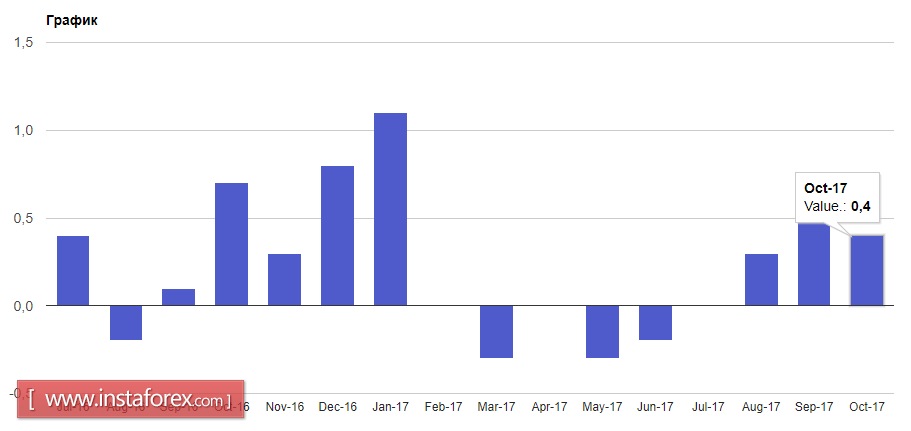
The base index, which does not take into account energy prices, grew by only 0.2% and 2.3% in October of this year compared with October of last year, 2016.
As for the technical picture of the EURUSD pair, the pressure on the euro could continue. While the trade is conducted in the lower part of the side channel below the level of 1.1890, it is possible to count on further decrease of the euro to the area of 1.1810 and 1.1780, where large buyers will gradually return to the market.