 English
 Русский
 Bahasa Indonesia
 Bahasa Malay
 ไทย
ไทย Español
 Deutsch
 Български
 Français
 Tiếng Việt
 中文
中文 বাংলা
বাংলা हिन्दी
 Čeština
 Українська
 Română


The slowdown in the German manufacturing sector exerted more pressure on the euro in the first half of the day than good data on the growth of the sentiment index in the euro zone economy. The EURUSD pair continues to decline, performing a correction after a failed attempt at growth earlier this year.
As it became known from official data in Germany last November, there was a reduction in orders in the manufacturing sector. So, in comparison with October 2017, the volume of orders in the German manufacturing sector decreased by 0.4%. It should be noted that in October, compared with September, the indicator grew by 0.7%. Economists expected further growth in orders in November. Despite this, as noted by a number of experts, the low level of reserves and the high level of capacity utilization is a reason for calm in relation to a new wave of growth in orders in the near future.
The euro almost did not react to data on producers who are optimistic about their prospects. This indicates the likely continuation of the eurozone's economic growth earlier this year.
According to the report of the European Commission, the sentiment index in the economy of the eurozone for the month of December 2017 rose to 116.0 points from 114.6 points in November. Economists had expected the index to rise to 114.8 points. The report indicates that the increase in confidence is directly related to the growth of the industrial sector, whose indicator rose to 9.1 points from 8.1 points. The indicator of the business climate remained at a fairly high level.
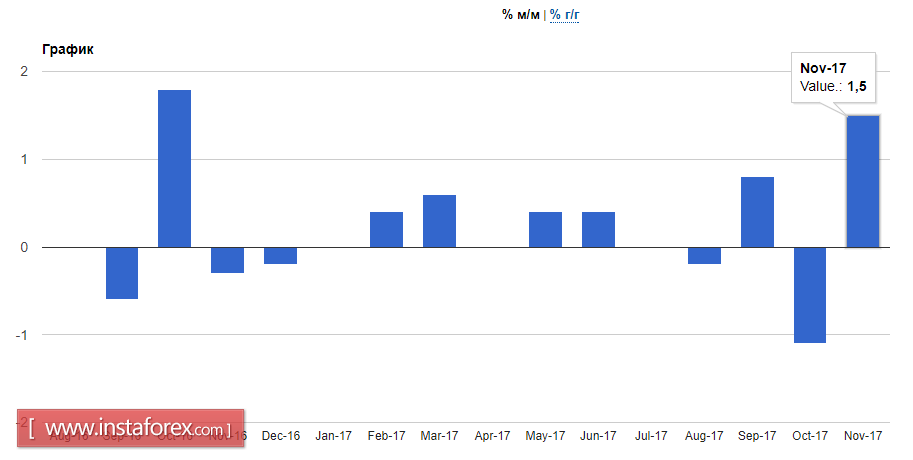
A good growth in retail sales in the euro area will undoubtedly support the economy, which will have a favorable effect on GDP in late 2017. According to the data, in comparison with October, retail sales in the euro area for the month of November last year grew by 1.5% after a serious reduction in the preceding month. Compared to the same period in 2016, retail trade grew by 2.8%. Economists had expected a growth in November of 1.4% in monthly terms and 2.4%, in the annual terms.
As for the technical picture of the EURUSD pair, there have been no significant changes in terms of the direction of the movement. To fix profit on short positions and to consider long positions in risky assets at the beginning of the week is best after updating the support levels to the area of 1.1950 and 1.1910.
The Swiss franc has responded with a drop in data of the Swiss consumer price index in December 2017 which increased by 0.8% compared to the same period of the previous year. The data fully coincided with the forecast of economists, which did not cause changes in the developing market trend. According to the Bank of Switzerland, such data is also not particularly encouraging because even though Switzerland emerged from the deflation period, inflation remains very low. Thus, it is not yet possible to talk about changes in monetary policy.