 English
 Русский
 Bahasa Indonesia
 Bahasa Malay
 ไทย
ไทย Español
 Deutsch
 Български
 Français
 Tiếng Việt
 中文
中文 বাংলা
বাংলা हिन्दी
 Čeština
 Українська
 Română


EUR/USD
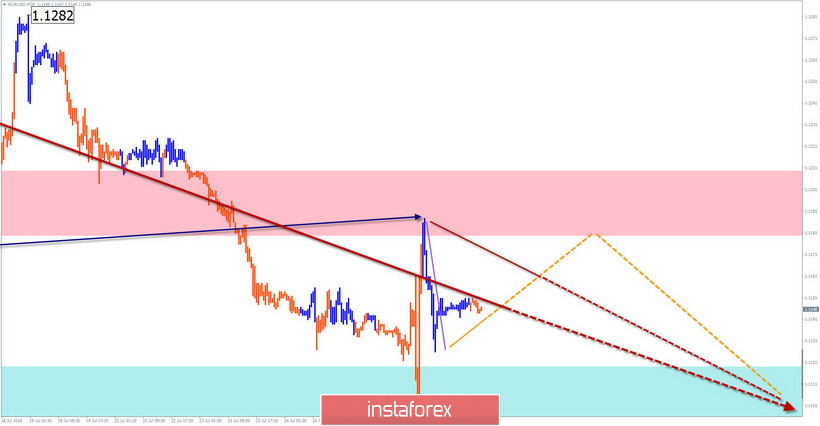
The unfinished wave model of the European currency started on June 25 and co-directed with the dominant trend direction. The first 2 parts (A+B) are formed in the wave structure. In the final part (C), an intermediate correction was completed yesterday.
Forecast:
Today, at the next session, a flat mood of movement is most likely, with an upward vector. In the afternoon, a reversal and the beginning of the decline are expected. A temporary reference point is the release of a news block from the United States. The support zone shows the lower limit of the expected daily volatility of the pair.
Recommendations:
Buying the euro today is quite risky, they should reduce the lot. The most promising are the sales of the instrument, the signals of which are recommended to be monitored in the area of the resistance zone.
Resistance zone:
- 1.1180/1.1210
Support zone:
- 1.1120/1.1080
GBP/USD
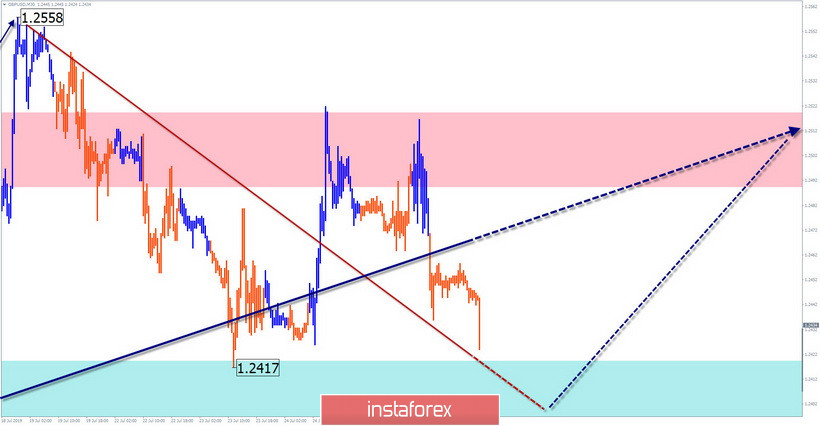
The last wave model of the short-term period, which is relevant at the time of analysis, starts from July 17. It is a bullish wave, the middle part (B) is formed in the co-ordinate. The downward zigzag entered the final phase.
Forecast:
The completion of the bearish stage of the movement is expected today in the area of the support zone. There is a chance of a short-term puncture of the lower boundary of the zone. The change of rate and the start of the ascent is most likely at the end of the day
Recommendations:
Sales of the British pound today are unpromising. In the area of the support zone, it is recommended to track reversal signals to find entry points to long positions.
Resistance zone:
- 1.2490/1.2520
Support zone:
- 1.2420/1.2390
Explanations to the figures: Waves in the simplified wave analysis consist of 3 parts (A-B-C). The last unfinished wave is analyzed. Zones show areas with the highest probability of reversal. The arrows indicate the wave marking according to the method used by the author, the solid background is the formed structure, the dotted ones are the expected movements.
Note: The wave algorithm does not take into account the duration of tool movements over time.