 English
 Русский
 Bahasa Indonesia
 Bahasa Malay
 ไทย
ไทย Español
 Deutsch
 Български
 Français
 Tiếng Việt
 中文
中文 বাংলা
বাংলা हिन्दी
 Čeština
 Українська
 Română


The Japanese currency is already approaching the 104th figure against the dollar, as it continues to update the price lows of the year. The last time the pair was on such troughs was in March 2018, when Donald Trump signed a memorandum on fighting China's economic aggression, which turned into a form of act of declaring a trade war. After a year and a half, the situation returned to its "zero point": the trade conflict between the superpowers flared up with renewed vigor, and the yen strengthened again, being in demand amid rising anti-risk sentiment.
A direct reason for the Japanese currency's growth was Trump's statement, who said that the September meeting of the negotiating group may not take place. In addition, he virtually ruled out the signing of the deal in the foreseeable future. All the agreements that were reached at the G20 summit collapsed like a house of cards. In particular, the White House decided not to issue licenses to American companies to resume cooperation with the Chinese company Huawei in the purchase of technological equipment in response to China's actions, which refused to purchase agricultural products from the United States.

Trump's statement last Friday came amid further weakening of the renminbi: the People's Bank of China weakened it to 7.069 today. During the US session, the USD/CNY rate slightly pulled back, but is still at record high levels. Let me remind you that at the beginning of last week, officials of the Chinese regulator tried to reassure foreign exporters at a special meeting - they assured representatives of big business that Beijing would not be used as a weapon in the trade war, and that companies could continue to acquire and sell the US currency freely. The second paragraph, of course, is carried out without any reservations, but at the same time, China's national currency remains the de facto weapon of the country in the trade war - even if it is of a "defensive" nature.
In addition, the market again began to talk about the fact that China, which is the world's largest foreign creditor of the US economy, will resort to selling Treasuries or significantly reduce investments in it. It is worth noting that the "horror story" that China is prepared to sell US public debt emerges in the foreign exchange market with enviable regularity, mainly during periods of political tension between Beijing and the United States. Regular conversations on this subject can be treated differently: on the one hand, over the past years, these rumors have not been confirmed and have been refuted by Chinese officials. On the other hand, China did not "let" the USD/CNY rate beyond the line of the 7th level for a long time, while this time the yuan crossed the designated Rubicon. This suggests that the trade war is acquiring new features, which means this time Beijing may apply other available methods of pressure. Be that as it may, the foreign exchange market reacted to these rumors seriously enough, supporting the Japanese currency.
However, anti-risk sentiment in the foreign exchange market increased not only due to the escalation of the US-Chinese trade war. Brexit's likelihood is increasing every day, and any reminders about this make traders nervous - in particular, the pound-dollar pair updated its annual lows again today, dropping to the bottom of the 20th figure. Now the pair is adjusting due to the dollar's weakness, but the prospects of a "chaotic" Brexit continue to set the tone for trading - and not only in the GBP/USD pair. Just today, British Prime Minister Boris Johnson in his video message confirmed that his country would "absolutely definitely" leave the European Union on October 31. After that, the demand for defensive assets increased, including the yen.
But the political crisis in Italy is fraught with new re-elections, the results of which could aggravate relations between Rome and Brussels. The idea of holding new elections is being lobbied by the country's deputy prime minister Matteo Salvini - he needs them in order to become the new prime minister. But this idea has not yet found support among Italian MPs. For example, the ex-leader of the Democratic Party, Matteo Renzi, called them "crazy" to hold them at a time when the budget for 2020 is on the agenda. At present, Italy is considering the formation of a government without Salvini. By the way, among the possible candidates for the post of head of the technical government, they call the current head of the ECB Mario Draghi. Political battles in Italy only increase the general nervousness in the market, increasing the demand for defensive instruments - first of all, for the Japanese currency.
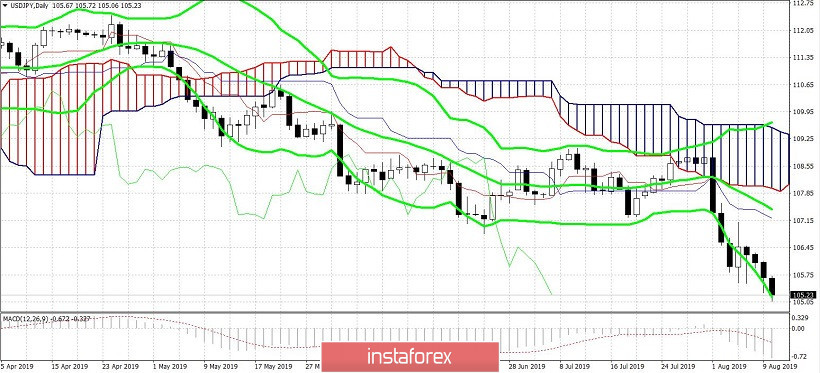
From a technical point of view, the situation is as follows. On all timeframes, without exception, the USD/JPY pair is located on the lower line of the Bollinger Bands indicator below all lines of the Ichimoku indicator, which generated a strong bearish "Parade of Lines" signal. This indicates a clear advantage of the downward movement. The bearish momentum is so strong that it is too early to speak about a price correction: only if the data on the growth of US inflation comes out much better than expected tomorrow, bulls of the pair can count on a price pullback. Otherwise, a downward course will remain in priority. The main goal of the downward movement is located at the lows of last year, that is, at around 104.65.