 English
 Русский
 Bahasa Indonesia
 Bahasa Malay
 ไทย
ไทย Español
 Deutsch
 Български
 Français
 Tiếng Việt
 中文
中文 বাংলা
বাংলা हिन्दी
 Čeština
 Українська
 Română


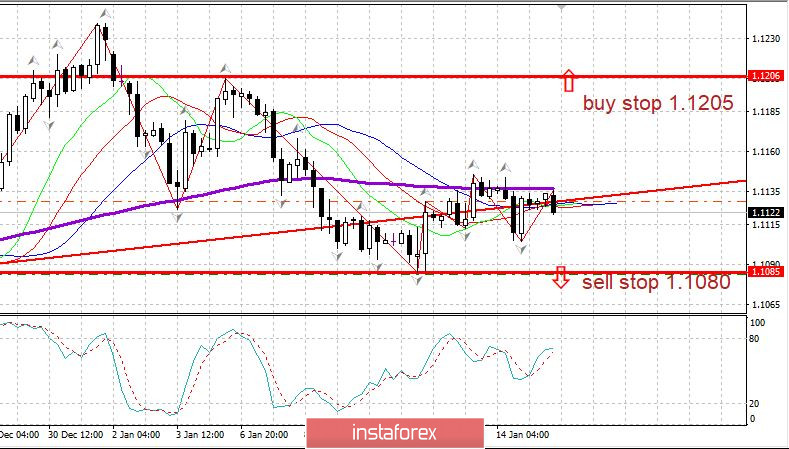
Since April 2018, the euro has been declining gradually but at the same time steadily against the dollar. Some stops have been recorded recently and the last minimum on EURUSD was noted on October 1, 2019, which is at 1.0880, and since then the euro began to grow. However, it's success seems so small, as currently, the price of 1.1120 is only equivalent to 240 points from the minimum.
Furthermore, if the current week does not close above the level of 1.1240, which leaves us to two and a half more days, then this attempt to grow will technically be completed.
The fact is that the Euro has not fallen since October 1, however, the euro cannot show healthy growth as well.
What is the reason?
There are two answers:
(a) small speculators - the main ones are on the market now, and
(b) negative swap
Large players have no interest in switching to euros because the percentage of euros on the ECB accounts is now equivalent to -0.4%, so it is not profitable for banks to keep accounts in euros. On the one hand, yields in the United States are generally higher with a virtually stable rate.
In theory, small speculators could start the movement. Of course, in those companies on the FOREX market, the positions of small players overlap each other by 90% or more. But the uncompensated is different, which needs to be brought to the market to ensure the broker's risk. These positions could change the picture for the Euro. However, it is hindered by a high negative swap.
The difference in the base rate for the euro and the dollar does not exceed to 1.6% per annum in favor of the dollar. But FOREX brokers set a negative swap at about 5% - 6% per annum. Which seems to be a bit, but this is only at first glance.
For a trader trying to play a trend, the usual loading of a deposit is about 10 to 1 leverage. For example, with this leverage used, a negative swap of 5% per annum turns into an additional cost of 50% per annum if a trader has to wait for a trend target for 1 year.
What is this in points? With a leverage of 10: 1, the swap will be 500-600 points of unearned profit for the year. And if you look at the falling volatility of the euro, in 2019, only 700 points went from the high of the year to the minimum of the euro. That is, if a trader "caught" a trend of 500-600 points, but had to keep it for almost a year. Note that this was a trend upward in the euro, so the trader gave all his earnings to cover a negative swap.
As we understand, catching and keeping a trend is not an easy task. Therefore, a critical mass of positions on the growth of the euro won't be collected.
On the other hand, it is enough for the ECB to change the approach to interest rates and this may turn the picture upside down.
The next ECB meeting will be held on January 23.
EURUSD:
We buy when breaking 1.1205 and up.
Sell from 1.1080 and down.