 English
 Русский
 Bahasa Indonesia
 Bahasa Malay
 ไทย
ไทย Español
 Deutsch
 Български
 Français
 Tiếng Việt
 中文
中文 বাংলা
বাংলা हिन्दी
 Čeština
 Українська
 Română


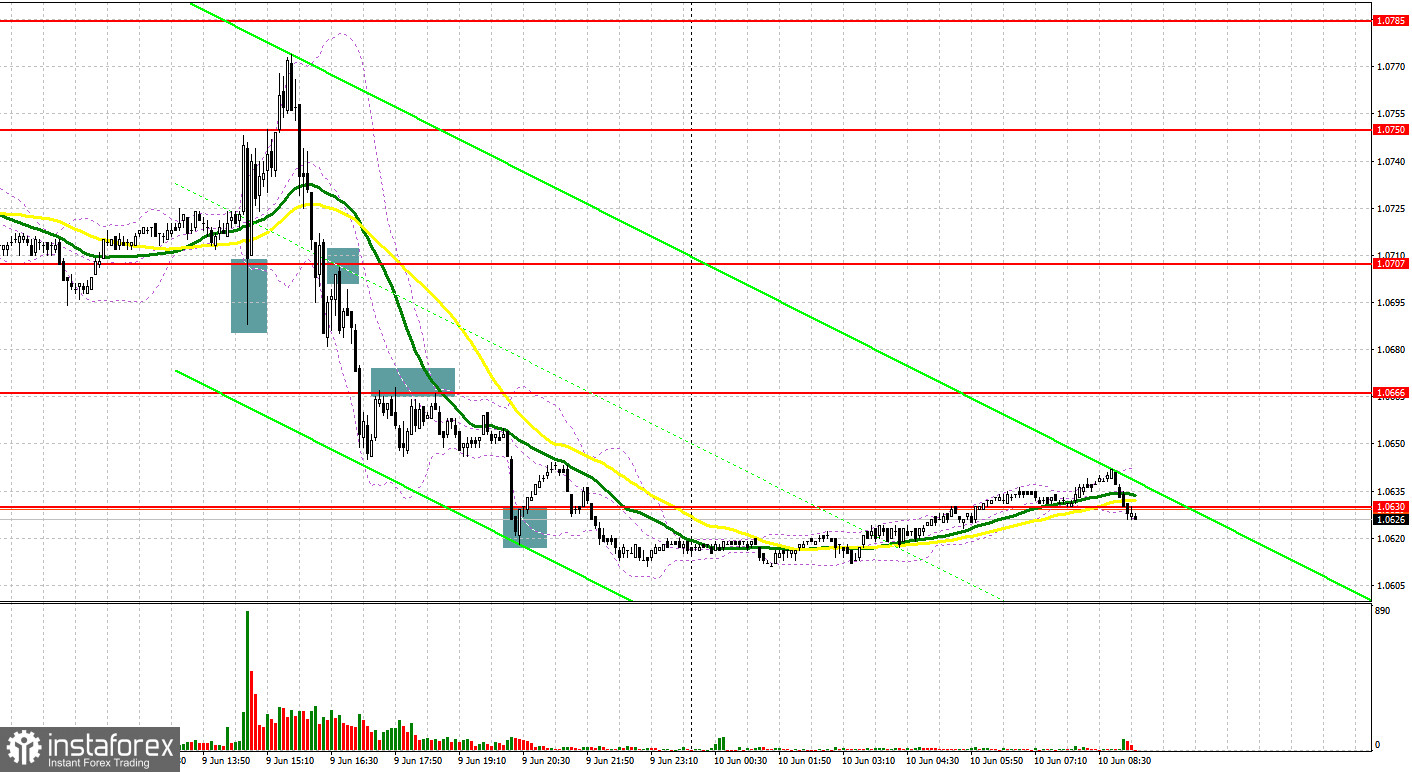
Yesterday, traders received several signals to enter the market. Let us focus on the 5-minute chart to clear up the market situation. Earlier, I asked you to pay attention to the level of 1.0707 to decide when to enter the market. In the first part of the day, bears broke 1.0707, but there was no good entry point as the pair just inched down. After the ECB announced its decision to conclude asset purchases, the pair once again dropped to 1.0707 and formed a false break. This led to a buy signal and a sudden move to 1.0750. However, bears failed to fix at this level after the euro's sell-off which began during the US trade. A break and an upward test of 1.0707 gave a good short signal. As a result, the pair dropped by 60 pips. The pair's settlement below 1.0666 and another sell signal brought about 40 pips of profit. Bulls tried to protect the level of 1.0630, but to no avail.
Conditions for opening long positions on EUR/USD:
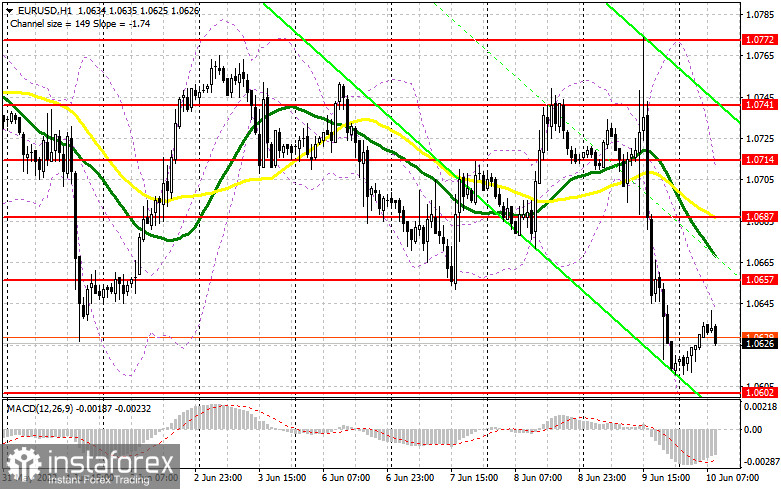
According to the announcement, the ECB is planning to conclude asset purchases in three weeks. It is an important action aimed at combating record high inflation. Then, the regulator intends to raise the key interest rate for the first time since 2011. However, the euro dropped amid the absence of aggressive decisions from the ECB. The euro is likely to be under pressure until the US publishes its inflation report. In the first part of the day, volatility is likely to be low due to the lack of important macroeconomic events in Europe. If the pair declines, only a false break of 1.0602 will give a long signal with the target at the resistance level of 1.0657. A break and downward test of this level will seriously affect seller's stop orders, thus giving a long signal with the target above 1.0687, where it is recommended to lock in profits. There, we can see moving averages, which may cap the upward potential of the euro/dollar pair. The pair will hardly reach the upper target of 1.0714 until the US inflation report. If the pair decreases and buyers fail to protect 1.0602, pressure on the euro will surge. The pair may slide to 1.0581. That is why it will be wise to go long after a false break of this level. Buy orders could also be initiated from 1.0559 or lower – from 1.0535, expecting a rise of 30-35 pips within the day.
Conditions for opening short positions on EUR/USD:
Sellers showed good performance and seriously hit buyers' positions. However, today's data may change the market situation. If the euro rises in the first part of the day, only a false break of 1.0657 will give a sell signal with the target at the support level of 1.0602. A break and settlement below this level as well as an upward test will provide traders with an additional sell signal that will affect buyers' stop orders and cause a slump to 1.0581. A break and settlement below 1.0581 may occur in the second part of the day after the US inflation report. According to the forecast, inflation may break another 40-year high. In this case, a lower target will be located at 1.0559, where it is recommended to leave the market. If the euro/dollar pair climbs during the European session and bears fail to protect 1.0657, buyers may regain control over the market. However, they will hardly benefit from the situation until the publication of the CPI data. Thus, it will be better to wait for a false break of 1.0687. It is also possible to sell the asset after a bounce off the high of 1.0714 and lower – from 1.0741, expecting a decline of 30-35 pips.
COT report
According to the COT report from May 24, the number of long positions advanced, whereas the number of short positions dropped. Traders continued opening long positions, expecting a more aggressive monetary policy from the ECB. Although last week, there were less comments about a key interest rate hike in the near future, the euro/dollar pair managed to retain its upward potential. Now, analysts suppose that the ECB will raise the deposit rate by one-fourth of a basis point as early as July. The next two hikes will take place in September and December. By the end of the year, the benchmark rate is expected to be at the level of 0.25%. However, some experts are sure that the central bank will have to take more aggressive measures. A lot depends on the inflation report for May of this year. The indicator may jump to 7.7% on a yearly basis, thus increasing pressure on politicians. Against the backdrop, the regulator may raise the key interest rate up to 0.5% from the current zero level. The COT report unveiled that the number of long non-commercial positions increased by 6,302 to 237,072 from 230,770, while the number of short non-commercial positions declined by 12,289 to 198,142 from 210,431. The euro's low price is making the currency more attractive for mid-term traders. According to the weekly results, the total non-commercial net position increased to 38,930 from 20,339. The weekly close price jumped to 1.0734 from 1.0556.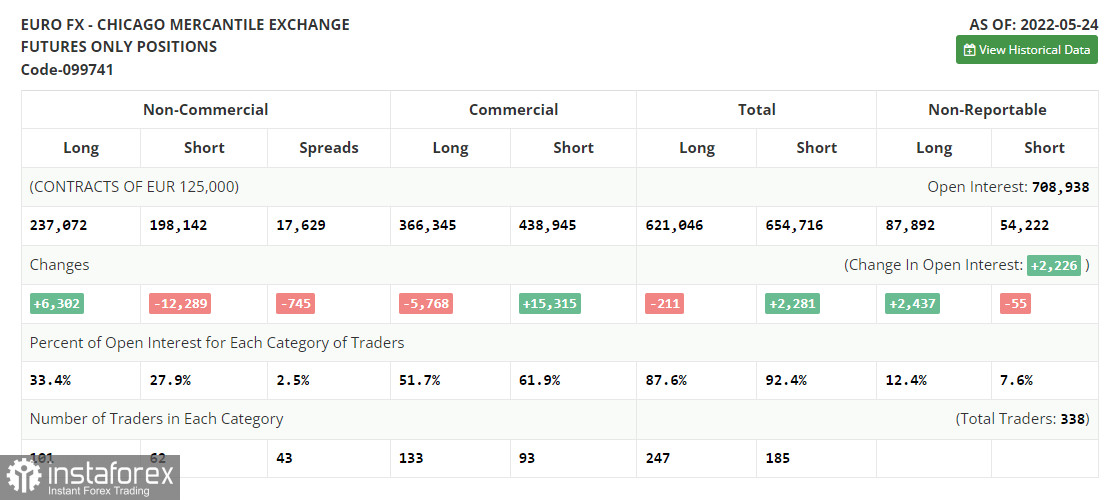
Signals of indicators:
Moving Averages
Trading is performed below 30- and 50-day moving averages, thus pointing to a possible decline in the euro in the short term.
Note: The period and prices of moving averages are considered by the author on the one-hour chart that differs from the general definition of the classic daily moving averages on the daily chart.
Bollinger Bands
In case of a decline, the lower limit of the indicator located at 1.0580 will act as support. If the pair grows, the resistance level will be located at the higher limit of the indicator at 1.0714.
Description of indicators- Moving average (moving average, determines the current trend by smoothing volatility and noise). The period is 50. It is marked in yellow on the chart.
- Moving average (moving average, determines the current trend by smoothing volatility and noise). The period is 30. It is marked in green on the graph.
- MACD indicator (Moving Average Convergence/Divergence - convergence/divergence of moving averages). A fast EMA period is 12. A slow EMA period is 26. The SMA period is 9.
- Bollinger Bands. The period is 20.
- Non-profit speculative traders are individual traders, hedge funds, and large institutions that use the futures market for speculative purposes and meet certain requirements.
- Long non-commercial positions is a total number of long positions opened by non-commercial traders.