 English
 Русский
 Bahasa Indonesia
 Bahasa Malay
 ไทย
ไทย Español
 Deutsch
 Български
 Français
 Tiếng Việt
 中文
中文 বাংলা
বাংলা हिन्दी
 Čeština
 Українська
 Română


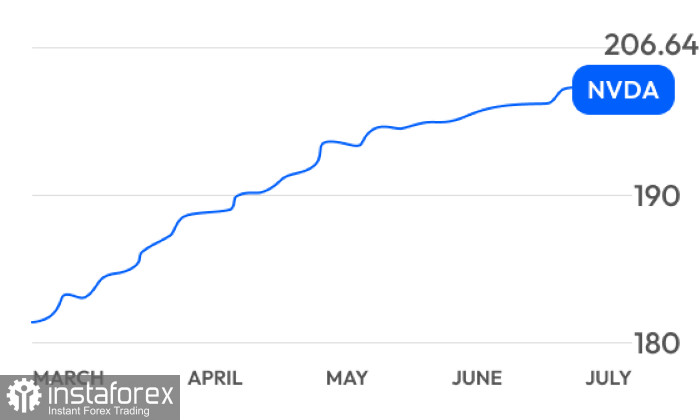
A fierce battle is unfolding on the global stock market for the title of the world's most valuable company by December 2026. Alphabet (Google) poses the primary threat to Nvidia's (NVDA) leadership. Shares of Alphabet have surged 43% since October, while Nvidia's stock gained a modest 6.3% over the same period. This dynamic rally has brought Alphabet to the brink of overtaking Nvidia in market capitalization, which has already led to declining investor confidence on prediction markets.
Despite this, the fundamental position of Nvidia and the broader artificial intelligence sector remains solid. In early August 2026, Nvidia shares rose by more than 2% to $205.57. This was bolstered by a Goldman Sachs report in which Chief Strategist Ben Snider urged market participants not to panic over rumors of an "AI bubble bursting." According to Goldman Sachs, second-quarter S&P 500 earnings grew by 26%, with AI infrastructure companies driving a third of that growth. From the second half of 2026 through 2027, their share of aggregate earnings growth is expected to exceed 50%.
Market confidence is further backed by earnings reports from tech giants:
- Microsoft Azure's cloud revenue surpassed $100 billion annualized (+43% in Q4).
- Amazon's market cap surpassed $3 trillion, driven by $25 billion in annualized sales from AI and chips.
- Alphabet raised its 2026 capital expenditure (capex) forecast to $195–205 billion.
In total, the top five tech giants allocated $182 billion to capex and raised $101 billion in financing during the second quarter, guaranteeing massive demand for Nvidia's computing power and chips.
Key Headwinds
Despite the sector's strong financial metrics, Nvidia's stock and leadership status face significant pressure:
- Alphabet's Rapid Ascent: Alphabet's rally (+43%) is drawing investor capital away, posing a direct threat to Nvidia's position as the top company by market cap.
- Questions Around AI ROI: The market is demanding proof from hyperscalers of a quick return on investment (ROI) for multi-billion-dollar spending. Investor skepticism has led to sharp pullbacks: Oracle shares have fallen 30% year-to-date due to massive spending and dependence on OpenAI, while Meta's increased capex led to an initial 9% drop in its stock.
- High Volatility and Capital Rotation: Shakes in the tech sector and profit-taking by hedge funds are causing sharp, short-term price fluctuations in Nvidia stock.
- Declining Odds on Prediction Markets: The probability of Nvidia retaining its status as the largest company by June 30 fell to 76%, reflecting growing analyst doubt regarding its uncontested market dominance by year-end.
Forecast
Based on the presented data, our forecast for Nvidia's status and stock trajectory is as follows:
Status as the World's Most Valuable Company by December 2026
Nvidia's chances of maintaining the top market cap spot by December 31, 2026, are diminishing. Although the company remains the primary beneficiary of the AI boom, Alphabet's rapid growth (+43%) and Microsoft's strong performance present intense competition. We forecast that Nvidia is highly likely to yield its market cap leadership to Alphabet by the end of 2026 or enter a state of tight parity.
Nvidia Stock Trajectory (Growth vs. Decline)
Regarding Nvidia's share price ($205.57), we forecast moderate growth rather than a decline. The company's fundamentals are shielded by Big Tech's massive capital expenditures ($182 billion for the quarter) and strong profit growth across the AI sector. Concerns over a "bubble" are not supported by fundamental reports. However, a dramatic surge should not be expected: the stock will likely grow at a measured pace, facing volatility and corrections due to intense market scrutiny over hyperscaler return on investment.