 English

 Русский
 Bahasa Indonesia
 Bahasa Malay
 ไทย
 Español
 Deutsch
 Български
 Français
 Tiếng Việt
 中文
 বাংলা
 हिन्दी
 Čeština
 Українська
 Română



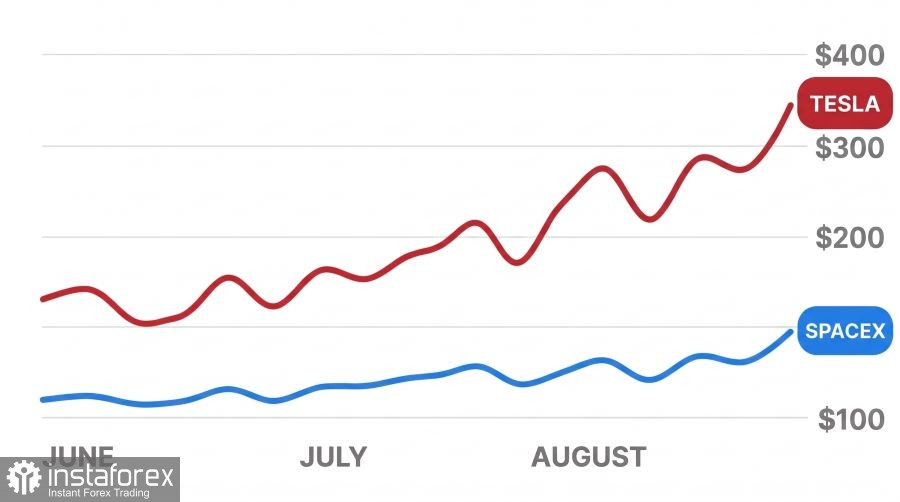
Tesla (NASDAQ: TSLA) shares closed the regular trading session down -3.08% at $374.58 before settling at $373.35 in after-hours trading. The stock declined alongside the broader tech sector following the release of a mixed Q3 2026 earnings report and reports of a looming mega-merger.
Elon Musk has officially confirmed the initiation of merger talks between Tesla and SpaceX to form a combined holding company valued at $3.5 trillion. Independent directors from both boards have established special committees to evaluate the proposed terms. Musk himself has been recused from discussions due to a conflict of interest stemming from his dual chief executive role. Under the proposed structure, SpaceX is valued at $2 trillion, while Tesla is appraised at $1.5 trillion. The transaction is targeted to close before the end of Donald Trump's presidential term in January 2029, banking on a favorable regulatory environment.
Tesla's third-quarter results delivered mixed signals. Adjusted earnings per share came in at $0.48 versus consensus estimates of $0.45. The company posted positive free cash flow of $1.5 billion after accounting for all capital expenditures. However, quarterly revenue remained flat year-over-year at $28.05 billion, and electric vehicle deliveries slipped 2% to 486,532 units.
Operating profit from core automotive operations plunged 56%, weighed down by rising expenditures on server infrastructure and artificial intelligence algorithm development. Tesla management lowered its full-year capital expenditure forecast for manufacturing plants and equipment from $25 billion to $20 billion. On a private call with investors, company representatives flatly refused to comment on the prospective SpaceX combination.
In my view, the consolidation with SpaceX is primarily designed to compensate for decelerating electric vehicle sales. Musk's aerospace firm posted a quarterly profit of $4.4 billion—its first since its initial public offering—driven by a +161% revenue surge to $14.58 billion. Its supercomputing and neural network unit brought in $7.56 billion, surpassing the Starlink satellite network. I believe this merger is crucial for Musk to freely shift engineering talent and computing power between the two enterprises without triggering shareholder litigation.
Key Headwinds
I highlight five primary pressure points weighing on Tesla's share price and the feasibility of the merger:
•Slowing vehicle sales and margin erosion EV sales growth has stalled, and core operating income has plummeted by 56%. The 2% decline in deliveries points directly to market saturation across the existing model lineup. The capital consumed by training neural networks is eroding current earnings, and I do not expect meaningful financial returns from the Optimus robotics line or autonomous robotaxi initiatives in the coming quarters.
•Steep shareholder voting hurdles and legal exposure Final approval requires the consent of holders representing at least a majority of all outstanding Tesla shares. Musk holds a 20% equity stake in Tesla and commands 82% of SpaceX's voting rights via super-voting shares. Institutional funds are understandably alarmed by the threat of dilution and are already mounting legal challenges, citing the contentious fallout from the 2016 SolarCity buyout.
•Federal safety scrutiny over Cybercab robotaxis The National Highway Traffic Safety Administration (NHTSA) opened a formal defect investigation into Tesla's autonomous vehicles in Texas. The inquiry followed reports of robotaxis speeding in active school zones, alongside broader questions surrounding the certification of its autonomous driving stack. Regulators have mandated formal sworn depositions by October 30, which creates a major bottleneck for rollout plans in other metropolitan areas.
•Postponement of mass production for the Roadster to 2028 The showcase of the sports car equipped with cold-gas thrusters met widespread skepticism across Wall Street. I share the view of analysts who regard the presentation as an engineering stunt with negligible implications for mass-market vehicle sales. Pushing volume production back by two years cuts off near-term cash inflows from pre-order deposits.
•Elevated crude above $112 and broader tech weakness Geopolitical conflict involving Iran pushed Brent crude oil prices past $112 per barrel. High energy costs continue to fuel US inflation, compelling the Federal Reserve to keep interest rates elevated. With Treasury yields hovering near multi-year highs, the Nasdaq fell 2.6%, accelerating the selloff in Tesla equity.
Outlook
My outlook for Tesla's stock performance remains noticeably more measured than the projections of market optimists targeting a rally toward $420–$485 per share.
I expect Tesla shares to trade sideways in a consolidated band between $350 and $385 through the remainder of 2026. The $1.5 billion free cash flow buffer should protect against a severe break below $340. However, the 56% collapse in operating profit and the capex cutback to $20 billion will likely prevent the stock from breaking out to new highs. I anticipate that the annual shareholder meeting on December 3 will pass without a definitive merger vote, as finalizing parity terms across the independent committees will take substantial time.
The political backdrop will remain the chief catalyst for volatility. Elon Musk contributed $276 million to Republican campaign funds ahead of the Congressional midterms. Should Democrats regain control, regulatory bodies will almost certainly ramp up scrutiny of SpaceX's federal defense and civil contracts alongside Tesla's autonomous driving software, creating substantial execution risk for the transaction.
Through the first half of 2027, I project Tesla shares to hold within a $360–$410 corridor. Because completing the transaction requires the affirmative vote of an absolute majority of all outstanding shares, closing the deal will face an uphill battle against institutional asset managers. I advise investors to avoid speculative buying based on mega-cap merger rumors and await verifiable evidence of an operational turnaround in the core automotive business.