 English
 Русский
 Bahasa Indonesia
 Bahasa Malay
 ไทย
ไทย Español
 Deutsch
 Български
 Français
 Tiếng Việt
 中文
中文 বাংলা
বাংলা हिन्दी
 Čeština
 Українська
 Română


Analysis of GBP/USD 5M
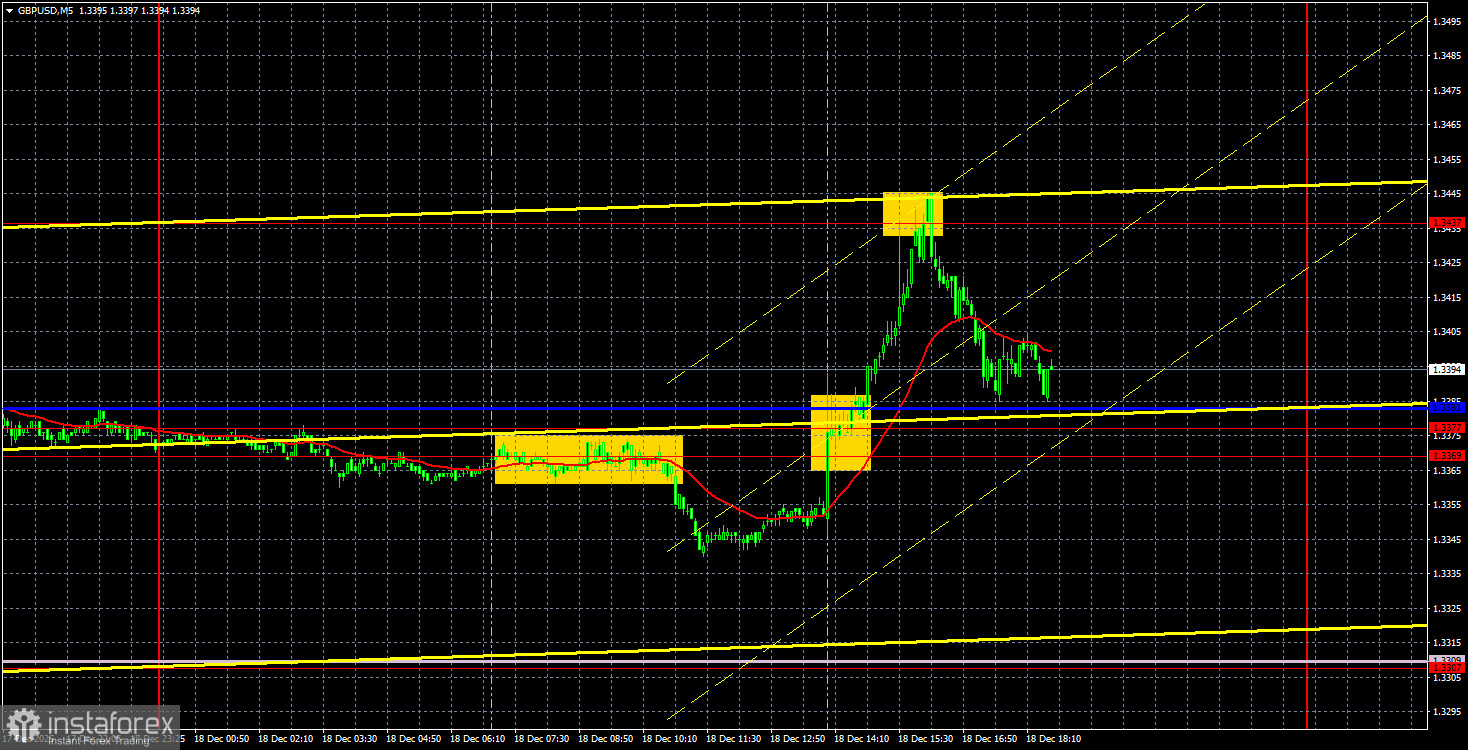
The GBP/USD currency pair began Thursday in decline, but after the Bank of England's meeting and its decision to lower the key interest rate by 0.25%, the British pound shifted into an upward trend. Illogical? At first glance, yes. However, the market had already understood the British central bank's intentions following the November inflation report. It became clear at that time that a new round of monetary policy easing would follow. Thus, this decision had been priced in "in advance," and we can say the same as we often do after almost every central bank meeting—do not rush to conclusions. It is essential to give the market time to settle and process the information before drawing conclusions. The pound rose on the entirely "dovish" decision of the Bank of England, but had already returned to its initial positions by the evening. Classic.
From a technical perspective, surprisingly, a flat market has formed for the British currency. This flat trend has been ongoing for over a week. The price is stuck between 1.3307 and 1.3437, and the super-important macroeconomic and fundamental backdrop this week has had no impact on this situation. It is fair to note that many reports and events contradicted each other. British data did not support the pound, but neither did the U.S. data support the dollar.
On the 5-minute time frame yesterday, three trading signals were formed, two of which could have brought decent profits. During the European trading session, the pair bounced from the area of 1.3369-1.3377 but could only move down by 20-25 pips. Then, the price consolidated above this area, followed by a test of 1.3437, a bounce, and a return to the 1.3369-1.3377 area. Thus, the last two trades were profitable, while the first was closed at breakeven with a Stop Loss.
COT Report
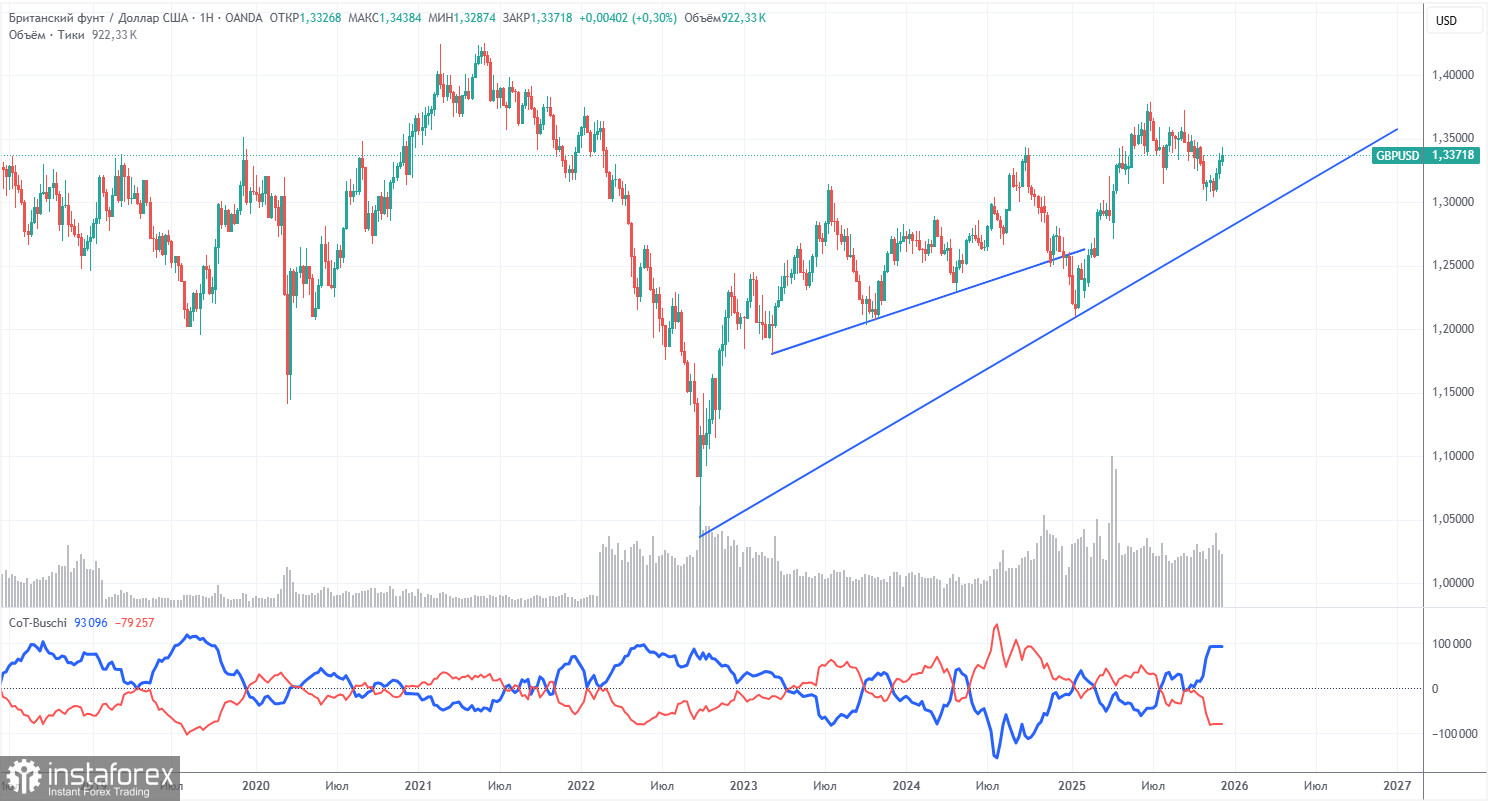
COT reports for the British pound show that commercial traders' sentiment has been changing constantly in recent years. The red and blue lines, representing net positions of commercial and non-commercial traders, frequently intersect and are usually close to the zero mark. Currently, they are almost at the same level, indicating a roughly equal number of long and short positions.
The dollar continues to decline due to Donald Trump's policies, as shown in the weekly time frame (illustration above). The trade war will continue in one form or another for a long time. The Federal Reserve will lower its rate within the next 12 months regardless. Demand for the dollar will decline in any case. According to the most recent COT report (dated October 28) regarding the British pound, the "Non-commercial" group opened 7,000 BUY contracts and 10,500 SELL contracts. Consequently, the net position of non-commercial traders decreased by 3,500 contracts over the week. However, this data is already outdated, and there are no fresh updates.
In 2025, the pound has risen significantly, but it is important to understand that the reason is one: Trump's policies. Once this reason is mitigated, the dollar may begin to rise, but when that will happen is unknown. It does not matter how the net position of the pound grows or declines (if it declines). The net position of the dollar, in any case, is falling, and it is generally doing so at a faster pace.
Analysis of GBP/USD 1H
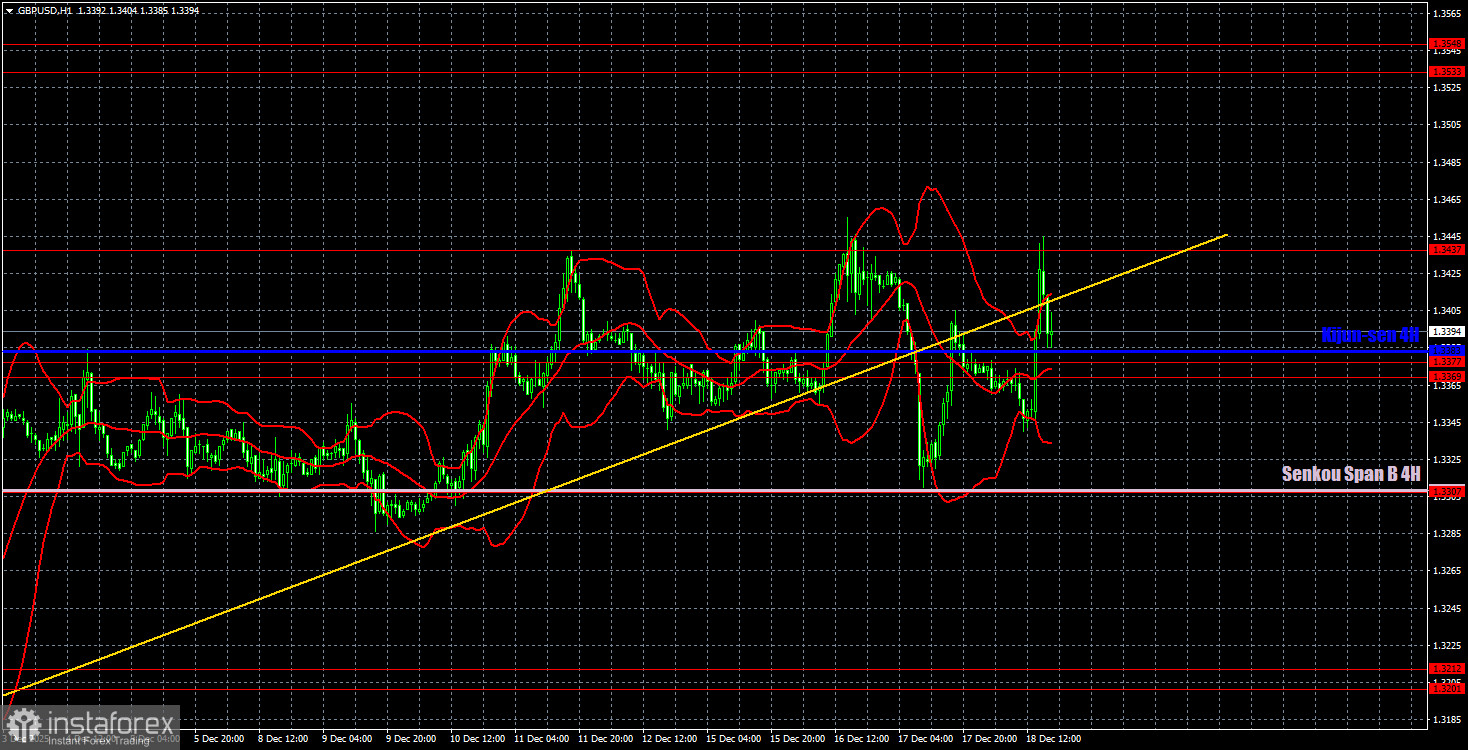
On the hourly time frame, the GBP/USD pair continues to form an upward trend despite the breakout of the trend line. We believe that growth will continue in the medium term, regardless of the local macroeconomic and fundamental background. Recently, a flat trend has formed, so further movement will be determined once the price breaks out of the sideways channel.
For December 19, we highlight the following important levels: 1.2863, 1.2981-1.2987, 1.3042-1.3050, 1.3096-1.3115, 1.3201-1.3212, 1.3307, 1.3369-1.3377, 1.3437, 1.3533-1.3548, 1.3584. The Senkou Span B line (1.3308) and the Kijun-sen line (1.3383) may also serve as signal sources. A Stop Loss is recommended to be set at breakeven when the price moves in the correct direction by 20 pips. The lines of the Ichimoku indicator may shift throughout the day, which should be taken into account when determining trading signals.
On Friday, a retail sales report will be published in the UK, while in the U.S., the University of Michigan consumer sentiment index is scheduled. This week, many more important events and releases failed to provoke a trending movement. Likely, Friday will bring dull trading.
Trading Recommendations:
Today, traders may consider selling if the price consolidates below the 1.3369-1.3377 area, with a target at 1.3307. Long positions will become relevant upon bouncing from the area of 1.3369-1.3377 or from the level of 1.3307, with a target at 1.3437.
Illustration Explanations:
Support and resistance price levels are indicated by thick red lines around which the movement may conclude. They are not sources of trading signals.
Kijun-sen and Senkou Span B lines are lines of the Ichimoku indicator, transferred to the hourly time frame from the 4-hour time frame. They are strong lines.
Extreme levels are thin red lines from which the price has previously bounced. They are sources of trading signals.
Yellow lines represent trend lines, trend channels, and any other technical patterns.
Indicator 1 on COT charts shows the size of each category of traders' net position.