 English
 Русский
 Bahasa Indonesia
 Bahasa Malay
 ไทย
ไทย Español
 Deutsch
 Български
 Français
 Tiếng Việt
 中文
中文 বাংলা
বাংলা हिन्दी
 Čeština
 Українська
 Română


Trade review and trading tips for the euro
The test of the 1.1635 price occurred when the MACD indicator had moved far below the zero mark, limiting the pair's downward potential. For that reason, I did not sell the euro.
Friday's US nonfarm payrolls disappointed economists' expectations, but the simultaneous decline in the unemployment rate to 4.4% triggered a short-term strengthening of the dollar. However, the initial dollar rise driven by the favorable unemployment reading soon gave way to relative stability, then to moderate weakening. Investors took into account that slowing employment growth may constrain US GDP growth and, consequently, the Federal Reserve's plans to cut the key rate. In the near term, the market's focus will be on new US economic data and Fed officials' comments on the future path of monetary policy.
As for European reports, only the Sentix investor confidence indicator for the eurozone is expected today. This indicator typically has little market impact, but it is worth monitoring as one element of the mosaic that reflects overall investor sentiment. Geopolitical risks remain in view. The situation around Venezuela, Greenland, and Cuba remains tense, and any signs of escalation could cause volatility in financial markets.
Regarding the intraday strategy, I will mainly rely on scenarios 1 and 2.
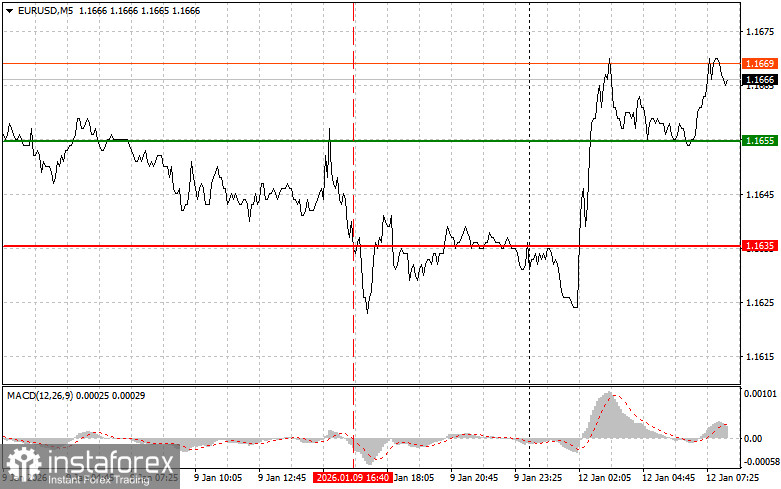
Buy scenarios
Scenario 1: Buy the euro if the price reaches around 1.1677 with a target of 1.1705. At 1.1705, I plan to exit the market and also sell the euro in the opposite direction, anticipating a move of 30–35 pips from the entry point. Expect euro strength after strong data. Important: before buying, ensure the MACD indicator is above the zero mark and is just beginning to rise from it.
Scenario 2: Buy the euro if there are two consecutive tests of 1.1653 while the MACD is in the oversold area. This will limit the pair's downside potential and lead to an upward reversal. Expect rises to the opposite levels 1.1677 and 1.1705.
Sell scenarios
Scenario 1: Sell the euro after reaching 1.1653. The target will be 1.1624, where I plan to exit the market and buy immediately in the opposite direction (anticipating a 20–25 pip move in the opposite direction). Pressure on the pair will return after weak reports. Important: before selling, ensure the MACD indicator is below the zero mark and is just beginning to fall from it.
Scenario 2: Sell the euro if there are two consecutive tests of 1.1677 while the MACD is in the overbought area. This will limit the pair's upward potential and lead to a reversal downward. Expect declines to the opposite levels 1.1653 and 1.1624.
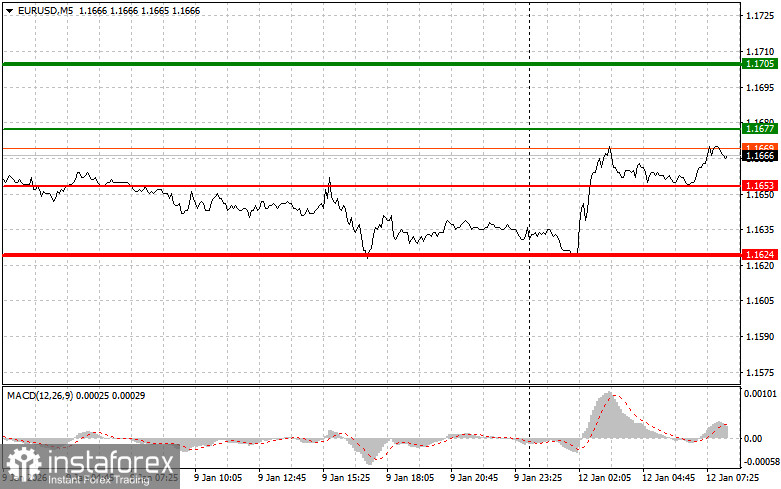
What is on the chart
Thin green line — entry price at which you can buy the instrument
Thick green line — suggested Take Profit price or level at which to manually lock in profit, since further rise above this level is unlikely
Thin red line — entry price at which you can sell the instrument
Thick red line — suggested Take Profit price or level at which to manually lock in profit, since further decline below this level is unlikely
MACD indicator — when entering the market, it is important to follow the overbought and oversold zones
Important notes: Beginner forex traders must be very cautious when deciding to enter the market. It is best to be out of the market before major fundamental reports are released to avoid being caught in sharp price swings. If you decide to trade during news releases, always place stop orders to minimize losses. Without stop orders, you can lose your entire deposit quickly, especially if you do not use money management and trade large volumes.
Remember that successful trading requires a clear trading plan like the one presented above. Spontaneous trading decisions based on current market noise are a losing strategy for the intraday trader.