 English
 Русский
 Bahasa Indonesia
 Bahasa Malay
 ไทย
ไทย Español
 Deutsch
 Български
 Français
 Tiếng Việt
 中文
中文 বাংলা
বাংলা हिन्दी
 Čeština
 Українська
 Română


Trade Review and Trading Tips for the Japanese Yen
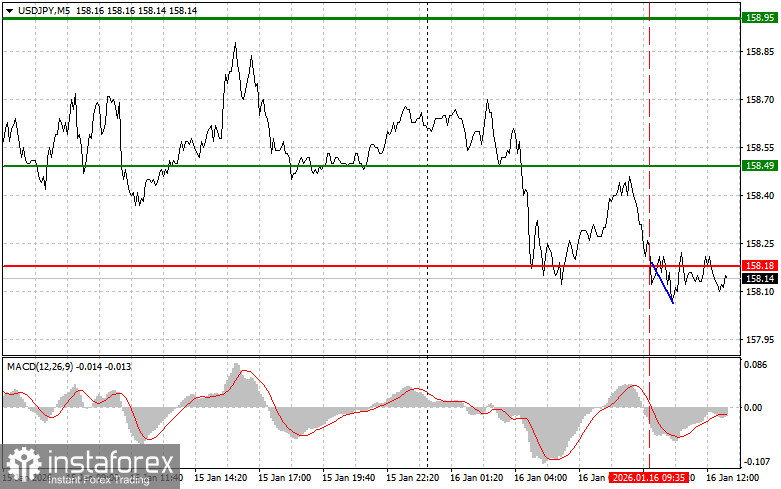
The test of the 158.18 price level occurred at a moment when the MACD indicator was just beginning to move downward from the zero line, which confirmed a correct entry point for selling the dollar. However, the pair did not develop a major decline.
Going forward, a thorough analysis of upcoming economic releases will be extremely important, as it will allow market participants to better understand the state of the U.S. economy. Growth in U.S. industrial production typically indicates rising consumer demand, an increase in orders, and, consequently, a positive overall impact on the economy, which would help the dollar strengthen against the Japanese yen. Speeches by FOMC members—particularly Michelle Bowman and Philip N. Jefferson—will also be closely monitored. Their remarks on the economic environment and future monetary policy actions will significantly affect investor sentiment and, as a result, fluctuations in the U.S. dollar. However, it should be remembered that the Japanese regulator has repeatedly hinted that it is ready to intervene if the national currency weakens further. This will clearly limit dollar buying against the yen in the near term.
As for the intraday strategy, I will rely primarily on the implementation of Scenarios No. 1 and No. 2.
Buy Signal
Scenario No. 1: I plan to buy USD/JPY today when the entry point around 158.27 is reached (green line on the chart), with a target of growth toward the 158.66 level (the thicker green line on the chart). Around 158.66, I plan to exit long positions and open short positions in the opposite direction (aiming for a move of 30–35 points in the opposite direction from that level). The pair's rise can be expected to continue in line with the prevailing trend.Important! Before buying, make sure that the MACD indicator is above the zero line and is just starting to rise from it.
Scenario No. 2: I also plan to buy USD/JPY today in the event of two consecutive tests of the 158.04 level while the MACD indicator is in oversold territory. This would limit the pair's downward potential and lead to a bullish market reversal. A rise toward the opposite levels of 158.27 and 158.66 can be expected.
Sell Signal
Scenario No. 1: I plan to sell USD/JPY today after a break below the 158.04 level (red line on the chart), which would lead to a rapid decline in the pair. The key target for sellers will be the 157.71 level, where I plan to exit short positions and immediately open long positions in the opposite direction (aiming for a move of 20–25 points in the opposite direction from that level). Pressure on the pair may return today in the event of a dovish Fed stance.Important! Before selling, make sure that the MACD indicator is below the zero line and is just starting to decline from it.
Scenario No. 2: I also plan to sell USD/JPY today in the event of two consecutive tests of the 158.27 level while the MACD indicator is in overbought territory. This would limit the pair's upward potential and lead to a bearish market reversal. A decline toward the opposite levels of 158.04 and 157.71 can be expected.
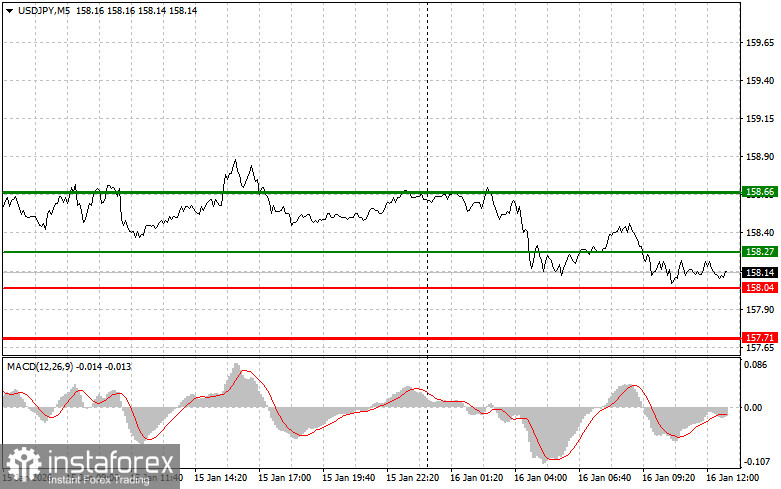
What's on the Chart:
- Thin green line – entry price at which the trading instrument can be bought;
- Thick green line – estimated price where Take Profit can be placed or profits can be taken manually, as further growth above this level is unlikely;
- Thin red line – entry price at which the trading instrument can be sold;
- Thick red line – estimated price where Take Profit can be placed or profits can be taken manually, as further decline below this level is unlikely;
- MACD indicator – when entering the market, it is important to rely on overbought and oversold zones.
Important. Beginner Forex traders must be extremely cautious when making market entry decisions. Before the release of major fundamental reports, it is best to stay out of the market to avoid sharp price fluctuations. If you decide to trade during news releases, always place stop-loss orders to minimize losses. Without stop-loss orders, you can very quickly lose your entire deposit—especially if you do not use proper money management and trade large volumes.
And remember that successful trading requires a clear trading plan, like the one presented above. Spontaneous trading decisions based on the current market situation are an inherently losing strategy for an intraday trader.