English
 Русский
 Bahasa Indonesia
 Bahasa Malay
 ไทย
ไทย Español
 Deutsch
 Български
 Français
 Tiếng Việt
 中文
中文 বাংলা
বাংলা हिन्दी
 Čeština
 Українська
 Română



At the time of writing, the USD/JPY rate was around 157.95, down 0.10% on the day, as the US dollar comes under pressure from political and trade risks.
The pair is falling due to broad dollar weakness against G10 currencies. The US dollar's weakening is linked to escalating tensions between the United States and the European Union over the sovereignty of Greenland, where repeated threats by US President Donald Trump to impose tariffs on several European countries and the United Kingdom heighten uncertainty over transatlantic relations. This undermines demand for the US dollar and prompts capital diversification into other G10 currencies.
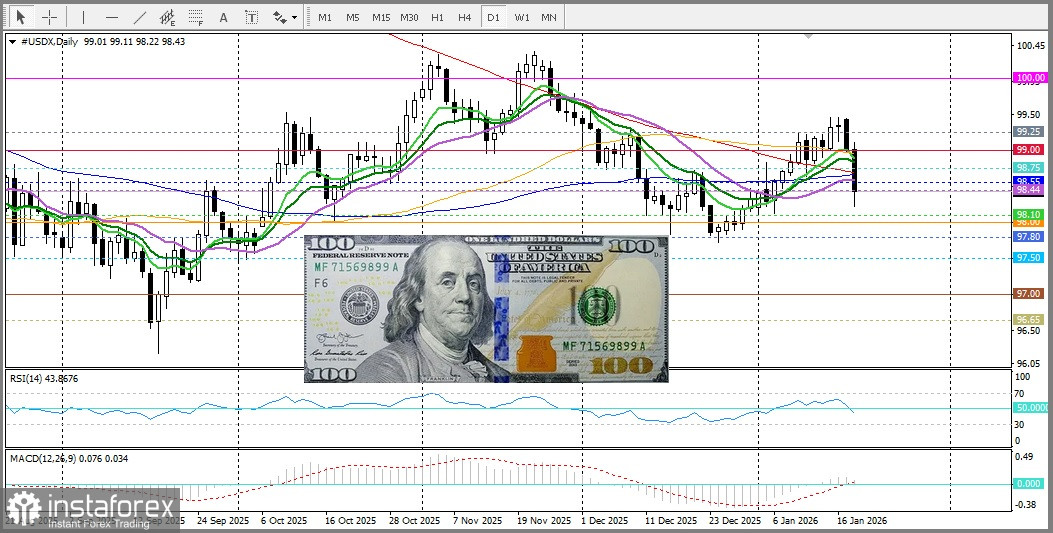
The US dollar index (DXY), which reflects its movement against a basket of six major currencies, plunged on Tuesday, confirming a drop in investor confidence. Markets are closely following legal proceedings on the legitimacy of the US tariffs, as the US Supreme Court has not yet ruled on the use of emergency authorities to impose them.
The Japanese yen is receiving only limited support from the dollar's weakness, as its appreciation remains constrained. Japanese Prime Minister Sanae Takaichi announced the dissolution of the lower house of parliament, calling for early elections, and promised a two-year suspension of the consumption tax, raising expectations of looser fiscal policy and limiting yen strength versus several other currencies.
Now, for better trading opportunities, attention should be paid to the Bank of Japan's monetary policy decision due this week, which will be a key catalyst for the yen.
In the context of global geopolitical and trade tensions, USD/JPY dynamics will continue to depend on risk appetite and political developments on both sides of the Pacific.
From a technical point of view, the round level 158.00 is acting as resistance for USD/JPY. The pair has shown resilience below the 157.40 level. If prices manage to hold above the round 158.00 level, the next resistance for USD/JPY will be in the 158.60–158.70 zone, above which it will aim for the month's high. Daily-chart oscillators are positive despite the waning MACD histogram. Nevertheless, the bulls remain in control.
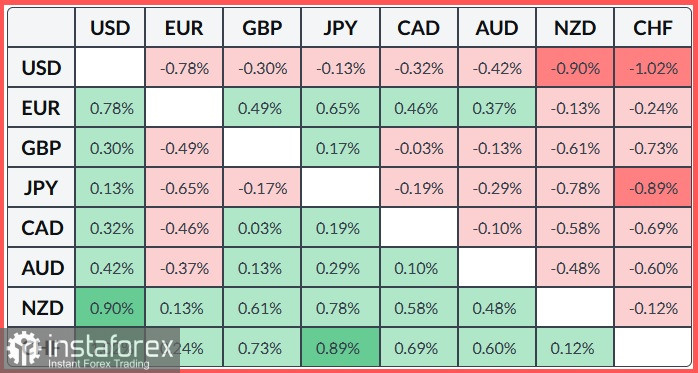
The table below shows the percentage change in the US dollar against major currencies for the day, with the US dollar remaining strongest against the Japanese yen.