 English
 Русский
 Bahasa Indonesia
 Bahasa Malay
 ไทย
ไทย Español
 Deutsch
 Български
 Français
 Tiếng Việt
 中文
中文 বাংলা
বাংলা हिन्दी
 Čeština
 Українська
 Română


Today, the Bitcoin exchange rate hit a weekly low of around $62,600, clearly signaling a new major sell-off towards $50,000, a level widely discussed in the market recently.

Donald Trump's unpredictable, protectionist trade policy has led to a sharp aversion to risk assets. This wave of risk aversion, which has swept traditional financial markets, has not spared the cryptocurrency market. Traders, fearing new consequences from trade wars and potential sanctions, are moving their capital into more conservative instruments, such as gold or reliable government bonds.
The sharp strengthening of the U.S. dollar resulting from this policy also puts pressure on cryptocurrencies. In an environment of uncertainty, the dollar becomes a safe haven for capital, thereby reducing interest in more volatile assets like Bitcoin. Short-term profit-seeking investors view this as a signal to reduce their positions, further contributing to price declines.
At the same time, fundamental factors such as expectations of imminent interest rate cuts by central banks, which could support risk assets, have not yet had a significant impact. Rather, the negative news backdrop and concerns about future economic stability dominate the market, prompting Bitcoin to test lower support levels. The forecast for a decline to $50,000 is becoming increasingly realistic given the current situation.
As for the intraday strategy in the cryptocurrency market, I will continue to focus on any significant pullbacks of Bitcoin and Ethereum while anticipating the ongoing development of a long-term bullish market that has not gone away.
Bitcoin
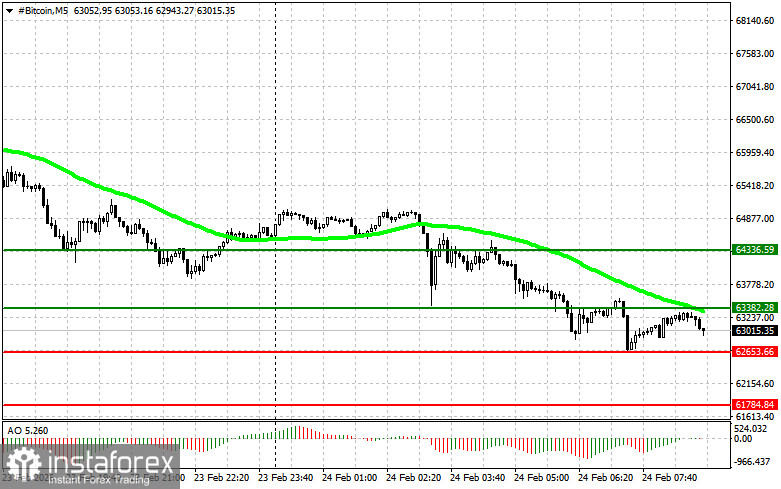
Buy Scenario
Scenario #1: I plan to buy Bitcoin today when the price reaches an entry point around $63,300, targeting a move to $64,300. At $64,300, I intend to exit the purchases and immediately sell back on the pullback. Before buying on a breakout, make sure the 50-day moving average is below the current price and the Awesome Oscillator is above zero.
Scenario #2: I can buy Bitcoin at the lower boundary of $62,600 if there is no market reaction to its breakout back towards $63,300 and $64,300.
Sell Scenario
Scenario #1: I plan to sell Bitcoin today after reaching an entry point around $62,600, targeting a decline to $61,700. At $61,700, I intend to exit the sales and immediately buy back on the pullback. Before selling on a breakout, ensure the 50-day moving average is above the current price and the Awesome Oscillator is below zero.
Scenario #2: I can sell Bitcoin from the upper boundary of $63,300 if there is no market reaction to its breakout back towards levels of $62,600 and $61,700.
Ethereum
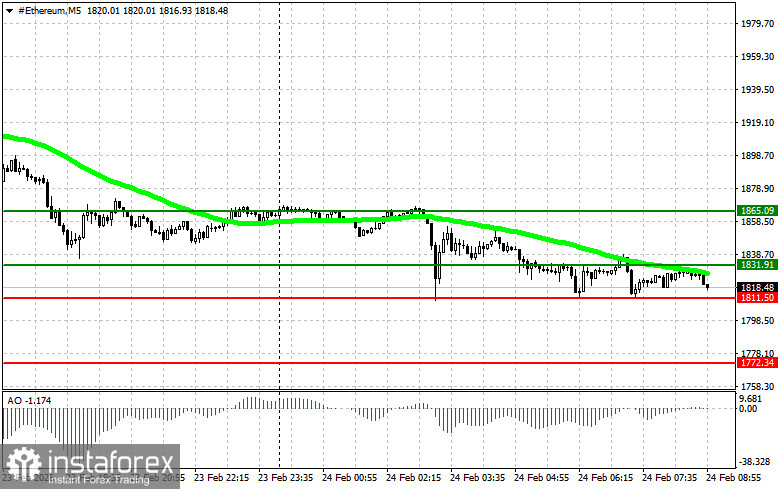
Buy Scenario
Scenario #1: I plan to buy Ethereum today when the price reaches an entry point around $1,831, targeting a move to $1,865. At $1,865, I intend to exit the purchases and immediately sell back on the pullback. Before buying on a breakout, make sure the 50-day moving average is below the current price and the Awesome Oscillator is above zero.
Scenario #2: I can buy Ethereum at the lower boundary of $1,811 if there is no market reaction to its breakout back towards $1,831 and $1,865.
Sell Scenario
Scenario #1: I plan to sell Ethereum today after reaching an entry point around $1,811, targeting a decline to $1,772. At $1,772, I intend to exit the sales and immediately buy back on the pullback. Before selling on a breakout, ensure the 50-day moving average is above the current price and the Awesome Oscillator is below zero.
Scenario #2: I can sell Ethereum at the upper boundary of $1,831 if there is no market reaction to its breakout back towards $1,811 and $1,772.