 English
 Русский
 Bahasa Indonesia
 Bahasa Malay
 ไทย
ไทย Español
 Deutsch
 Български
 Français
 Tiếng Việt
 中文
中文 বাংলা
বাংলা हिन्दी
 Čeština
 Українська
 Română


Trade analysis and trading advice for the European currency
The test of the 1.1545 price occurred when the MACD indicator had just begun moving downward from the zero mark, confirming a correct entry point for selling the euro. As a result, the pair declined by more than 20 points.
A sharp fivefold drop in industrial orders in Germany, recorded at 11%, triggered a fall in the European currency. Data from the leading economy of the eurozone raised concerns among investors about a possible slowdown in economic growth across the entire region. A combination of factors — including tighter international trade conditions and geopolitical instability — is creating an unfavorable environment for European manufacturers. The expected deterioration in external market conditions is intensifying these challenges, forcing companies to adjust their operations. The strong euro, which rose significantly last year, along with weak economic growth rates, casts doubt on the stability of Germany's industrial sector in the near future.
Today, with the absence of significant statistical data from the United States, the focus of global markets and analysts shifts to the Middle East. The escalation of tensions between the U.S.–Israel coalition and Iran is taking center stage, determining the further dynamics of financial assets. Market participants will closely monitor any signals revealing the parties' next intentions, assessing the potential risks associated with possible retaliatory strikes and their consequences for the global economy.
As for the intraday strategy, I will mainly rely on the implementation of Scenario No. 1 and Scenario No. 2.
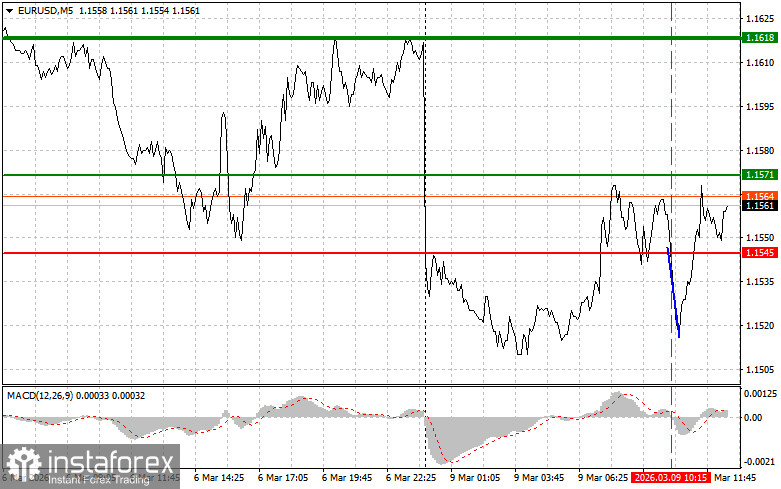
Buy Signal
Scenario No. 1: Today, euro purchases can be considered when the price reaches around 1.1571 (green line on the chart) with a target of 1.1618. At 1.1618, I plan to exit the market and also sell the euro in the opposite direction, expecting a 30–35 point move from the entry point. A strong rise in the euro today is unlikely.
Important: Before buying, make sure the MACD indicator is above the zero line and just beginning to move upward.
Scenario No. 2: I also plan to buy the euro today if there are two consecutive tests of the 1.1545 price while the MACD indicator is in the oversold zone. This will limit the pair's downward potential and lead to a market reversal upward. Growth toward the opposite levels of 1.1571 and 1.1618 can be expected.
Sell Signal
Scenario No. 1: I plan to sell the euro after the price reaches 1.1545 (red line on the chart). The target will be 1.1488, where I intend to exit the market and immediately buy in the opposite direction (expecting a 20–25 point move in the opposite direction). Pressure on the pair may return at any moment.
Important: Before selling, make sure the MACD indicator is below the zero line and just beginning to move downward.
Scenario No. 2: I also plan to sell the euro today if there are two consecutive tests of the 1.1571 price while the MACD indicator is in the overbought zone. This will limit the pair's upward potential and lead to a downward market reversal. A decline toward the opposite levels of 1.1545 and 1.1488 can be expected.
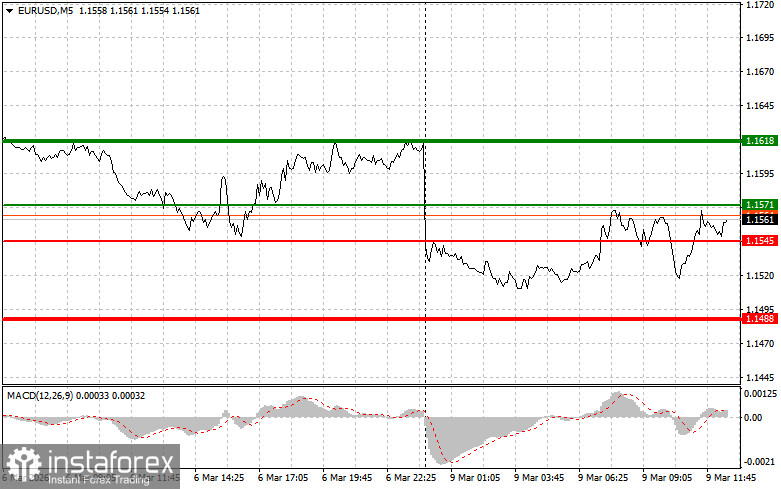
What is shown on the chart
- Thin green line – entry price where the trading instrument can be bought.
- Thick green line – the expected level where Take Profit orders can be placed or profits can be fixed manually, since further growth above this level is unlikely.
- Thin red line – entry price where the trading instrument can be sold.
- Thick red line – the expected level where Take Profit orders can be placed or profits can be fixed manually, since further decline below this level is unlikely.
- MACD indicator – when entering the market, it is important to consider overbought and oversold zones.
Important
Beginner Forex traders should be extremely cautious when making decisions about entering the market. Before the release of important fundamental reports, it is best to stay out of the market to avoid sharp price fluctuations. If you decide to trade during news releases, always place stop-loss orders to minimize losses. Without stop-loss orders, you can lose your entire deposit very quickly, especially if you do not use proper money management and trade with large volumes.
Remember that successful trading requires a clear trading plan, similar to the one presented above. Making spontaneous trading decisions based on the current market situation is an inherently losing strategy for an intraday trader.