 English
 Русский
 Bahasa Indonesia
 Bahasa Malay
 ไทย
ไทย Español
 Deutsch
 Български
 Français
 Tiếng Việt
 中文
中文 বাংলা
বাংলা हिन्दी
 Čeština
 Українська
 Română


The GBP/USD currency pair also traded lower on Thursday. It cannot be said that the downward trend has fully resumed, but the GBP/USD pair is still sliding. Given that the UK inflation report was published on Wednesday and there were no significant reports on Thursday, it is clear the market is focused only on the Middle East and ignoring all macroeconomic events, as it has before.
It is worth noting that the fundamentals and macroeconomics could have supported the pound this week and last. Recall that the Bank of England took a hawkish stance at its last meeting, while the Federal Reserve maintained a neutral position. The Bank of Canada is ready to raise rates, but the Fed is not. The inflation report released on Wednesday showed a slight acceleration in the core figure. Certainly, the market is awaiting March consumer price data and preparing for a significant acceleration in inflation and an even tighter stance from the British central bank. However, even a small increase in inflation in February could have triggered a rise in the British currency.
Regarding Thursday, there was no reason for the GBP/USD pair to fall if we did not take geopolitics into account. This leads us to conclude that the market continues to ignore all factors against the US dollar and reacts only to geopolitical factors that support it.
In general, there is little left to discuss except geopolitics. One could list statements from representatives of the Fed, the European Central Bank, and the Bank of England, which have begun commenting again after last week's meetings. But what is the point of this if the market does not respond to these statements? We recall that the US labor market remains in a coma, the American economy is slowing, and a recession could occur in 2026-2027. We could talk about the November elections this year, where Trump's party has a 99.9% chance of losing. But even this doesn't hold much meaning right now, as the market is only tracking geopolitics.
And there are no geopolitical news updates. There are only rumors, insiders (the truthfulness of which cannot be verified), and outright "fake news." And based on this completely unverified and sometimes blatantly false information, the market has to make trading decisions. In our opinion, traders are making the right decision by keeping the dollar close. If the US dollar is once again perceived by everyone as a safe-haven currency, then what is the point in selling it when American paratroopers and infantry are heading towards the shores of Iran? Regarding Trump's statements about negotiations and a truce, he mentioned yesterday at a press conference that Iran offered to make him the Supreme Leader. Trump, of course, declined but urged Tehran to finalize a deal as soon as possible. Essentially, this is all one needs to know about the seriousness of the statements from the White House leader. The US President remains true to form: he can say anything, but if he is later caught lying, he can always claim he was misunderstood.
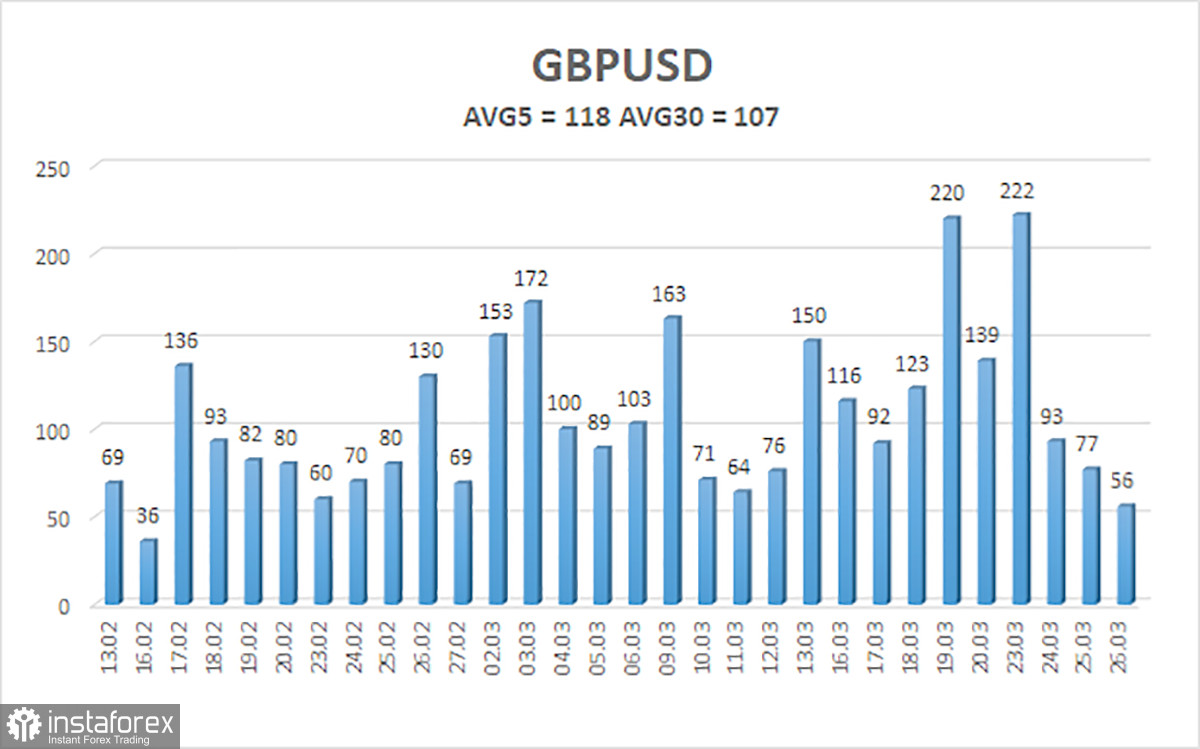
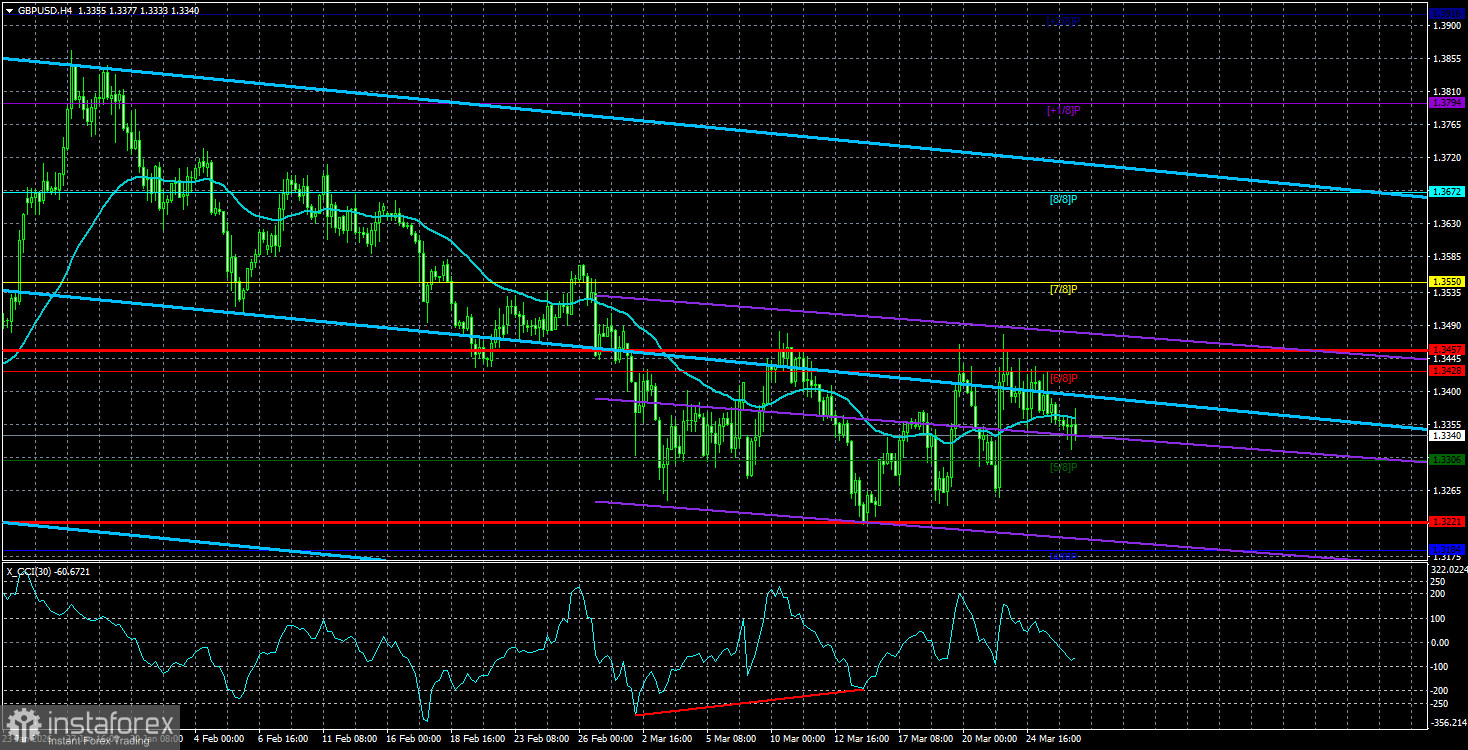
The average volatility of the GBP/USD pair over the last 5 trading days as of March 27 is 118 pips. This value is considered "high" for the pound/dollar pair. On Friday, March 27, we expect the pair to trade within a range bounded by 1.3221 and 1.3457. The upper linear regression channel has turned downward, which indicates a change in trend. The CCI indicator has entered the oversold area twice and has also formed a "bullish" divergence, which again warns of a potential end to the downward trend. However, geopolitics is currently more important than technical signals.
Nearest Support Levels:
S1 – 1.3306
S2 – 1.3184
S3 – 1.3062
Nearest Resistance Levels:
R1 – 1.3428
R2 – 1.3550
R3 – 1.3672
Trading Recommendations:
The GBP/USD currency pair continues to correct after a month and a half, but its long-term prospects have not changed. Trump's policies will continue to exert pressure on the US economy, so we do not expect the US currency to grow in 2026. Thus, long positions with a target of 1.3916 and above remain relevant when the price is above the moving average. When the price is below the moving average line, minor short positions can be considered, with targets at 1.3221 and 1.3184, based on geopolitical factors. In recent weeks, nearly all news and events have turned against the British pound, leading the downward trend to become protracted.
Explanations of the Illustrations:
Linear regression channels help determine the current trend. If both are pointing in the same direction, it means the trend is strong at the moment;
The moving average line (settings 20,0, smoothed) defines the short-term trend and the direction in which trading should currently be conducted;
Murray levels are target levels for movements and corrections;
Volatility levels (red lines) represent the likely price channel in which the pair will spend the next 24 hours based on current volatility metrics;
The CCI indicator—its entry into the oversold area (below -250) or into the overbought area (above +250) indicates that a trend reversal in the opposite direction is imminent.