 English
 Русский
 Bahasa Indonesia
 Bahasa Malay
 ไทย
ไทย Español
 Deutsch
 Български
 Français
 Tiếng Việt
 中文
中文 বাংলা
বাংলা हिन्दी
 Čeština
 Українська
 Română


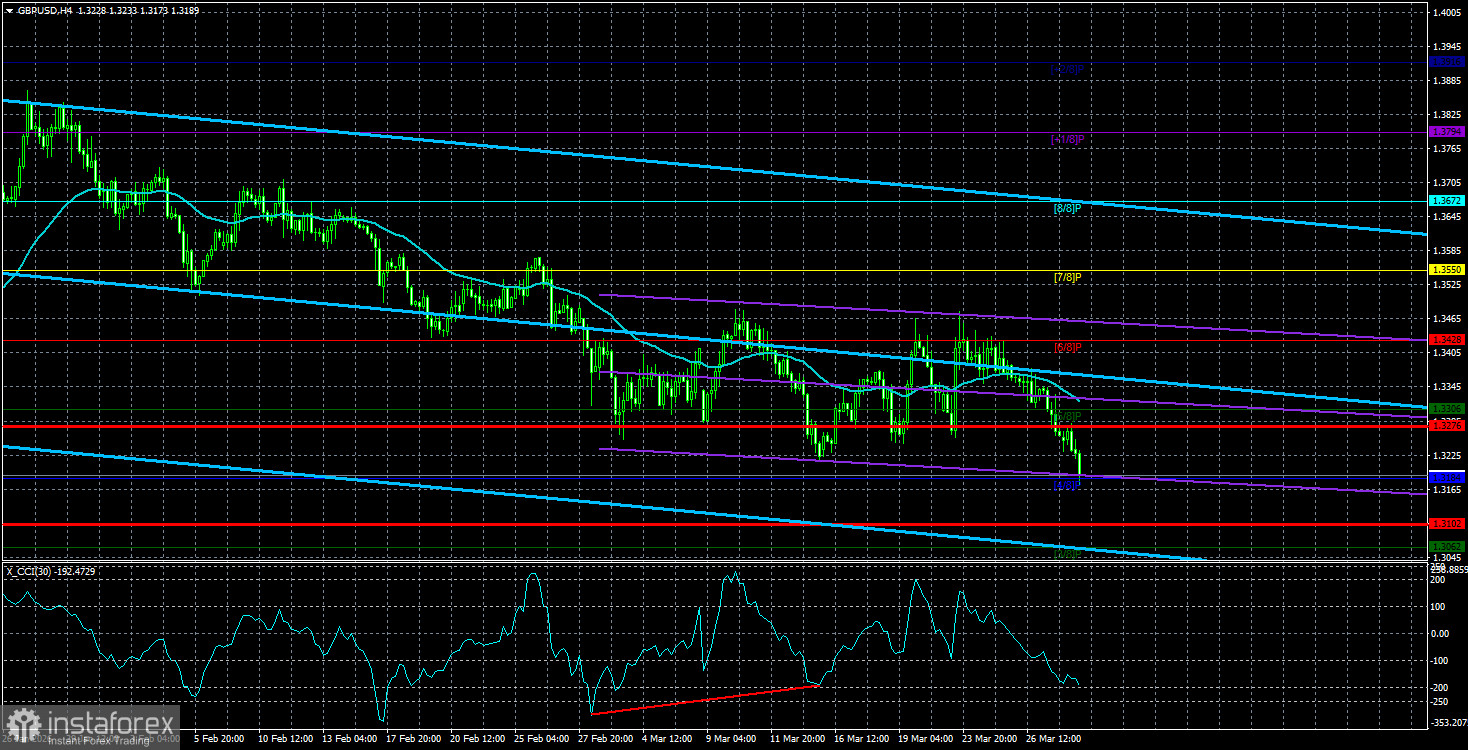
The GBP/USD currency pair also continued its sluggish decline on Monday, seemingly responding to Donald Trump's regular statements. Recall that since last Monday, Trump has been almost daily discussing a ceasefire and negotiations with "the right and smarter (than the previous regime) people." Meanwhile, Iran denies the existence of any negotiations, the US is deploying military forces in the Persian Gulf region, and Trump continues to issue threats against Iran. Thus, even if we only consider the statements of the American president, it is extremely difficult to understand what is happening: preparing for the opening of a new theater of military operations or negotiating a ceasefire?
In our opinion, Iran's position in this conflict is clear, understandable, logical, and well-reasoned. Iran did not start this war; even three-quarters of the population in America do not understand why this war was necessary, and Trump's plummeting political ratings perfectly answer the question of how Americans feel about the war initiated by the US in the Middle East. Tehran denies any negotiations with Washington (why deny them if they exist?) and demands reparations for the destroyed infrastructure (which is logical) and wants to establish a fee for passing through the Strait of Hormuz (similar to the Suez Canal). Everything is clear and transparent.
It is not surprising that the market trusts the statements of the Iranian authorities rather than Trump, who contradicts himself. Who Trump is negotiating with is a big secret. Do negotiations with Iran even exist? It remains a mystery. Why amass ground troops against Iran if negotiations for a ceasefire are underway? It's unclear. The apex of American absurdity was Trump's statement that America simply wants to seize Iranian oil. Yes, this is the 21st century, and this is not the speech of some American comedian or stand-up performer. Such statements are made by the president of the United States, who currently considers himself the best president in the country's history.
Essentially, there is practically nothing else to discuss in the context of the currency market right now. Everything boils down to geopolitics. We understand that some traders are already tired of reading countless articles and news about the US president's statements or events in the Middle East. But what is the point of discussing events and factors that have no impact on currency pair movements? We could highlight the weak US labor market, the Non-Farm Payrolls reports, and the unemployment rate expected this week. We could again draw attention to the divergence in monetary policy between the Fed and the ECB/Bank of England, which favors the euro and the pound. But what's the point? The US labor market continues to fail every month, yet the dollar keeps rising. The ECB and the Bank of England could raise key rates by as much as 2% immediately, but the dollar still climbs.
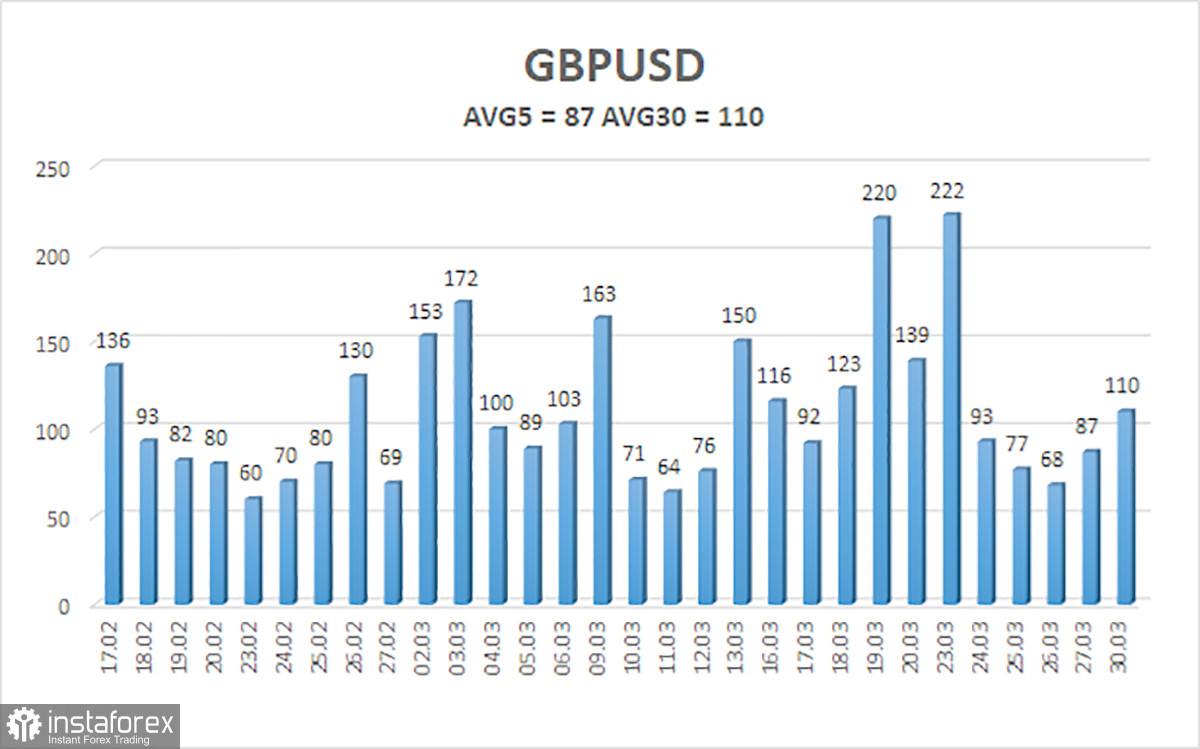
The average volatility of the GBP/USD pair over the past five trading days is 87 pips. For the pound/dollar pair, this value is considered "high." Thus, on Tuesday, March 31, we expect movement within a range bounded by 1.3102 and 1.3276. The upper channel of the linear regression has turned downwards, indicating a trend change. The CCI indicator has entered the oversold area twice and has formed a "bullish" divergence, which again warns of the end of the downward trend. But geopolitics is currently more significant than technical signals.
Nearby Support Levels:
- S1 – 1.3184
- S2 – 1.3062
- S3 – 1.2939
Nearby Resistance Levels:
- R1 – 1.3306
- R2 – 1.3428
- R3 – 1.3550
Trading Recommendations:
The GBP/USD currency pair has been moving down for a month and a half, but its long-term prospects have not changed. Trump's policies will continue to exert pressure on the US economy, so we do not expect growth from the US currency in 2026. Thus, long positions with a target of 1.3916 and above remain relevant if the price is above the moving average. If the price is below the moving average line, small short positions can be considered, with targets at 1.3102 and 1.3062, based on geopolitical factors. In recent weeks, almost all news and events have been negative for the British pound, keeping the downward trend intact.
Explanations for Illustrations:
- Linear regression channels help identify the current trend. If both are directed in the same way, then the trend is currently strong.
- The moving average line (settings 20,0, smoothed) determines the short-term trend and the direction in which trading should currently be conducted.
- Murray levels are target levels for movements and corrections.
- Volatility levels (red lines) represent the likely price channel in which the pair will spend the next day, based on current volatility readings.
- The CCI indicator entering the oversold area (below -250) or the overbought area (above +250) indicates a trend reversal approaching in the opposite direction.