 English
 Русский
 Bahasa Indonesia
 Bahasa Malay
 ไทย
ไทย Español
 Deutsch
 Български
 Français
 Tiếng Việt
 中文
中文 বাংলা
বাংলা हिन्दी
 Čeština
 Українська
 Română


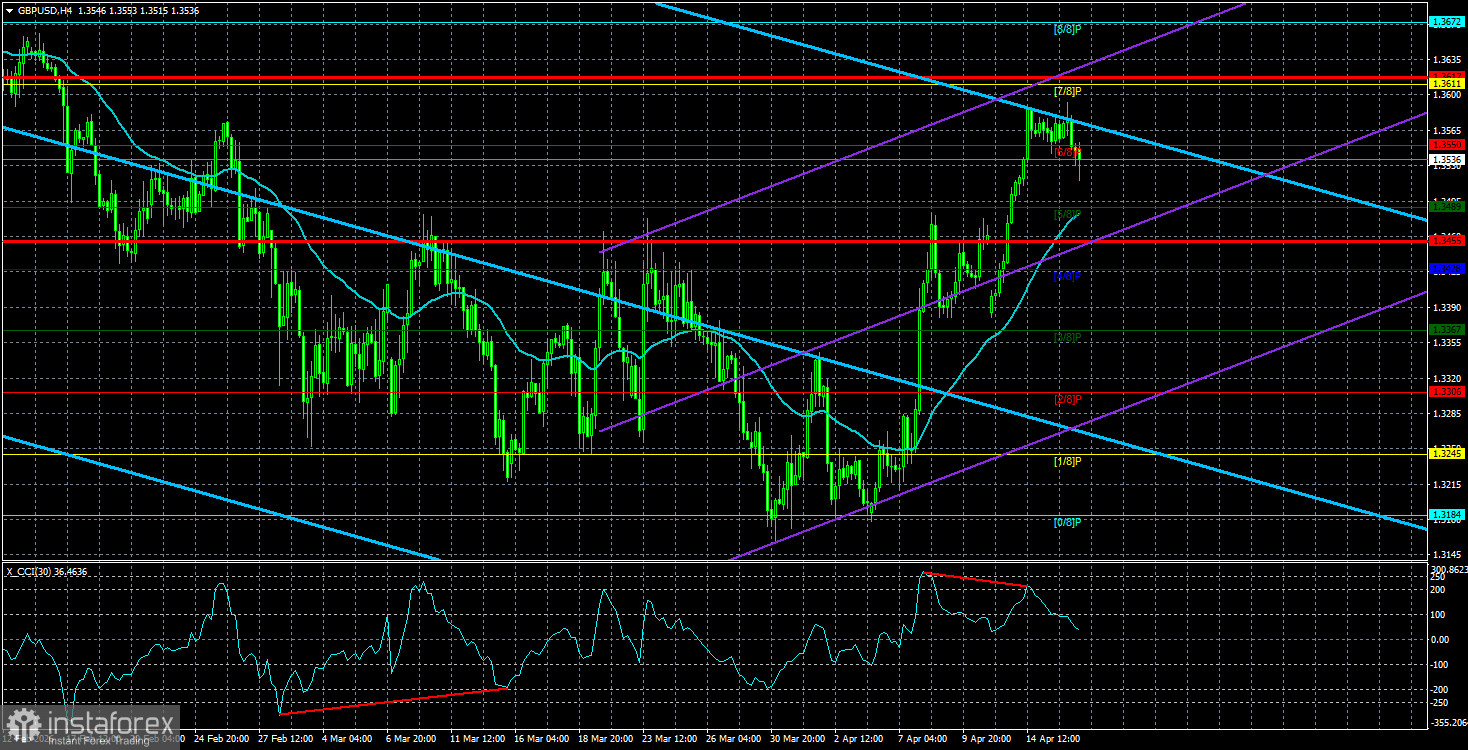
The GBP/USD currency pair was unable to extend its upward movement on Thursday, as there were no major news events that day. The market has fully priced in the war in the Middle East and all its most negative consequences; it has accounted for the de-escalation, ceasefire, and negotiations, and now there are no new updates. Therefore, the market has been moving with minimal volatility for two consecutive days.
Yesterday, reports on February's GDP and industrial production were published in the UK. As expected, traders ignored them, which we had warned about in advance. Macroeconomics remains secondary, and the market has ignored a significant number of reports over the past two months, including truly important ones. Thus, even if the macroeconomic factor returned to focus, there was little hope that the market would react to second-tier British reports from the outset. Both reports showed positive figures, but during the first half of the day, the British currency was in decline. Consequently, there was no reaction at all.
If the situation in the Middle East does not revert to a state of war, the market will gradually distance itself from geopolitical factors and shift its attention back to the most significant fundamental and macroeconomic events. For instance, this month, meetings for the Bank of England, the European Central Bank, and the Federal Reserve are scheduled. The market may finally realize that the likelihood of the Fed tightening monetary policy in 2026 is virtually zero, while the European and British central banks may raise key rates several times.
The market will remember that Donald Trump's trade policy remains unchanged, and there has been no news about new tariffs in recent months simply because the U.S. president has been occupied with the war in Iran. If the war ends, Trump will turn his attention to trade tariffs (especially since the current ones are set to expire in a month and a half), to the Fed (which still does not want to lower the key rate), to countries in Latin America (where order also needs to be established), and so on. Therefore, traders should not relax. As long as Trump remains the President of the United States, there will be no shortage of significant events.
Most of Trump's actions and decisions lead to only one result—the decline of the U.S. dollar. Moreover, the whole world can now see that Trump's "golden age" has yet to arrive, and the White House's contradictory, chaotic policies are causing other countries to increasingly refuse to cooperate with Washington in any area. Trump has yet to achieve the crucial result in the 14 months of his second presidential term. The economy is growing slowly, the labor market has been convulsing for over a year, inflation is rising again, and numerous protests against the President have occurred across America. Additionally, Trump needs a weak dollar to bring the U.S. trade balance closer to zero. Therefore, we continue to expect a long-term decline in the U.S. currency.
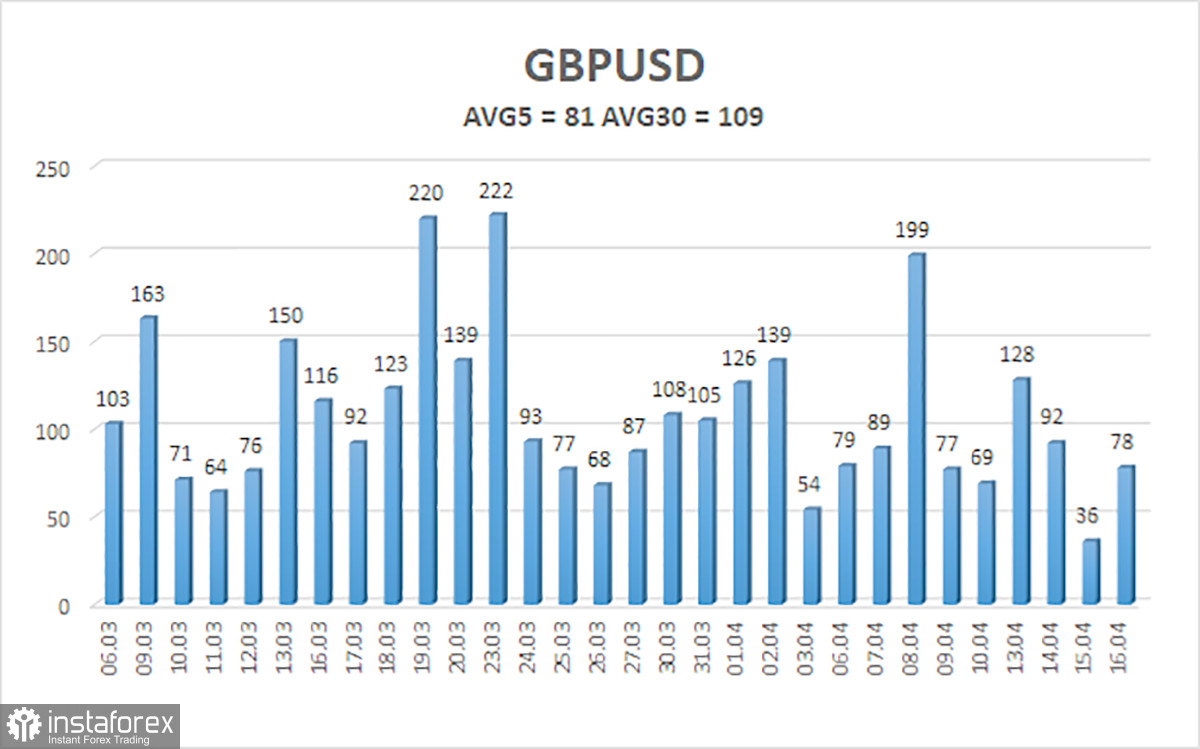
The average volatility of the GBP/USD pair over the last 5 trading days is 81 pips, which is considered "average." On Friday, April 17, we expect the pair to trade within a range bounded by 1.3455 and 1.3617. The upper channel of the linear regression has turned downward, indicating a trend change. The CCI indicator has entered the overbought zone and formed a "bearish" divergence, signaling a possible downward pullback.
Closest Support Levels:
S1 – 1.3489
S2 – 1.3428
S3 – 1.3367
Closest Resistance Levels:
R1 – 1.3550
R2 – 1.3611
R3 – 1.3672
Trading Recommendations:
The GBP/USD pair continues its recovery after two months dominated by geopolitical factors. Donald Trump's policies will continue to exert pressure on the U.S. economy, so we do not expect the dollar to rise in 2026. Therefore, long positions targeting 1.3916 and above remain relevant as long as the price is above the moving average. If the price is below the moving average line, short positions can be considered, with targets at 1.3428 and 1.3367, based on geopolitical factors. In recent months, almost all news and events have been negative for the British pound, leading to a prolonged downward trend. However, geopolitics no longer supports the dollar, and the pound feels freer now.
Explanations for Illustrations:
Regression channels help determine the current trend. If both are directed in the same way, it indicates a strong trend.
The moving average line (settings 20.0, smoothed) defines the short-term trend and direction in which trading should proceed.
Murray levels serve as target levels for movements and corrections.
Volatility levels (red lines) indicate the probable price channel in which the pair is likely to trade over the next day, based on current volatility readings.
The CCI indicator's entry into the oversold area (below -250) or the overbought area (above +250) indicates that a trend reversal in the opposite direction is approaching.