 English
 Русский
 Bahasa Indonesia
 Bahasa Malay
 ไทย
ไทย Español
 Deutsch
 Български
 Français
 Tiếng Việt
 中文
中文 বাংলা
বাংলা हिन्दी
 Čeština
 Українська
 Română



Only two days into the new week, a plethora of geopolitical events, news, and "insider" information have surfaced. The week began with an American destroyer attempting to breach the blockade of the Strait of Hormuz and being attacked by two Iranian missiles. Everything that has happened since then falls into the realm of speculation and conjecture. According to some reports, the next day (that is, on Tuesday), the US Navy attacked several Iranian boats. On Monday, news emerged of Iranian missile strikes on the United Arab Emirates. However, all this information remains unverified. On the one hand, no one is denying it; on the other hand, on Tuesday, there have been no new missile strikes from either side of the conflict. The reasons for this remain unknown. It could be that negotiations have resumed, or perhaps this is the calm before the storm.
Two scenarios are possible. On Monday, there was again "insider information" indicating that Israel and the US are preparing a new massive strike against Iran. It is possible that the current lull is preparation for a new attack on Tehran. At the same time, nearly every day brings news of negotiations and proposals from both sides aimed at resolving the conflict. The origins of this information are unclear, as the sources of the insights are not disclosed.
Nevertheless, the following versions of the current situation are emerging. Iran is reportedly ready to soften its demands in negotiations. Tehran is willing to abandon the requirement for the withdrawal of US troops from the region and is prepared to reduce uranium enrichment to a level sufficient for the operation of its nuclear power plants. At the same time, Iran insists that the "nuclear question" should be addressed last and not be a key point in the negotiations.
The American position is completely opposite—first, an agreement on the nuclear issue, then discussions on a complete ceasefire, security guarantees, lifting sanctions, and unblocking the Strait of Hormuz. As we can see, both sides continue to bombard each other (according to the insights) with various proposals, but Tehran's and Washington's positions remain very far apart.
Based on all of the above, I still believe that the likelihood of reaching a peace agreement in the near future is negligible. However, the market is not overly concerned about the potential resumption of active hostilities. Demand for US currency increased slightly on Monday, and by Tuesday, the market calmed as no new missile strikes or attacks occurred. Therefore, I consider that from their current positions, both instruments could begin to establish new upward waves. It's important to note that this week will see numerous important economic reports, the predictions for which are quite uncertain. Thus, while geopolitics may not provide support for sellers, the economy may.
Wave Picture for EUR/USD:
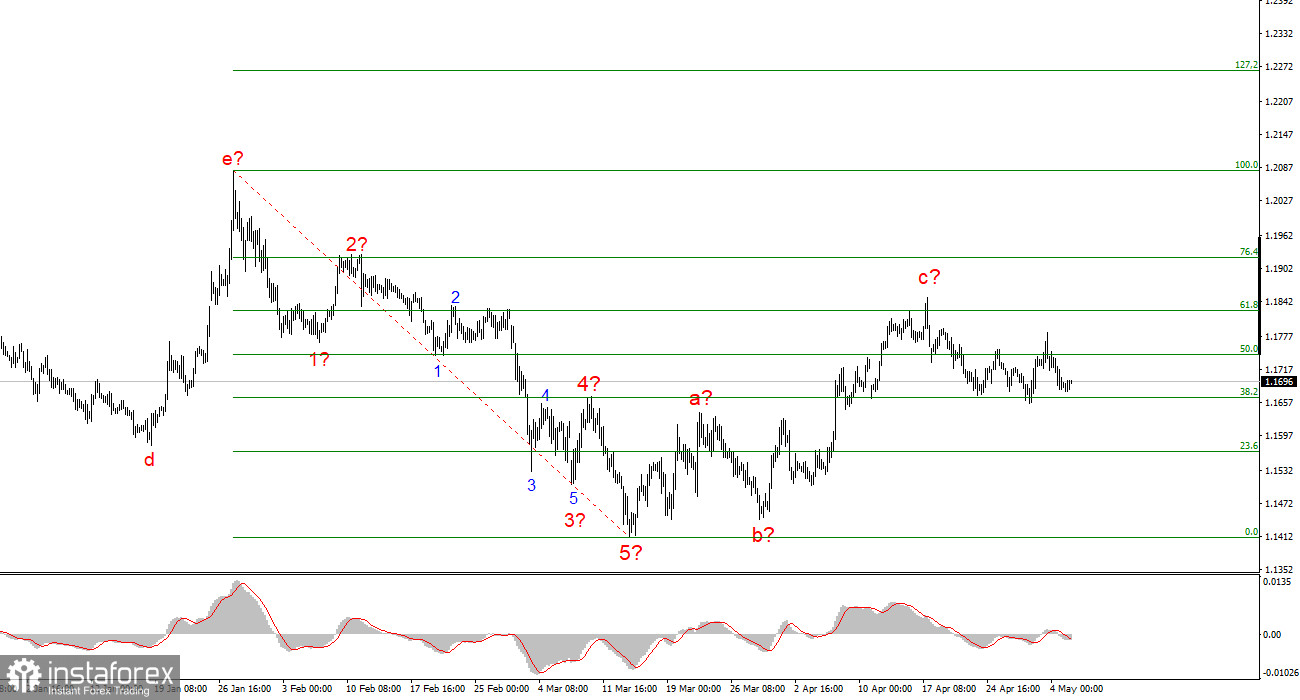
Based on the analysis of EUR/USD, I conclude that the instrument remains within an upward segment of the trend (as shown in the lower image) and, in the short term, is in a corrective structure. The corrective wave set appears quite complete and may only take on a more complex, elongated form if the geopolitical background in the Middle East does not worsen this week. Otherwise, a new downward segment of the trend may begin from the current positions. We have seen the corrective wave, and I expect further increases in the instrument from current levels, targeting around the 19 figure.
Wave Picture for GBP/USD:
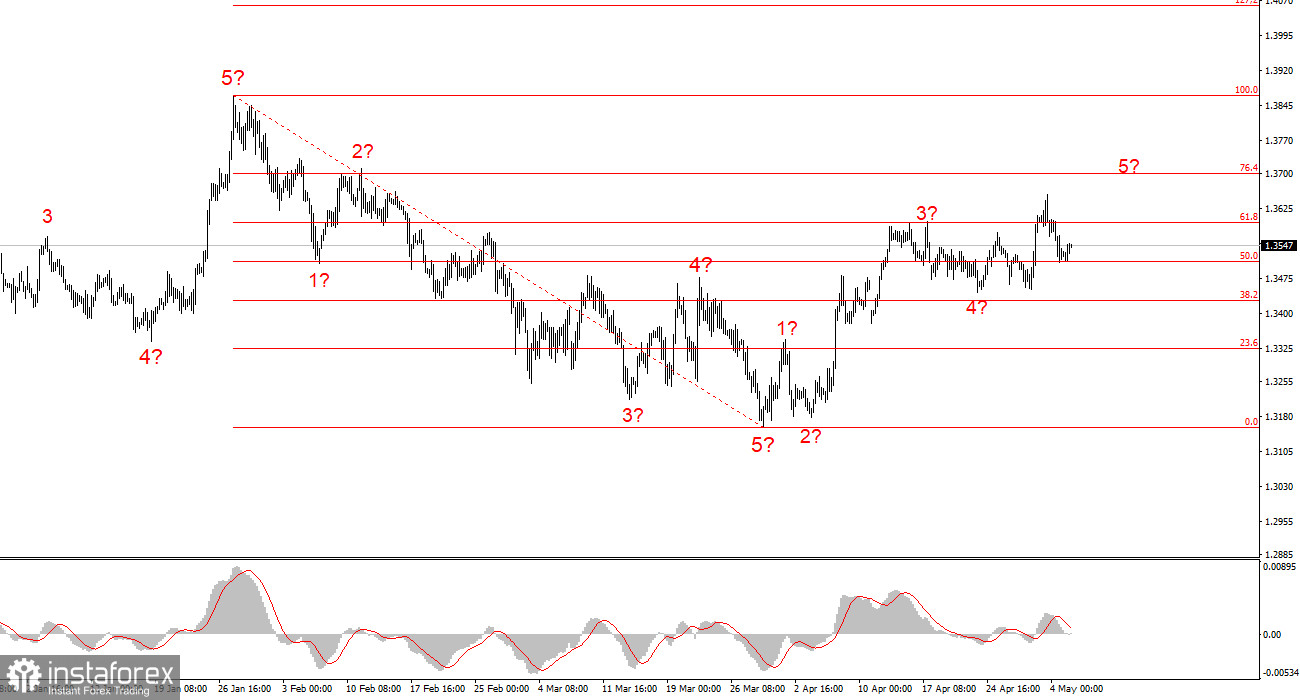
The wave pattern for the GBP/USD instrument has become clearer over time, as I anticipated. Now we see a clear five-wave upward structure on the charts that may be completed soon. If this is indeed the case, we can expect a corrective wave set to form. Therefore, the base scenario for the coming days is an increase in the area of the 37 figure. Everything else will depend on geopolitical factors.
Key Principles of My Analysis:
- Wave structures should be simple and clear. Complex structures are difficult to trade and are often subject to change.
- If there is no confidence in what is happening in the market, it is better not to enter.
- There is never 100% certainty in the direction of movement, nor can there ever be. Always remember to use protective stop-loss orders.
- Wave analysis can be combined with other types of analysis and trading strategies.