 English
 Русский
 Bahasa Indonesia
 Bahasa Malay
 ไทย
ไทย Español
 Deutsch
 Български
 Français
 Tiếng Việt
 中文
中文 বাংলা
বাংলা हिन्दी
 Čeština
 Українська
 Română


The Australian dollar, which had recently been performing well against its American counterpart, is rapidly losing ground, reflecting a growing awareness of the scale of the impending economic crisis.
In the Australian Treasury's budget documents, the baseline scenario projects inflation falling to 2.5% by 2027, after peaking at 5% in mid-2026. This is based on expectations of declining oil prices.
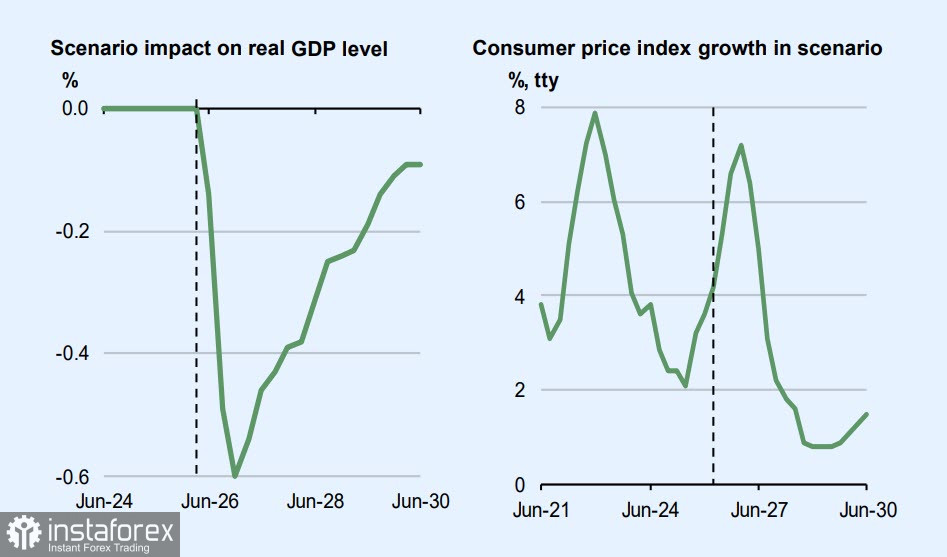
However, according to worst-case scenario modeling conducted by the Treasury, inflation could exceed 7% if a prolonged war in the Middle East pushes oil prices above $200 per barrel in the third quarter.
In turn, such an outcome would lead to a decrease in real GDP growth rates by 0.5% over the next two financial years and an official unemployment rate of 5% in 2027-2028, with GDP growth not reaching pre-war levels even by 2030.
The minutes from the May Reserve Bank of Australia meeting indicate that eight out of nine board members supported raising the interest rate to 4.35%. This was primarily due to rising inflation risks associated with the conflict in the Persian Gulf. Currently, markets are pricing in a 75% probability of another rate hike in August, with the potential for further increases to 4.85%.
The minutes express growing concern among board members about inflation remaining high for an extended period. The RBA acknowledges that rate increases may not significantly affect short-term inflation, as its primary cause lies outside the bank's control and is linked to rising oil prices driven by supply constraints.
The RBA's own forecast assumes that the Strait of Hormuz will reopen soon. It is unclear why the RBA is so optimistic, as there is still no clear solution to the issue despite ongoing diplomatic negotiations. Since the meeting, little time has passed, and the rhetoric from RBA representatives has changed. RBA Deputy Governor Sarah Hunter noted that the impact of rising oil prices would be felt more quickly and strongly on consumer prices in Australia than in previous periods. She also acknowledged the existence of a negative scenario in which households reduce consumption, and businesses cut back on investments more than expected.
The RBA's mandate is to combat inflation, while the government focuses on ensuring economic growth. Both key financial authorities in Australia find themselves in a challenging situation. The only hope is for a swift resolution to the conflict in the Middle East; otherwise, the consequences for the country may be catastrophic.
The net long position in the Australian dollar (AUD) increased by $0.5 billion to $6.1 billion over the reporting week, indicating strongly bullish speculative sentiment. At the same time, the currency's calculated price is accelerating its decline, moving further from the long-term average.
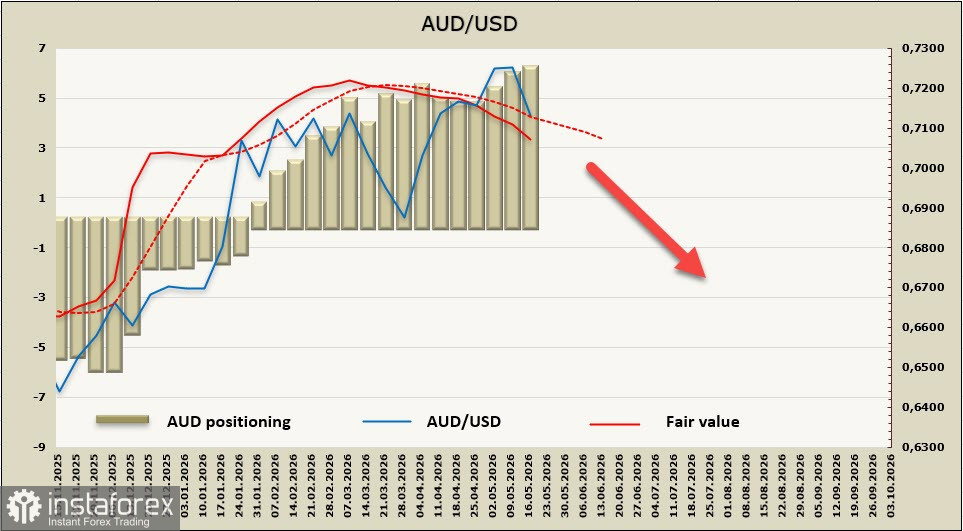
A week earlier, we suggested that aggressive RBA rate hikes have their limits in supporting the Australian dollar, and a reversal is imminent. The movement began last week, and as of now, AUD/USD has lost over 40% of its gains since early April, suggesting the decline has further room to run. The nearest support is at the technical level of 0.7058, while we expect longer-term movements to 0.6940/60.