 English
 Русский
 Bahasa Indonesia
 Bahasa Malay
 ไทย
ไทย Español
 Deutsch
 Български
 Français
 Tiếng Việt
 中文
中文 বাংলা
বাংলা हिन्दी
 Čeština
 Українська
 Română


On Tuesday, the Scottish Parliament supported a push for a fresh independence referendum from the United Kingdom, voting in favor of a motion that asks London to grant the devolved legislature the powers to hold such a vote. A majority of members voted for the relevant proposal—only 55 of 129 parliamentarians voted against it.
It should be noted at once that the Scottish Parliament did not authorize a referendum, but merely officially demanded that London transfer the relevant powers to it. Therefore, traders in the GBP/USD pair reacted only weakly to the news: the price updated a local low (1.3433), but then returned to the middle of the 1.34 region.
In other words, market participants received this sensational news calmly and without panic, given the protracted and highly ambiguous nature of the Scottish question. Nevertheless, in my view this is a sufficiently worrying signal that could become a real alarm bell if Edinburgh's initiative begins to find support "at the center."
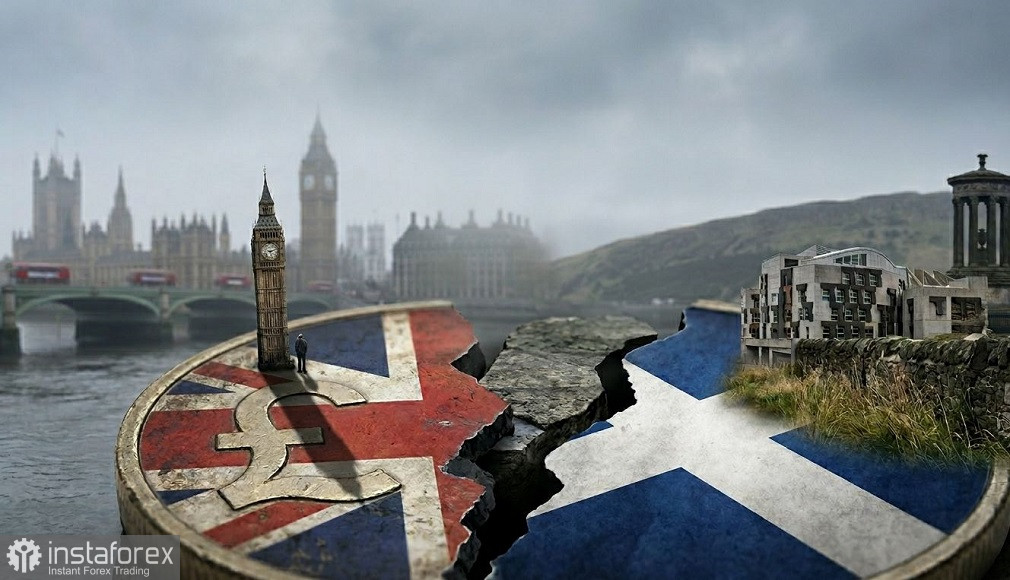
The motion approved by deputies calls for an order under section 30 of the Scotland Act 1998 that would grant the Scottish Parliament the authority to organize a referendum on independence.
I recall that in 2014 Scotland held a referendum in which residents of the region voted against leaving the United Kingdom. That vote took place two years before another historic plebiscite — the nationwide referendum in which the country narrowly voted to leave the EU. Unlike the rest of the kingdom, the Scots adopted a pro-European stance: more than 60 percent voted against Brexit. After that the mood in Scotland shifted noticeably in favor of independence; pollsters estimate that in a repeat referendum Edinburgh could, with high probability, vote to leave the United Kingdom and subsequently seek readmission to the European Union.
London, for its part, is actively seeking to prevent such an outcome by pointing to the 2014 result and arguing that the issue has already been put to the people and resolved against independence. In other words, British authorities proceed from the position that the will of the Scots has already been expressed.
Nevertheless, the Scottish National Party has long and consistently insisted on the need for a fresh referendum despite the center's hard line. These debates are not new. In 2021, First Minister Nicola Sturgeon actively promoted the topic, saying the region intended to return to the European Union "as an independent nation."
Five years on, talk of leaving the United Kingdom has returned with renewed force amid unexpected local election results in Britain and increased political activism in Scotland. And although formal consent from London still looks unlikely, the political debate over the issue has become an almost inevitable outcome.
The fact is that the results of the most recent local elections in the United Kingdom have strengthened political fragmentation, reflecting the weakening of the traditional two-party system. The principal winners of the elections were Nigel Farage's right-wing Reform UK and representatives of the Green Party. The right-wing party took control of ten councils, successfully drawing votes away from both the Conservatives and Labor, which had traditionally counted on the working class vote. Edinburgh's democratic mandate strengthened against the backdrop of a historic electoral collapse by Britain's mainstream parties in Scotland.
Against that background, London is forced to respond more actively to rising protest and regional sentiments. At the same time, the weakening of Labor's position reduces the effectiveness of the main political brake on independence initiatives, since Labor has traditionally been their most consistent opponent.
Thus, Westminster is likely to refuse the request, but it may seek to create a negotiation format or a commission to reduce political tension. Attempts by Scotland to take unilateral or consultative steps cannot be ruled out; these would increase institutional uncertainty — for example, through a "consultative" plebiscite. Possible additional options include legal appeals and even the formation of a "constitutional convention of Scotland" as an attempt to devise an independence model outside a formal referendum.
Such scenarios could exert pressure on the pound, particularly given the unstable position of Prime Minister Keir Starmer, who recently narrowly avoided losing his office after poor local election results.
Overall, it is fair to conclude that the Scottish National Party has intensified its rhetoric and moved to a more confrontational tactic. That implies the issue of Scottish independence will again appear regularly on front pages, prompting higher volatility in the GBP/USD pair. In the event of rising uncertainty and, even more so, political turbulence, the pound will once again face significant pressure.
From a technical standpoint, on the four-hour chart GBP/USD sits between the middle and lower lines of the Bollinger Bands and below the Tenkan-sen and Kijun-sen lines. At the same time the price is trading within the Ichimoku Kumo cloud. The nearest target for southbound movement is 1.3400 — the lower boundary of the Kumo cloud, which coincides with the lower Bollinger Band on the same timeframe.