 English
 Русский
 Bahasa Indonesia
 Bahasa Malay
 ไทย
ไทย Español
 Deutsch
 Български
 Français
 Tiếng Việt
 中文
中文 বাংলা
বাংলা हिन्दी
 Čeština
 Українська
 Română


Review of Trades and Trading Tips for the Euro
The test of the 1.1605 level occurred when the MACD indicator was just beginning to move lower from the zero line, confirming a valid entry point for selling the euro. However, the pair failed to stage a significant decline, resulting in a loss on the trade.
Despite eurozone retail sales falling by 0.4% in April compared with March, while rising by 1.0% year-on-year, the euro remained resilient. On a monthly basis, retail trade volume in the eurozone declined by 0.4% in April, while retail sales across the EU as a whole fell by 0.5%. However, compared with April 2025, the retail sales index increased by 1.0% in the eurozone and by 0.9% across the EU. The modest monthly decline points to a moderate slowdown in consumer demand, although a year-on-year contraction was avoided. This is consistent with the broader picture of a weak eurozone economy at the beginning of 2026: GDP growth in the first quarter amounted to just 0.1%, while inflation accelerated to 3.0% year-on-year amid rising energy prices driven by the conflict in the Middle East.
In the second half of the day, traders are expected to focus on the release of key U.S. macroeconomic reports. Particular attention will be paid to the latest weekly initial jobless claims data. Any deviation from forecasts, whether positive or negative, will be closely scrutinized by market participants.
In addition, FOMC member Mary Daly is scheduled to speak. Statements by Federal Reserve officials are traditionally examined for clues regarding future policy actions, whether related to changes in the benchmark interest rate or other measures aimed at easing or tightening monetary conditions.
As for the intraday strategy, I will primarily rely on the implementation of Scenarios No. 1 and No. 2.
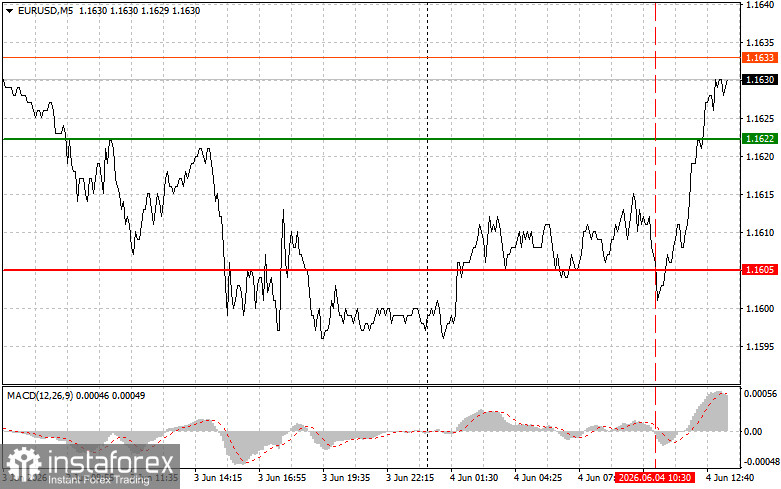
Buy Signal
Scenario No. 1: Today, I plan to buy the euro if the price reaches the 1.1640 level (green line on the chart), targeting a rise to 1.1674. At 1.1674, I plan to exit long positions and immediately sell the euro in the opposite direction, aiming for a 30–35 point correction from the entry point. Further gains in the euro today can be expected only if U.S. data comes in weaker than forecast. Important! Before buying, make sure that the MACD indicator is above the zero line and is just beginning to move higher.
Scenario No. 2: I also plan to buy the euro today if there are two consecutive tests of the 1.1620 level while the MACD indicator is in oversold territory. This will limit the pair's downward potential and trigger a reversal to the upside. In this case, a move toward the opposite levels of 1.1640 and 1.1674 can be expected.
Sell Signal
Scenario No. 1: I plan to sell the euro after the price reaches the 1.1620 level (red line on the chart). The target will be 1.1585, where I intend to exit short positions and immediately buy in the opposite direction, expecting a 20–25 point rebound from the level. Pressure on the pair is likely to return today if U.S. data comes in strong. Important! Before selling, make sure that the MACD indicator is below the zero line and is just beginning to move lower.
Scenario No. 2: I also plan to sell the euro today if there are two consecutive tests of the 1.1640 level while the MACD indicator is in overbought territory. This will limit the pair's upward potential and trigger a reversal to the downside. In this case, a decline toward the opposite levels of 1.1620 and 1.1585 can be expected.
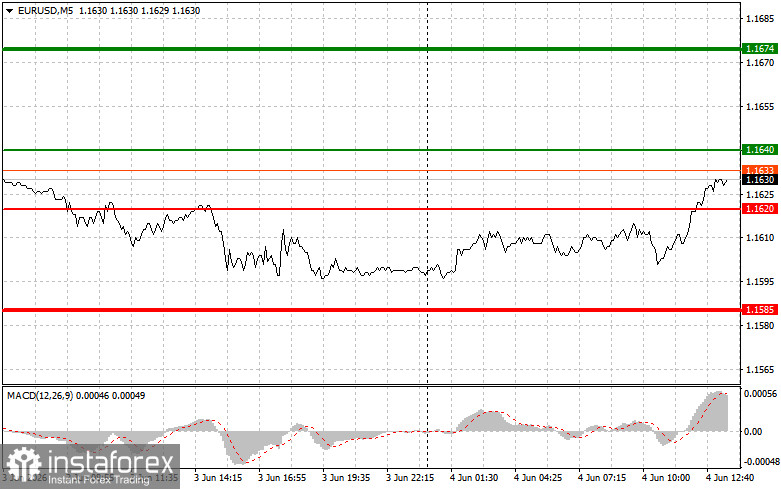
Chart Explanation:
- Thin green line – the entry price at which the trading instrument can be bought;
- Thick green line – the estimated level where Take Profit orders can be placed or profits can be locked in manually, as further growth above this level is unlikely;
- Thin red line – the entry price at which the trading instrument can be sold;
- Thick red line – the estimated level where Take Profit orders can be placed or profits can be locked in manually, as further decline below this level is unlikely;
- MACD indicator – when entering the market, it is important to use overbought and oversold zones as guidance.
Important. Beginner Forex traders should exercise extreme caution when making market-entry decisions. It is best to stay out of the market ahead of major fundamental reports in order to avoid sharp price fluctuations. If you decide to trade during news releases, always place stop-loss orders to minimize potential losses. Without stop-loss orders, you can lose your entire deposit very quickly, especially if you do not apply proper money management and trade large volumes.
Remember that successful trading requires a clear trading plan, such as the one outlined above. Making spontaneous trading decisions based solely on the current market situation is inherently a losing strategy for an intraday trader.