 English
 Русский
 Bahasa Indonesia
 Bahasa Malay
 ไทย
ไทย Español
 Deutsch
 Български
 Français
 Tiếng Việt
 中文
中文 বাংলা
বাংলা हिन्दी
 Čeština
 Українська
 Română


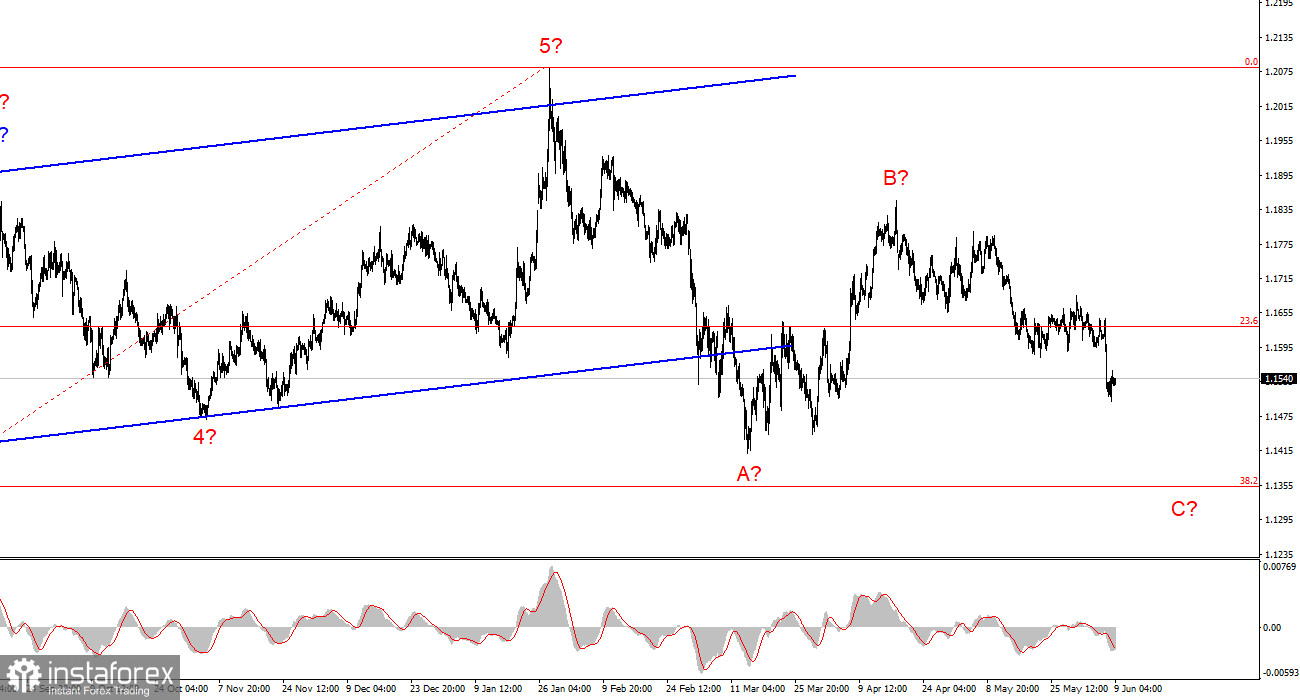
The wave pattern on the 4-hour chart for EUR/USD has undergone some adjustments. There is still no reason to dismiss the upward trend segment (shown in the lower chart), which began in January of last year. However, the current trend structure has now taken on a corrective form. In the longer term, wave C may develop, with its low expected to form below the low of wave A. At present, it is difficult to believe in such a significant decline of the euro, but the first quarter of 2026 demonstrated that geopolitical developments can dramatically alter market trends.
On the lower timeframe, a classic five-wave bearish structure can be identified. Following the completion of this structure, the pair may transition to a new upward wave sequence, and at this stage the pattern appears complete. Therefore, a rebound from the 1.1513 level, which corresponds to the 76.4% Fibonacci retracement level, may support further appreciation of the euro. However, without support from geopolitical developments and the ECB, any upward movement in the euro is likely to remain limited.
The EUR/USD pair changed little during Monday's trading session, while volatility remained subdued. News flow was limited, and market participants found little of interest. Today's session may also remain relatively quiet, as traders appear to be conserving their resources ahead of Wednesday and Thursday.
It should be noted that the U.S. inflation report for May will be released tomorrow, while Thursday will bring the ECB policy meeting and remarks from Christine Lagarde. What can be expected from these events?
The outlook for U.S. inflation is relatively straightforward. The higher the inflation reading, the stronger the market's expectations for tighter Federal Reserve monetary policy. However, the market already assumes that the FOMC may raise interest rates this year. Therefore, this factor appears to be largely priced in. As a result, even a strong inflation reading is unlikely to trigger a substantial rise in the U.S. dollar.
If inflation declines, given the Federal Reserve's reluctance to raise rates, the dollar could begin to lose support. In my view, the Consumer Price Index report is unlikely to provide significant support for sellers this week.
The ECB meeting, by contrast, is currently being largely ignored by the market. Market participants are focused on a potential Federal Reserve rate increase but are paying less attention to the ECB rate hike expected on Thursday. Consequently, the factor of monetary policy tightening in the Eurozone may not yet be fully reflected in market pricing.
If this assessment is correct, the euro could begin forming a new upward trend segment toward the end of the week. Initially, this move would be considered corrective. However, with support from geopolitical developments, it could evolve into an impulsive advance. In my view, the current balance between risk and potential reward remains favorable for opening long positions. Nevertheless, traders should continue to monitor developments closely, as a breakdown in negotiations between Iran and the United States could trigger renewed strength in the U.S. dollar.
General Conclusions
Based on the EUR/USD analysis, I conclude that the instrument remains within the broader upward trend segment (shown in the lower chart), while in the shorter term it remains within a downward trend segment that may already be complete.
In my opinion, the current environment presents a reasonable opportunity to consider long positions. The unsuccessful attempt to break below 1.1513, which corresponds to the 76.4% Fibonacci retracement level, together with the completed appearance of the downward trend structure, suggests that the pair may transition to a new upward wave sequence with targets near the 1.1700 level and above.
On the higher timeframe, an upward trend segment remains visible, followed by the development of a corrective wave structure. In the near term, wave C is expected to form with targets near 1.1352, which corresponds to the 38.2% Fibonacci retracement level. Once the A-B-C corrective structure is completed, a new long-term upward trend may begin.
Key Principles of My Analysis
- Wave structures should be simple and clearly identifiable. Complex structures are difficult to trade and are frequently subject to revision.
- If there is no confidence in the market situation, it is better to stay out of the market.
- Absolute certainty regarding market direction does not exist. Always use protective Stop Loss orders.
- Wave analysis can be combined with other forms of analysis and trading strategies.