 English
 Русский
 Bahasa Indonesia
 Bahasa Malay
 ไทย
ไทย Español
 Deutsch
 Български
 Français
 Tiếng Việt
 中文
中文 বাংলা
বাংলা हिन्दी
 Čeština
 Українська
 Română


Yesterday, US equity indices finished sharply lower. The S&P 500 fell by 1.87% and the Nasdaq 100 dropped by 1.62%. The Dow Jones Industrial Average lost 1.98%.
Today, markets are already bouncing after two heavy sessions. S&P 500 futures are up about 0.7%, recovering from a five-week low, while Nasdaq 100 futures are +1.1%. European bourses opened roughly 0.5% higher, led by energy names. The catalyst was the end of US strikes on Iran: US Central Command said the defensive strikes were halted roughly four hours after they began. Brent eased about 2.6% to below $93/bbl.
That said, this cannot yet be called a definitive reversal. In an interview, Trump warned the US will strike Iran again if Tehran does not sign a temporary peace deal. This is the second round of strikes in two days — the first followed the downing of a US helicopter; the second reinforced the signal.
It is clear that Trump's rhetoric alone has not previously produced results with Iran, so the market is rightly cautious about words turning into durable outcomes. The futures buying suggests traders are hoping that a quick end to the strikes means both sides will return to the negotiating table — but that remains a hope, not a fact.
A separate market story today is the SpaceX IPO. The offering was oversubscribed by more than four times the available float. For markets, this is a mixed signal: on one hand, it proves investor appetite for AI/tech stories remains extremely strong; on the other, a record-sized IPO — at a rich valuation — forces investors to reallocate capital: selling other positions, reducing leverage and freeing liquidity. That concentrated capital shift is exerting short-term pressure across risk assets.
Also on the calendar today is the ECB meeting — the first rate increase since 2023 is widely regarded as likely. The key event will be Christine Lagarde's comments on the policy path and how the bank views the inflation outlook against the backdrop of the ongoing Middle East conflict.
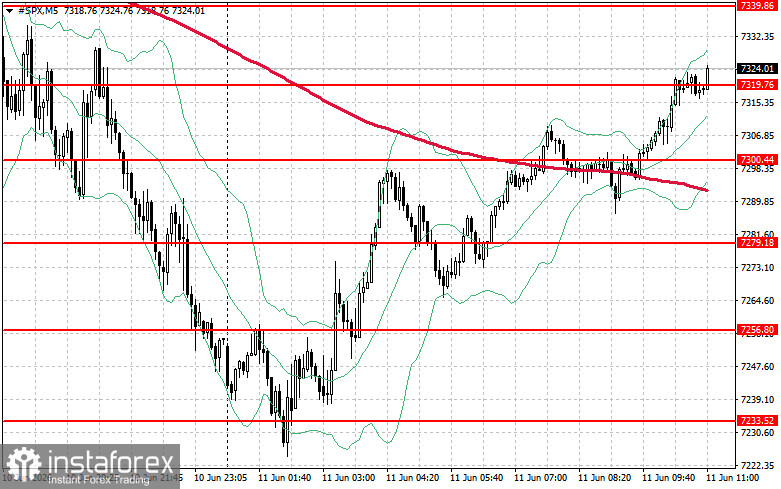
Technically, the S&P 500 analysis suggests that the immediate task for buyers is to overcome the resistance level of $7,339. Doing so would confirm further upside and open the path to $7,355. Maintaining control above $7,381 would further strengthen buyers' positions. On the downside, buyers need to defend the $7,300 area. A break below that level would likely push the index back to $7,279 and open the way to $7,256.