 English
 Русский
 Bahasa Indonesia
 Bahasa Malay
 ไทย
ไทย Español
 Deutsch
 Български
 Français
 Tiếng Việt
 中文
中文 বাংলা
বাংলা हिन्दी
 Čeština
 Українська
 Română


Review of Trades and Trading Tips for the Euro
The test of the 1.1598 level occurred when the MACD indicator had already moved significantly below the zero line, which limited the pair's downward potential. For this reason, I did not sell the euro.
Weak eurozone data, particularly the trade balance deficit and stagnant industrial production, are putting the ECB in a difficult position and weighing on the euro in the short term. On the one hand, inflation remains a concern, with ECB President Christine Lagarde acknowledging the presence of second-round effects. This supports the case for further interest rate hikes to cool demand and stabilize prices. On the other hand, persistent weakness in the real economy could be exacerbated by tighter monetary policy. Higher interest rates increase borrowing costs for businesses, potentially leading to lower investment and slower economic growth. This creates a risk of recession, which the ECB will likely seek to avoid.
During the second half of the day, several important macroeconomic releases are expected that could significantly affect market sentiment and, consequently, currency market dynamics. The first key release will be the Empire State Manufacturing Index. Calculated by the Federal Reserve Bank of New York, this indicator measures business activity in New York State's manufacturing sector, but its movements often provide insight into broader trends in U.S. industry. The index's performance, particularly deviations from forecasts or previous readings, will help determine whether the manufacturing sector is maintaining growth momentum or beginning to slow.
The market will then closely monitor U.S. industrial production data. An acceleration or slowdown in industrial output growth will serve as an indicator of the overall strength or weakness of the economy. Finally, particular attention will be paid to manufacturing output data. Signals of growth or contraction in this sector may directly affect expectations regarding corporate earnings and the overall health of the U.S. economy.
As for the intraday strategy, I will primarily rely on the implementation of Scenarios No. 1 and No. 2.
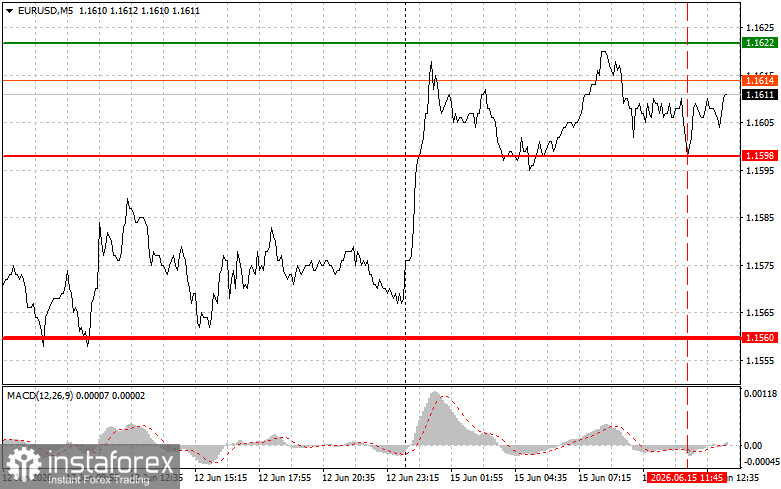
Buy Signal
Scenario No. 1: Today, buying the euro can be considered once the price reaches 1.1622 (the green line on the chart), with a target at 1.1663. At 1.1663, I plan to exit long positions and open short positions in the opposite direction, targeting a 30–35 point move from the entry point. Further gains in the euro are likely only if U.S. data come in weaker than expected.
Important: Before buying, make sure the MACD indicator is above the zero line and is just beginning to move higher from it.
Scenario No. 2: I also plan to buy the euro if the price tests 1.1598 twice consecutively while the MACD indicator is in oversold territory. This would limit the pair's downward potential and trigger a bullish market reversal. In this case, a move toward the opposite levels of 1.1622 and 1.1663 can be expected.
Sell Signal
Scenario No. 1: I plan to sell the euro after the price reaches 1.1598 (the red line on the chart). The target will be 1.1560, where I intend to exit short positions and immediately open long positions in the opposite direction, targeting a 20–25 point rebound. Pressure on the pair is likely to return today if U.S. economic data prove strong.
Important: Before selling, make sure the MACD indicator is below the zero line and is just beginning to move lower from it.
Scenario No. 2: I also plan to sell the euro if the price tests 1.1622 twice consecutively while the MACD indicator is in overbought territory. This would limit the pair's upward potential and trigger a bearish market reversal. In this case, a decline toward the opposite levels of 1.1598 and 1.1560 can be expected.
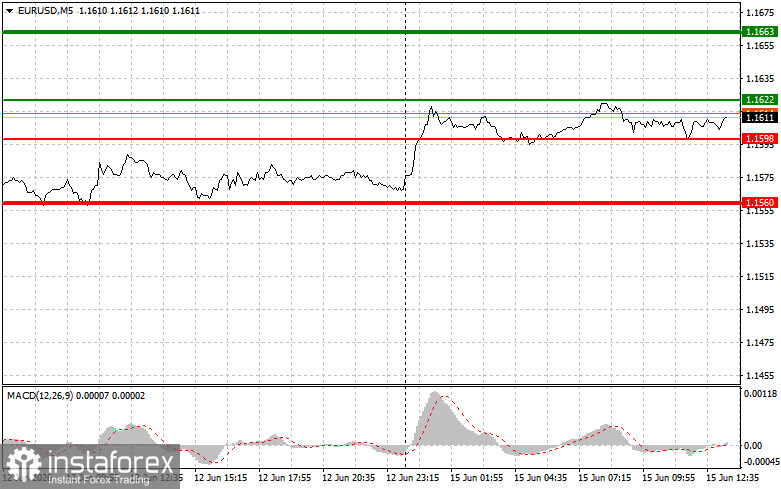
Chart Notes:
- Thin green line – entry price at which the trading instrument can be bought;
- Thick green line – estimated Take Profit level or an area where profits may be manually secured, as further growth above this level is considered unlikely;
- Thin red line – entry price at which the trading instrument can be sold;
- Thick red line – estimated Take Profit level or an area where profits may be manually secured, as further decline below this level is considered unlikely;
- MACD indicator – when entering the market, it is important to take overbought and oversold zones into account.
Important: Beginner Forex traders should exercise extreme caution when making market entry decisions. It is often best to stay out of the market ahead of major fundamental releases to avoid sharp price fluctuations. If you decide to trade during news releases, always place stop-loss orders to minimize potential losses. Without stop-loss protection, you can lose your entire deposit very quickly, especially if you do not use proper money management and trade large position sizes.
Remember that successful trading requires a clear trading plan, such as the one outlined above. Spontaneous trading decisions based solely on current market conditions are generally a losing strategy for intraday traders.