 English
 Русский
 Bahasa Indonesia
 Bahasa Malay
 ไทย
ไทย Español
 Deutsch
 Български
 Français
 Tiếng Việt
 中文
中文 বাংলা
বাংলা हिन्दी
 Čeština
 Українська
 Română


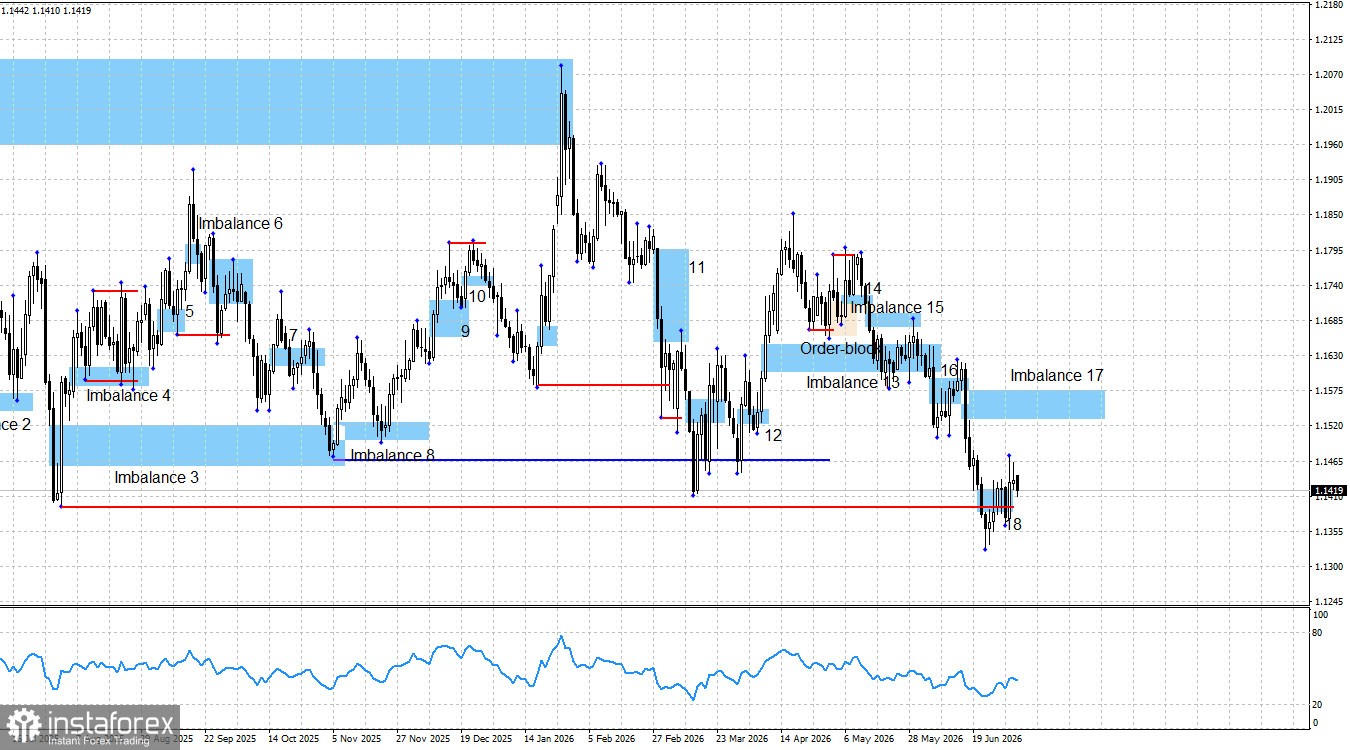
The EUR/USD pair remains within a local bearish impulse, but the bulls have gained some opportunities over the past week. An international economic forum was held in Portugal this week, where Kevin Warsh reiterated the need to bring inflation lower. At the same time, however, he did not clarify whether the Federal Reserve intends to achieve this through tighter monetary policy or expects inflation to ease naturally as energy prices decline. Since the market received no clear answer, inflation data will remain the primary guide. However, the latest US labor market figures suggest that inflation is not the only factor worth monitoring. Job creation has continued to slow from month to month. Over the past three months, employment growth has fallen short of traders' expectations by a total of 100,000 jobs. As a result, the cooling labor market may force the FOMC to weigh any further monetary tightening much more carefully. The next inflation report should help answer the key question: is further policy tightening—which many traders are currently anticipating—still justified?
Over the past week and a half, the euro has managed to post modest gains. This bullish advance was enough to invalidate Imbalance 18, allowing traders to shift their focus toward Imbalance 17. As long as Imbalance 17 remains valid, the bearish impulse remains intact. Even so, a new bullish impulse would be the preferred scenario. Regardless, the bulls have been given an opportunity. Whether they can capitalize on it remains to be seen.
Geopolitical factors have taken a back seat in recent weeks as the market has focused on the Federal Reserve, but they could return to the forefront. Tehran and Washington signed a memorandum of understanding, extended the ceasefire by 60 days, and began working toward the full reopening of the Strait of Hormuz and a comprehensive nuclear agreement. The market did not see the expected dollar decline following the easing of geopolitical tensions, nor did it see the euro strengthen despite the ECB's monetary tightening. Quite the opposite. The bears continued to dominate despite the supportive news flow and geopolitical backdrop. Now, geopolitical developments are once again disappointing, so renewed bearish pressure would not be surprising. Nevertheless, the bulls' position does not appear weak enough to justify another retreat.
The current chart structure continues to indicate that the bearish impulse, which began on April 17, remains in place. Bearish Imbalance 17 has not yet been filled, while Imbalance 18 has been invalidated following weak US labor market data. No bullish patterns have formed, and none are likely to appear in the coming days. Therefore, the bulls may continue the corrective advance toward Imbalance 17, but there is currently no attractive technical setup for trading that move. It is also worth noting that liquidity was swept last week below the August 1 low from last year (red line on the chart).
Monday's economic calendar was weak in every sense. Eurozone retail sales once again came in below expectations, while producer prices exceeded forecasts. As a result, the euro remained under pressure, although selling was relatively limited. Around the same time, the US ISM Services PMI is scheduled for release, meaning stronger market moves are still possible later in the day.
The bulls still have plenty of reasons to remain active in 2026, and even the conflict in the Middle East has not diminished them. Structurally and fundamentally, President Trump's policies—which led to a significant decline in the US dollar last year—have not changed. At present, there are still no compelling long-term support factors for the US dollar despite the FOMC's hawkish stance. EUR/USD has approached a series of significant lows and swing points where liquidity could be swept, potentially providing a signal for a reversal of the current bearish impulse.
Economic calendar for the United States and the Eurozone:
Germany
- Industrial Production (06:00 UTC)
United States
- ADP Employment Change (12:15 UTC)
The economic calendar for July 7 contains only two events, neither of which is considered highly important. Therefore, the impact of the economic backdrop on market sentiment on Tuesday is expected to be minimal or absent.
EUR/USD forecast and trading outlook
In my view, the pair remains in the process of forming a bullish trend. The fundamental backdrop shifted sharply in favor of the bears four months ago, but the broader trend cannot yet be considered canceled or complete. Therefore, the bulls may launch a new advance after liquidity is swept below the clearly defined lows. However, opening long positions at this stage is not advisable. Bullish chart patterns should form first.
At present, traders are monitoring two bearish imbalances, one of which has already been invalidated. At the same time, attention should be paid to the proximity of four significant swing points where liquidity could be swept, as well as to the questionable fundamental backdrop supporting the US dollar's appreciation. Therefore, a bullish advance is expected, but this scenario requires at least some technical confirmation. Alternatively, traders can wait for a fresh sell signal within Imbalance 17.