 English
 Русский
 Bahasa Indonesia
 Bahasa Malay
 ไทย
ไทย Español
 Deutsch
 Български
 Français
 Tiếng Việt
 中文
中文 বাংলা
বাংলা हिन्दी
 Čeština
 Українська
 Română


Trade Review and Trading Recommendations for the Japanese Yen
The test of the 162.44 level occurred when the MACD indicator had already moved significantly above the zero line, limiting the pair's upward potential. For this reason, I did not buy the U.S. dollar.
The U.S. dollar strengthened again today, while the Japanese yen weakened after Donald Trump effectively declared the ceasefire with Iran to be over. The U.S. president expressed frustration over yesterday's attack on oil tankers and stated that the ceasefire agreement was no longer valid and had effectively collapsed. In this situation, the Japanese yen found itself caught between opposing forces. As a traditional safe-haven currency, it could have benefited from rising geopolitical uncertainty. However, the stronger U.S. dollar pushed USD/JPY higher, while the prospect of rising oil prices weighed on Japan, which is heavily dependent on imported energy.
The key event of the second half of the day will be the release of the minutes from the Federal Reserve's June meeting. It is worth recalling that at that meeting—the first chaired by Kevin Warsh—the Federal Reserve kept the benchmark interest rate unchanged within the 3.50%–3.75% range but delivered a noticeably more hawkish message, while the updated projections suggested that a rate hike before the end of the year had become a possibility. The Japanese yen tends to react to such developments through changes in yield differentials. A hawkish set of meeting minutes could push USD/JPY higher by supporting U.S. Treasury yields, while a more dovish tone could send the pair lower. Traders should also keep the risk of foreign exchange intervention by the Bank of Japan in mind, as an excessively rapid rise in USD/JPY driven by hawkish Fed rhetoric would increase the likelihood of Japanese authorities intervening to slow the yen's depreciation—especially with the pair trading close to the 163.00 level.
As for my intraday strategy, I will primarily rely on implementing Scenario #1 and Scenario #2.
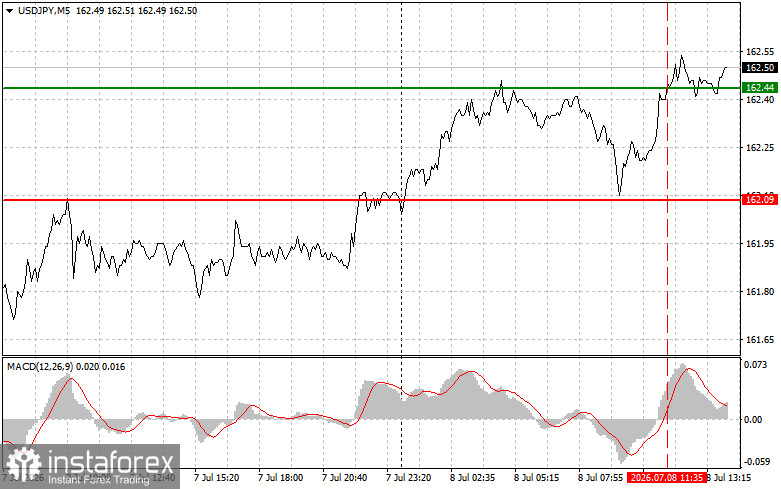
Buy Signal
Scenario #1
Today, I plan to buy USD/JPY if the price reaches the entry level around 162.64 (the green line on the chart), with a target at 163.18 (the thicker green line on the chart). Around 163.18, I plan to close long positions and open short positions in the opposite direction, anticipating a 30–35 point move. Further gains in the pair are possible today, although the upside is expected to remain relatively limited.
Important: Before opening a long position, make sure that the MACD indicator is above the zero line and has just begun moving higher.
Scenario #2
I also plan to buy USD/JPY if the price tests 162.38 twice consecutively while the MACD indicator is in oversold territory. This would limit the pair's downward potential and trigger a bullish market reversal. In this case, a move toward 162.64 and 163.18 can be expected.
Sell Signal
Scenario #1
Today, I plan to sell USD/JPY after the price breaks below 162.38 (the red line on the chart), which should trigger a rapid decline in the pair. The primary downward target will be 161.93, where I intend to close short positions and immediately consider opening long positions, anticipating a 20–25 point rebound. Selling pressure on the pair is likely to return if the central bank intervenes.
Important: Before opening a short position, make sure that the MACD indicator is below the zero line and has just begun moving lower.
Scenario #2
I also plan to sell USD/JPY if the price tests 162.64 twice consecutively while the MACD indicator is in overbought territory. This would limit the pair's upward potential and trigger a bearish market reversal. A decline toward 162.38 and 161.93 can then be expected.
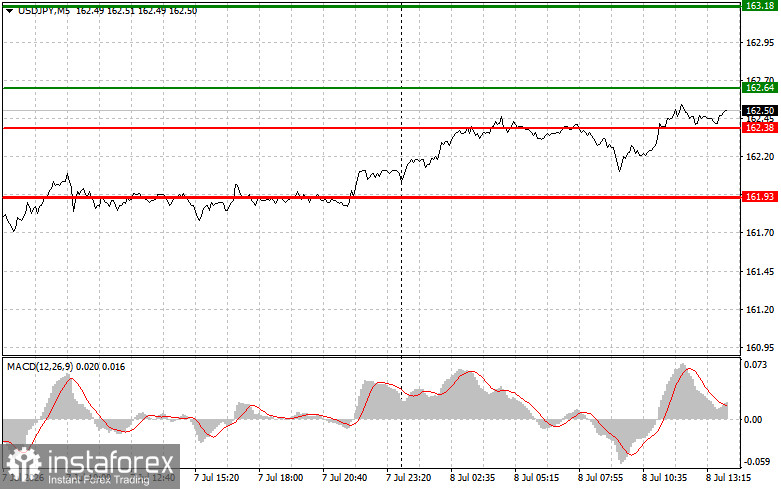
Chart Guide
- Thin green line – the entry price for opening long positions.
- Thick green line – the suggested Take Profit level or an area to lock in profits manually, as further gains above this level are considered unlikely.
- Thin red line – the entry price for opening short positions.
- Thick red line – the suggested Take Profit level or an area to lock in profits manually, as further declines below this level are considered unlikely.
- MACD indicator – when entering the market, pay close attention to overbought and oversold conditions.
Important
Beginner Forex traders should exercise extreme caution when making trading decisions. It is generally advisable to stay out of the market before the release of major economic reports to avoid sharp price swings. If you decide to trade during news releases, always use stop-loss orders to minimize potential losses. Trading without stop-loss orders can quickly result in the loss of your entire deposit, especially if you trade large position sizes without applying proper risk management.
Remember that successful trading requires a clear trading plan, such as the one outlined above. Making spontaneous trading decisions based solely on current market conditions is generally a losing strategy for intraday traders.