 English
 Русский
 Bahasa Indonesia
 Bahasa Malay
 ไทย
ไทย Español
 Deutsch
 Български
 Français
 Tiếng Việt
 中文
中文 বাংলা
বাংলা हिन्दी
 Čeština
 Українська
 Română


Analysis of Trading the Japanese Yen
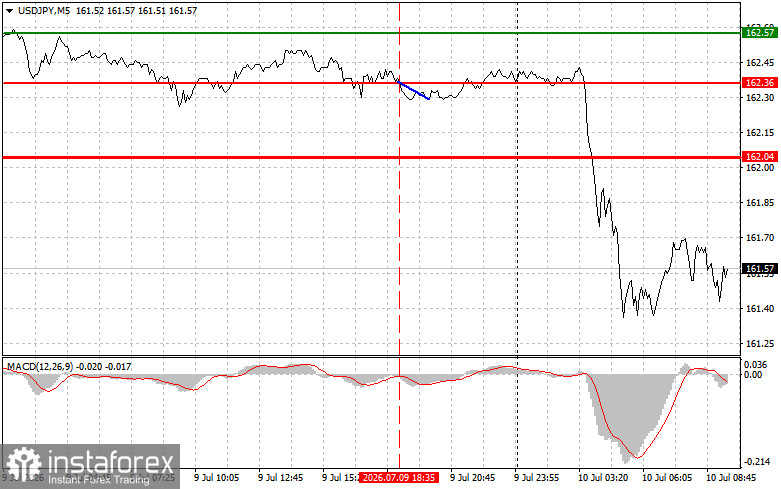
The price test at 162.36 coincided with the MACD indicator just beginning to move downward from the zero mark, confirming a good entry point to sell the dollar. As a result, the pair only declined by 6 pips, and that was the end of it.
The yen strengthened sharply against the dollar after unexpected comments from Japan's Finance Minister, Satsuki Katayama. She stated that authorities intend to encourage households and pension funds, including the massive GPIF with 293.6 trillion yen in assets, to increase their investments in domestic Japanese assets. The market interpreted this as a hint at a potential reversal of large capital flows back home, and the yen immediately rebounded from nearly a 40-year low. However, it is premature to expect further strengthening of the yen, as it is too soon to celebrate. The GPIF is overseen not by the Ministry of Finance, but by the Ministry of Health, Labour and Welfare, and any changes in strategy will take time and go through a lengthy process, while a fund representative declined to comment. Many market participants believe that the macroeconomic picture has not changed, and that this is more an attempt to soften the effects of the soft policy pursued by the Takahichi administration than a rejection of reflation. Thus, the current surge in the yen could easily be a short-term emotional spike rather than the start of a sustainable trend.
As for the intraday strategy, I will rely more on implementing scenarios No. 1 and No. 2.
Buy Scenarios
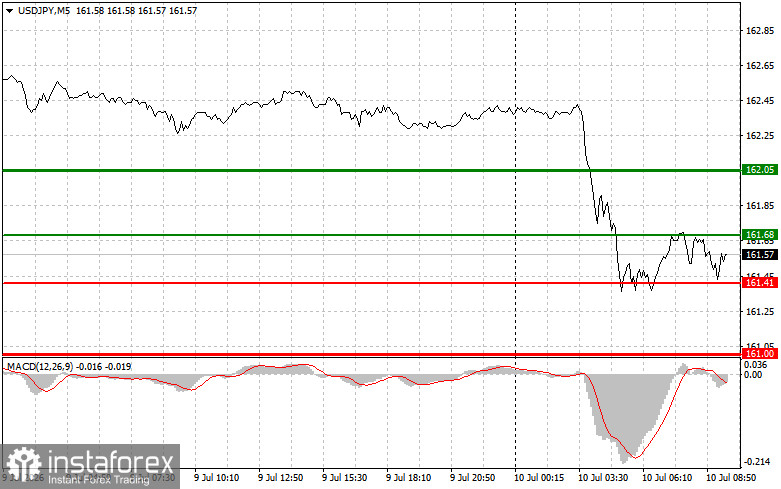
Scenario #1: I plan to buy USD/JPY today at an entry point around 161.68 (green line on the chart), targeting a move to 162.05 (thicker green line on the chart). At around 162.05, I plan to exit my long positions and sell immediately on a retracement, expecting a 30-35 pip move from the entry point. It is best to return to buying the pair during corrections and significant dips in USD/JPY. Important! Before buying, ensure that the MACD indicator is above the zero mark and is just beginning to rise from it.
Scenario #2: I also plan to buy USD/JPY today in the case of two consecutive tests of the price 161.41 when the MACD indicator is in the oversold area. This will limit the pair's downside potential and lead to an upward market reversal. A rise to opposing levels of 161.68 and 162.05 can be expected.
Sell Scenarios
Scenario #1: I plan to sell USD/JPY today only after breaking the level of 161.41 (red line on the chart), which will lead to a quick decline in the pair. The key target for sellers will be 161.00, where I plan to exit my short positions and immediately buy in the opposite direction (expecting a move of 20-25 pips in the opposite direction from the level). Sellers can return at any moment with just any hint from the central bank. Important! Before selling, ensure that the MACD indicator is below the zero mark and is just beginning its decline from it.
Scenario #2: I also plan to sell USD/JPY today in the case of two consecutive tests of the price 161.68 when the MACD indicator is in the overbought area. This will limit the pair's upward potential and lead to a downward market reversal. A decline toward the opposing levels of 161.41 and 161.00 is expected.
What the Chart Shows:
- The thin green line represents the entry price for buying the trading instrument;
- The thick green line is the estimated price at which to set Take Profit or lock in profits, as further upward movement is unlikely above this level;
- The thin red line is the entry price for selling the trading instrument;
- The thick red line is the estimated price at which to set Take Profit or lock in profits, as further downward movement is unlikely below this level;
- The MACD indicator. It is important to base market entries on overbought and oversold zones.
Important: Beginning traders in the Forex market must make entry decisions very cautiously. Before the release of significant fundamental reports, it is best to stay out of the market to avoid sudden price fluctuations. If you decide to trade during news releases, always set stop orders to minimize losses. Without stop orders, you can quickly lose your entire deposit, especially if you do not use money management and trade with large volumes.
And remember, for successful trading, it is necessary to have a clear trading plan, similar to the one I have presented above. Making spontaneous trading decisions based on the current market situation is fundamentally a losing strategy for intraday traders.