 English
 Русский
 Bahasa Indonesia
 Bahasa Malay
 ไทย
ไทย Español
 Deutsch
 Български
 Français
 Tiếng Việt
 中文
中文 বাংলা
বাংলা हिन्दी
 Čeština
 Українська
 Română


Bitcoin and Ethereum continue to trade near their lowest values in the past year and are still undergoing correction. Over the past three weeks, Ethereum and Bitcoin have managed to recover slightly, but there are still no signs of the end of the downward trend that began last year. The fundamental backdrop remains weak for the cryptocurrency segment and is primarily expressed in low spot demand, capital outflows to the AI sector, and the Federal Reserve's commitment to achieving inflation of 2%, which suggests, at a minimum, the maintenance of tight monetary policy. Thus, we still do not see any reasons for prolonged growth in Bitcoin and Ethereum.
Meanwhile, Coinbase CEO Brian Armstrong stated that Bitcoin, in its more than 15 years of existence, has not become a global alternative to fiat currency and a means of payment. Armstrong believes that this was indeed Satoshi's main idea, but it has not been realized. Currently, stablecoins, such as USDT, fulfill the function of "digital money" much better, while Bitcoin has firmly established itself as "digital gold." However, this status must be correctly understood. Gold is used as an investment instrument, not as a means of payment. The same applies to Bitcoin. It is purchased in hopes of future growth, not for paying for coffee at Starbucks. Thus, Bitcoin has failed to become a payment system and is unlikely to do so in the future.
The main problem for Bitcoin on its path to becoming a payment system is its limited supply. Investors understand that the number of coins is limited and prefer to accumulate them rather than spend them. Meanwhile, dollar-pegged tokens serve the function of "digital money" since their value is stable and their supply is not limited. According to Armstrong, Bitcoin serves one function while stablecoins serve another. They can coexist quite well.
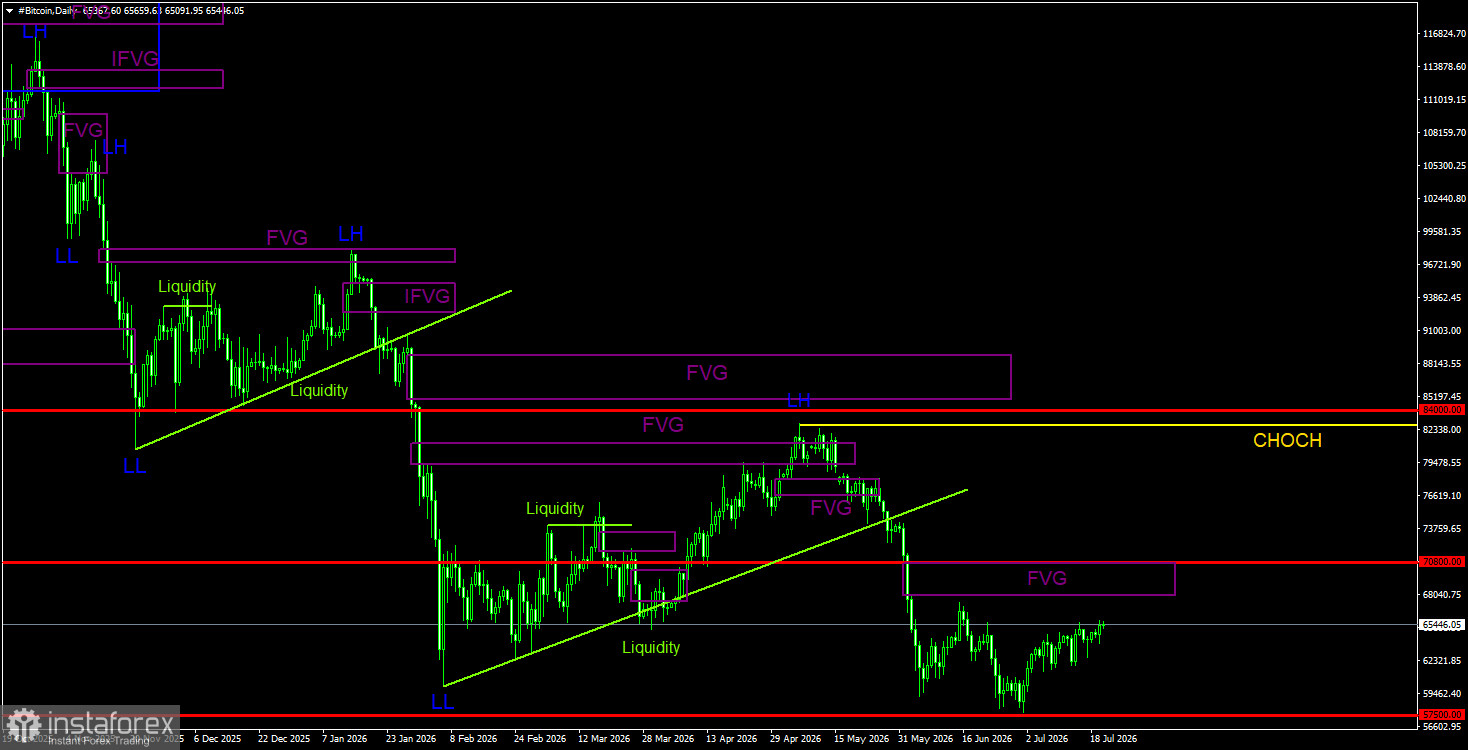
Recommendations for Trading BTC/USD:
Bitcoin continues to form a full-fledged downward trend. We continue to expect a decline with a target of $57,500 (the 61.8% Fibonacci level from a three-year upward trend), although this level has essentially already been tested. However, we do not believe that the downward trend will conclude here. The last bearish FVG was formed in the area of $68,000 - $70,700 on the daily timeframe, so this area serves as a POI for short positions in the coming weeks. On the 4-hour timeframe, Bitcoin continues its second wave of correction, but sell trades remain more attractive, as any rise now is inherently a correction.
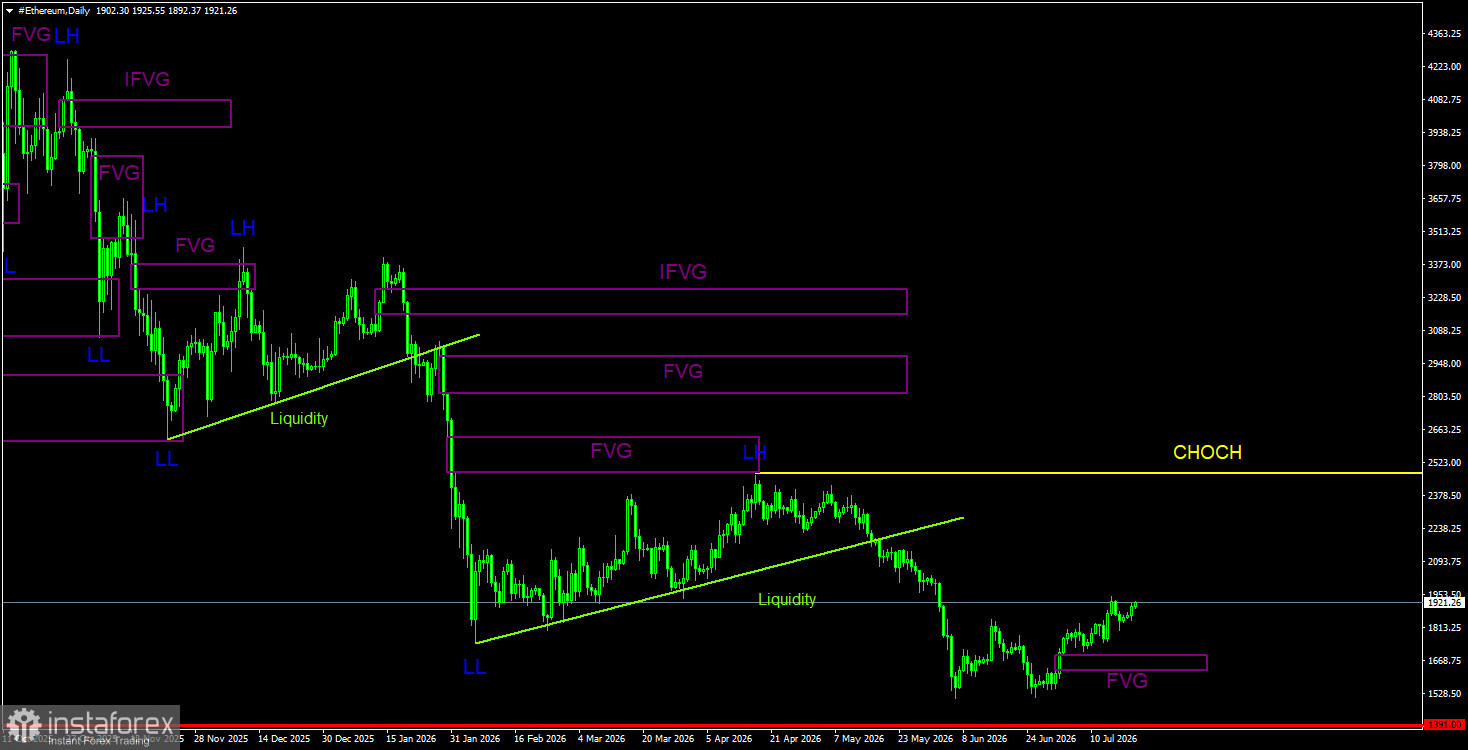
Recommendations for Trading ETH/USD:
On the daily timeframe, the downward trend that began in August of last year continues. The key pattern for selling remains a bearish order block on the weekly timeframe. We do not believe that the current downward trend is over, as there are no signs of its conclusion for either Bitcoin or Ethereum. The price has left the sideways channel, so the flat can be considered finished. A new wave of correction is expected following the formation of a buy signal on the 4-hour timeframe in the last bullish FVG. On the daily timeframe, we advise waiting for the correction to complete and for the bearish FVG for Bitcoin to play out rather than trading against the trend.
Explanations for Illustrations:
- CHOCH – change of trend structure.
- Liquidity – includes stop losses and pending orders that market makers use to build their positions.
- FVG – area of price inefficiency. The price passes through such areas very quickly, indicating a complete absence of one side in the market. Subsequently, the price tends to return and react to such areas in continuation of the main trend.
- IFVG – inverted area of price inefficiency. After returning to such an area, the price does not react to it but impulsively breaks through, then tests from the other side.
- OB – order block. The candle on which the market maker opened a position to absorb liquidity for forming their position in the opposite direction.