 English
 Русский
 Bahasa Indonesia
 Bahasa Malay
 ไทย
ไทย Español
 Deutsch
 Български
 Français
 Tiếng Việt
 中文
中文 বাংলা
বাংলা हिन्दी
 Čeština
 Українська
 Română


Bitcoin and Ethereum showed no meaningful recovery after the Asian sell-off and are preparing to extend their decline during the second half of the day, following the US technology sector lower.

Meanwhile, Bitmine Immersion Technologies, led by Tom Lee, announced that it already holds 5.79 million ETH, representing approximately 4.8% of the cryptocurrency's total supply. Last week, the company acquired nearly 10,000 coins. At present, Bitmine has already staked 4.9 million ETH, or around 85% of its total holdings, through its own validator infrastructure and partner platforms. The projected annual staking revenue is expected to reach approximately $299 million once all coins are fully deployed.
It is worth noting that these new purchases are taking place against the backdrop of a notable divergence in the performance of the two largest cryptocurrencies. Over the past week, Ethereum has gained approximately 2.4%, while Bitcoin has declined by around 0.7%. Bitmine Chairman Tom Lee specifically highlighted the rising ETH/BTC ratio, describing it as a three-month high and a sign of strengthening momentum in favour of Ethereum. This statement is consistent with his earlier comments about the beginning of a "crypto spring" made at the Proof of Talk conference in Paris, where he identified artificial intelligence, asset tokenisation, and the growing adoption of stablecoins as the main drivers behind his long-term Ethereum price target of $250,000.
As for short-term trading, the strategy and conditions are outlined below.
Bitcoin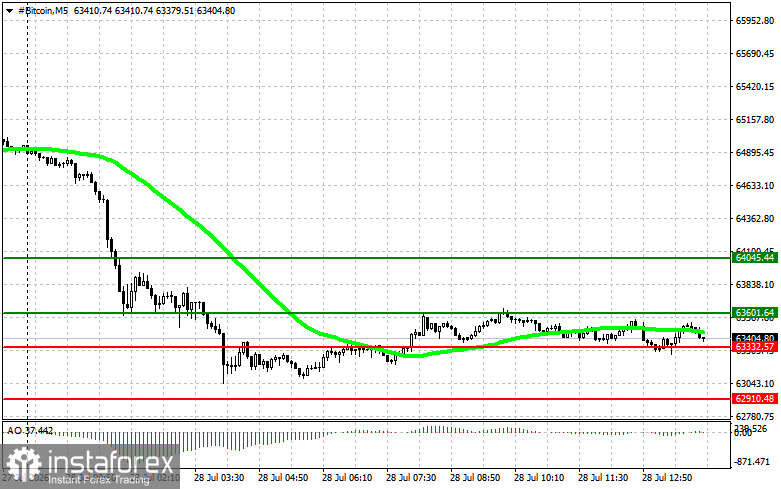
Buying Scenario
Scenario #1: I will buy Bitcoin today once the entry point around $63,600 is reached, with a target of a move towards $64,000. Around $64,000, I will exit long positions and immediately sell on a rebound. Before entering a breakout buy trade, it is necessary to confirm that the 50-day moving average is below the current price and that the Awesome Oscillator is above zero.
Scenario #2: Bitcoin can be bought from the lower boundary at $63,300 if there is no market reaction to a breakout below this level and the price returns towards $63,600 and $64,000.
Selling Scenario
Scenario #1: I will sell Bitcoin today once the entry point around $63,300 is reached, with a target decline towards $62,900. Around $62,900, I will exit short positions and immediately buy on a rebound. Before entering a breakout sell trade, it is necessary to confirm that the 50-day moving average is above the current price and that the Awesome Oscillator is below zero.
Scenario #2: Bitcoin can be sold from the upper boundary at $63,600 if there is no market reaction to a breakout above this level and the price returns towards $63,300 and $62,900.
Ethereum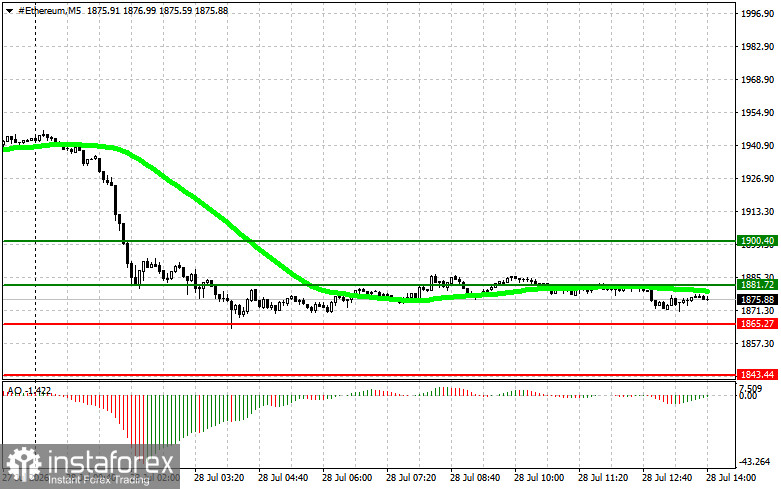
Buying Scenario
Scenario #1: I will buy Ethereum today once the entry point around $1,881 is reached, with a target move towards $1,900. Around $1,900, I will exit long positions and immediately sell on a rebound. Before entering a breakout buy trade, it is necessary to confirm that the 50-day moving average is below the current price and that the Awesome Oscillator is above zero.
Scenario #2: Ethereum can be bought from the lower boundary at $1,865 if there is no market reaction to a breakout below this level and the price returns towards $1,881 and $1,900.
Selling Scenario
Scenario #1: I will sell Ethereum today once the entry point around $1,865 is reached, with a target decline towards $1,843. Around $1,843, I will exit short positions and immediately buy on a rebound. Before entering a breakout sell trade, it is necessary to confirm that the 50-day moving average is above the current price and that the Awesome Oscillator is below zero.
Scenario #2: Ethereum can be sold from the upper boundary at $1,881 if there is no market reaction to a breakout above this level and the price returns towards $1,865 and $1,843.