 English
 Русский
 Bahasa Indonesia
 Bahasa Malay
 ไทย
ไทย Español
 Deutsch
 Български
 Français
 Tiếng Việt
 中文
中文 বাংলা
বাংলা हिन्दी
 Čeština
 Українська
 Română


Review of Trades and Trading Tips for the Japanese Yen
Due to low market volatility, none of the price levels I identified were tested during the first half of the day.
During the U.S. session, the market is awaiting only the weekly U.S. Initial Jobless Claims report, so major surprises are unlikely. This indicator provides a timely snapshot of labor market conditions and influences expectations regarding the Federal Reserve's interest rate policy, which in turn affects U.S. Treasury yields. However, in the absence of other significant economic releases, its impact is expected to remain limited. Most likely, the U.S. dollar will continue strengthening against the Japanese yen, supported by the existing bullish momentum. Given that no currency intervention is expected in the near term, any sharp pullbacks in the pair are likely to attract buyers more actively, although such declines have become noticeably less frequent recently. The optimal strategy remains buying the U.S. dollar and trading within the prevailing range.
As for my intraday strategy, I will primarily rely on the implementation of Scenario No. 1 and Scenario No. 2.
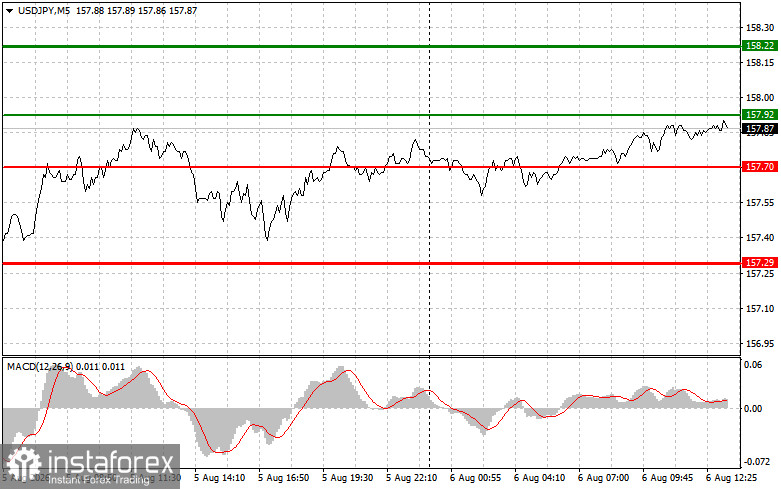
Buy Signal
Scenario No. 1: I plan to buy USD/JPY if the price reaches the entry point around 157.92 (the green line on the chart), targeting a move toward 158.22 (the thicker green line on the chart). Around 158.22, I plan to close long positions and open short positions in the opposite direction, expecting a reversal of 30–35 points. The pair is expected to continue rising today, although the upward potential is likely to be limited.
Important: Before buying, make sure the MACD indicator is above the zero line and is just beginning to rise from it.
Scenario No. 2: I also plan to buy USD/JPY if the price tests 157.76 twice in succession while the MACD indicator is in the oversold area. This would limit the pair's downward potential and trigger an upward market reversal. In this case, a rise toward 157.92 and 158.22 can be expected.
Sell Signal
Scenario No. 1: I plan to sell USD/JPY after the price breaks below 157.76 (the red line on the chart), which should lead to a rapid decline in the pair. The key target for sellers will be 157.42, where I plan to close short positions and immediately open long positions in the opposite direction, expecting a rebound of 20–25 points. Pressure on the pair is likely to return today only if the central bank intervenes.
Important: Before selling, make sure the MACD indicator is below the zero line and is just beginning to move lower from it.
Scenario No. 2: I also plan to sell USD/JPY if the price tests 157.92 twice in succession while the MACD indicator is in the overbought area. This would limit the pair's upward potential and trigger a downward market reversal. In this case, a decline toward 157.76 and 157.42 can be expected.
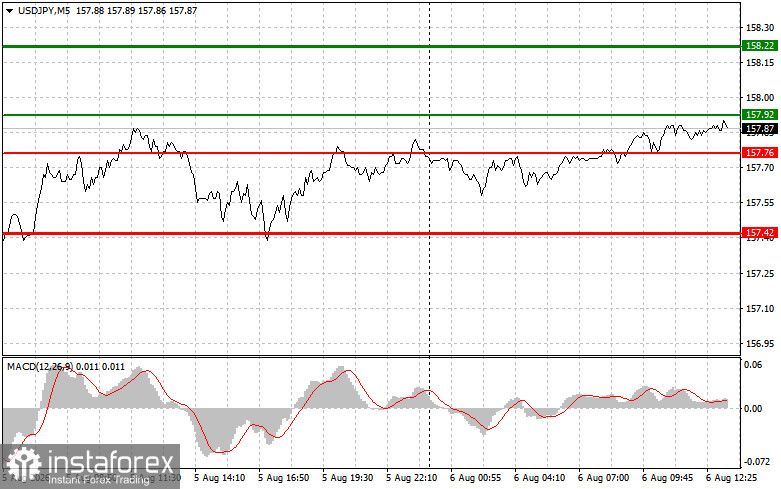
Chart Explanation
- Thin green line: Entry price for buying the trading instrument.
- Thick green line: Estimated Take Profit level or an area where profits can be locked in manually, as further gains above this level are considered unlikely.
- Thin red line: Entry price for selling the trading instrument.
- Thick red line: Estimated Take Profit level or an area where profits can be locked in manually, as further declines below this level are considered unlikely.
- MACD indicator: When entering the market, it is important to use the overbought and oversold zones as guidance.
Important: Beginner Forex traders should exercise extreme caution when making market entry decisions. It is generally advisable to stay out of the market ahead of major fundamental reports to avoid sharp price fluctuations. If you decide to trade during news releases, always use stop-loss orders to minimize potential losses. Without stop-loss orders, you can lose your entire deposit very quickly, especially if you trade large position sizes without proper money management.
Remember that successful trading requires a clear trading plan, such as the one outlined above. Making spontaneous trading decisions based solely on the current market situation is inherently a losing strategy for an intraday trader.