 English
 Русский
 Bahasa Indonesia
 Bahasa Malay
 ไทย
ไทย Español
 Deutsch
 Български
 Français
 Tiếng Việt
 中文
中文 বাংলা
বাংলা हिन्दी
 Čeština
 Українська
 Română


Trade Analysis and Tips for Trading the British Pound
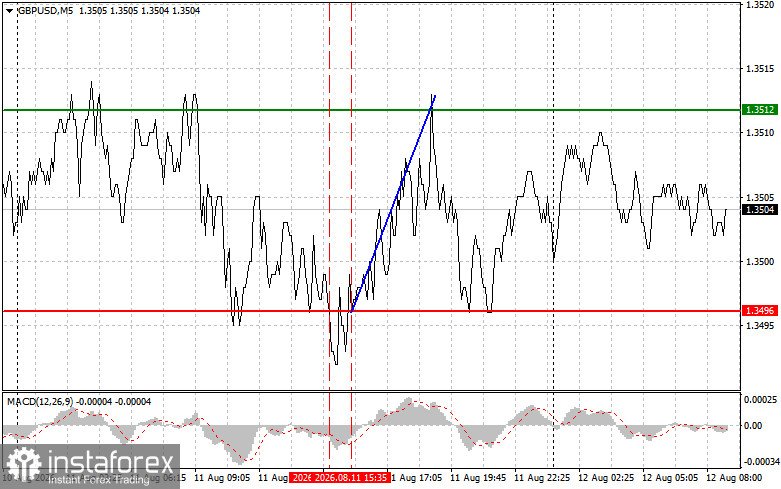
The price test at 1.3496 occurred when the MACD indicator had moved significantly below the zero mark, limiting the pair's downward potential. For this reason, I did not sell the pound. The second test of 1.3496 occurred when the MACD was in the oversold area, prompting the implementation of Scenario #2 to buy the pound. As a result, the pair rose by 18 pips.
The absence of key U.S. data and comments from the Federal Reserve shifted market attention to the real estate sector yesterday; however, this did not trigger any noticeable movement. Sales of existing homes in the US fell by 1.7% in July, although the market remained up by 2.4% since the beginning of the year. This indicator is considered secondary, and its near-complete alignment with economists' forecasts kept volatility low and did not provide the market with a clear direction. In these conditions, the British pound remained dependent on external forces. With the data falling within expectations, the dollar had no reason to move, and the GBP/USD pair was primarily driven by overall risk appetite.
The empty UK calendar once again puts the pound dependent on external conditions. Usually, reports on the labor market set the tone for the British currency, but today there are no such drivers. In such a situation, the key factors for the pair become the dynamics of the dollar and the overall risk appetite. In a favorable environment, pound buyers still have a chance to continue the bullish trend, especially since the British currency is already supported by prior momentum.
Regarding the intraday strategy, I will rely more on implementing Scenarios #1 and #2.
Buying Scenarios
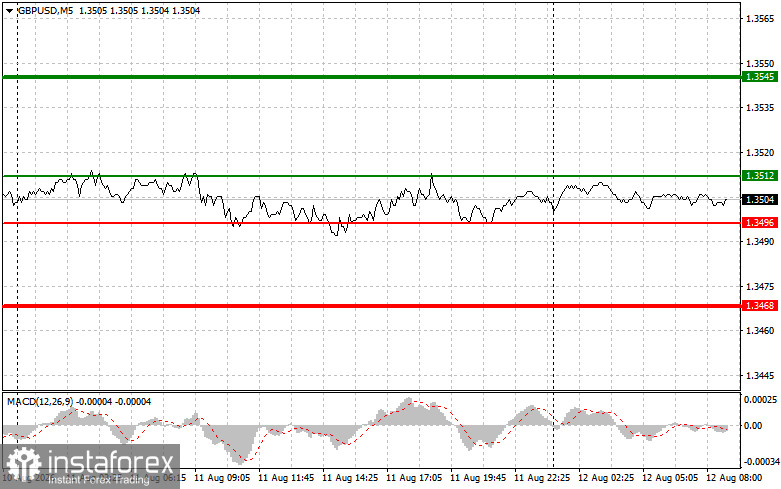
Scenario #1: Today, I plan to buy the pound when the price reaches around 1.3512 (green line on the chart), aiming for growth toward 1.3545 (thicker green line on the chart). At around 1.3545, I intend to exit my long positions and open short positions in the opposite direction (expecting a movement of 30-35 pips in the opposite direction from the level). One can count on the pound's growth today within the ongoing upward trend. Important! Before buying, make sure that the MACD indicator is above the zero mark and is just starting its rise from there.
Scenario #2: I also plan to buy the pound today in case of two consecutive tests of 1.3496, with the MACD indicator in the oversold area. This will limit the pair's downside potential and lead to an upward market reversal. One can expect growth towards opposite levels of 1.3512 and 1.3545.
Selling Scenarios
Scenario #1: Today, I plan to sell the pound after the 1.3496 level is updated (red line on the chart), which will lead to a rapid decline in the pair. The key target for sellers will be 1.3468, where I plan to exit my shorts and immediately open longs in the opposite direction (expecting a move of 20-25 pips in the opposite direction from the level). Only bad news will bring pressure back on the pound. Important! Before selling, make sure that the MACD indicator is below the zero mark and is just starting its decline from there.
Scenario #2: I also plan to sell the pound today in the event of two consecutive tests of 1.3512, with the MACD indicator in the overbought area. This will limit the pair's upward potential and lead to a market reversal downwards. One can expect a decline towards the opposite levels of 1.3496 and 1.3468.
What the Chart Shows:
- Thin green line – entry price for buying the trading instrument;
- Thick green line – estimated price where take profit can be set, or profit can be realized, as further growth above this level is unlikely;
- Thin red line – entry price for selling the trading instrument;
- Thick red line – estimated price where take profit can be set, or profit can be realized, as further decline below this level is unlikely;
- MACD Indicator. When entering the market, it is important to be guided by overbought and oversold zones.
Important: Beginner forex traders need to make entry decisions very cautiously. Before key fundamental reports are released, it is best to stay out of the market to avoid sharp price fluctuations. If you decide to trade during news releases, always set stop orders to minimize losses. Without placing stop orders, you can quickly lose your entire deposit, especially if you do not practice money management and trade large volumes.
And remember, successful trading requires a clear trading plan, as outlined above. Making spontaneous trading decisions based on the current market situation is inherently a losing strategy for intraday traders.