 English
 Русский
 Bahasa Indonesia
 Bahasa Malay
 ไทย
ไทย Español
 Deutsch
 Български
 Français
 Tiếng Việt
 中文
中文 বাংলা
বাংলা हिन्दी
 Čeština
 Українська
 Română


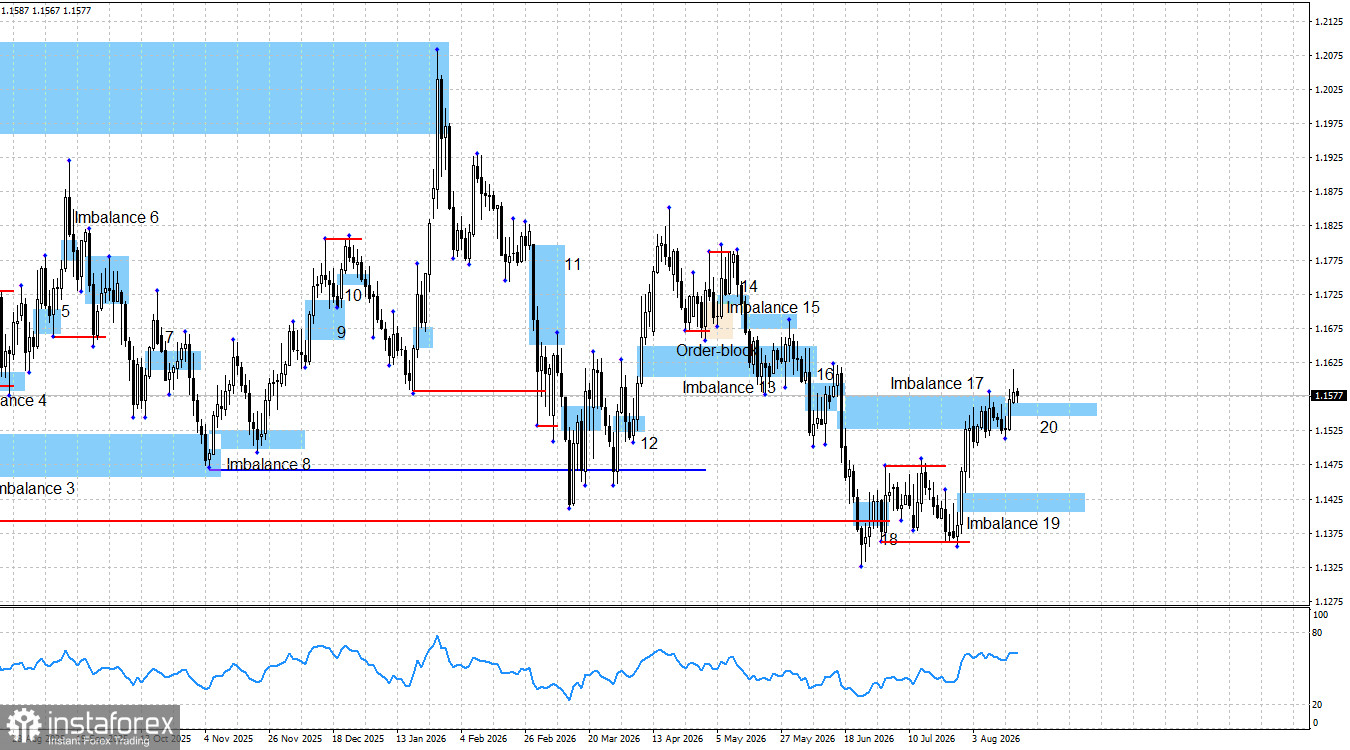
The EUR/USD pair continues to rise following two liquidity sweeps marked on the chart by red lines. Imbalance 17 restrained the bulls' advance for a long time and still cannot technically be considered invalidated, as there has been no break of its base at 1.1620. However, I think it is already clear to all traders that this pattern is no longer actionable and can be disregarded. Yesterday, a new pattern was formed — "bullish" imbalance 20, which now plays the key role. This pattern may either provide a new buy signal or become invalidated. In the first case, the bullish advance will continue; in the second, the bears will attempt to regain control of the market.
In my view, the fundamental backdrop continues to fully support the bulls. First, it is clearly visible on any chart that the euro is trading significantly below its average level over the past year. Second, the market no longer expects the FOMC to tighten monetary policy in September. Third, the market has begun to question whether Kevin Warsh is capable of doing everything necessary to bring inflation back to the target level. Fourth, US economic data has recently been disappointing. Fifth, geopolitical developments no longer support the bears or the dollar. Sixth, the ECB may tighten monetary policy once again this autumn. Therefore, I see no reason for a bearish advance.
As I warned in recent weeks, if the labor market once again produces a weak result, this would be a sufficiently strong reason for the Fed to refrain from raising rates. Of course, this cannot be stated with complete certainty, as one more inflation report and one more labor market report will be released before the September FOMC meeting. However, I am almost certain that the Fed will adopt a wait-and-see approach in September. Almost all traders are now abandoning their hawkish expectations for September.
Let me remind you that expectations regarding Fed monetary policy are always just expectations and can change in response to geopolitical developments or economic data. The latest US labor market data showed weak figures, inflation slowed, and GDP growth lost momentum. These three factors raise doubts about an FOMC rate hike not only in September but also in the foreseeable future. If the Strait of Hormuz is reopened in the near future, this would only ease energy-related pressure and allow inflation to continue declining, further weakening the bears' prospects. In my view, the bears' only opportunity now lies in a new escalation and a prolonged blockade of the Strait of Hormuz.
The current chart structure points to a highly probable beginning of a bullish impulse. "Bearish" imbalance 17 has been mitigated, the reaction to it was weak, and the pattern can now be considered invalidated. "Bullish" imbalance 19 remains unmitigated. A new "bullish" imbalance 20 has formed and may provide traders with a buy signal as early as today or tomorrow. Thus, the bulls currently have much stronger positions and prospects than the bears.
The economic backdrop on Tuesday allowed the euro to continue rising, but the economic data released during the day was not particularly important. The market did not react to the economic expectations indices for Germany and the European Union and did not consider the US housing construction reports worth trading. In my view, traders are currently prepared to act only on important data, and there were no such releases today.
There remain numerous reasons for the bulls to attack in 2026, and even the outbreak of war in the Middle East has not reduced their number. Structurally and globally, Trump's policies, which led to a significant decline in the dollar last year, have not changed. At present, I do not see any significant factors supporting the US currency, despite the FOMC's formally hawkish stance. Geopolitical developments, which supported demand for the US currency for much of the first half of 2026, can no longer provide such support. The conflict in the Middle East remains unresolved, but there have been no new hostilities from either Iran or the United States.
Economic Calendar for the US and the European Union:
- European Union – Speech by ECB President Christine Lagarde (07:10 UTC).
- European Union – Consumer Price Index (09:00 UTC).
- US – FOMC Meeting Minutes (18:00 UTC).
The economic calendar for August 19 contains three events, but I cannot consider any of them important. The impact of the economic backdrop on market sentiment on Wednesday will most likely be weak.
EUR/USD Forecast and Trading Tips:
In my view, the pair remains in the process of forming a bullish trend. The fundamental backdrop shifted sharply in favor of the bears six months ago, but the trend cannot be considered invalidated or complete. Thus, the bulls may well continue their advance following two liquidity sweeps of clearly defined lows. The bulls currently have support in the form of imbalance 20. A new buy signal may form in the near future. As targets for a new advance in the euro, I am considering the highs from May 29 and May 6 at 1.1686 and 1.1797, respectively.