 English
 Русский
 Bahasa Indonesia
 Bahasa Malay
 ไทย
ไทย Español
 Deutsch
 Български
 Français
 Tiếng Việt
 中文
中文 বাংলা
বাংলা हिन्दी
 Čeština
 Українська
 Română


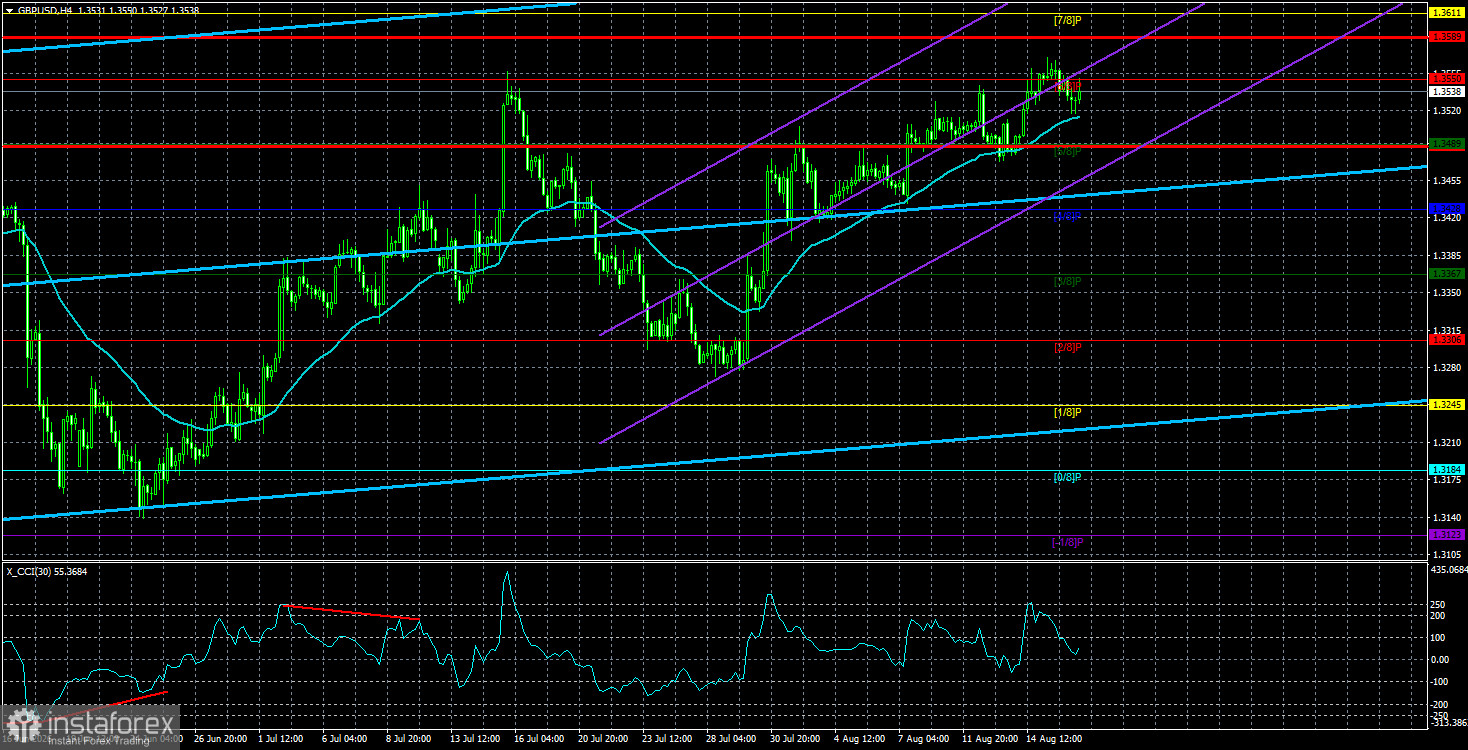
The GBP/USD currency pair traded lower on Tuesday, which can be easily explained. In the morning, the UK's June unemployment report was released and came in higher than analysts' forecasts and market expectations. The market had anticipated a decrease in unemployment to 4.8%, but the figure remained unchanged at 4.9%. As a result, the British currency lost ground throughout the day, but, once again, volatility remained sufficiently low, with the pound's decline amounting to only a few dozen pips. What are a few dozen pips for the British pound? Merely ordinary market noise or a technical pullback.
A key event for the British currency is scheduled for today. The UK consumer price index (CPI) is significant because the Bank of England is among the central banks that can tighten monetary policy if necessary. Therefore, if inflation starts to rise again in the U.S., we would doubt the Federal Reserve's willingness to tighten policy. If inflation accelerates in the UK, the BoE could raise the key rate soon.
The question is how much inflation will rise and whether it will be enough to warrant a rate hike. It is important to understand that a one-off acceleration in consumer prices is likely to be ignored by the BoE. In this regard, the trend is more critical than individual reports. Inflation in the UK can be said to have not reacted at all to the energy crisis and the war in the Middle East. Currently, it stands at only 2.6%, which is even lower than in the European Union. Thus, an acceleration of inflation to 2.9% or 3% is unlikely to bolster "hawkish" market expectations. If inflation exceeds 3%, the British pound could significantly strengthen against the U.S. dollar, as the BoE would again be much closer to raising the key rate than the Fed. Inflation below 2.9% will likely pressure the pound, as markets prepare for a return to monetary policy easing in the UK.
Therefore, inflation will determine market sentiment toward the British pound, but we must also remember that the fate of the GBP/USD pair largely depends on the dollar rather than the pound. Currently, there are many more factors favoring the pound than the U.S. dollar. We still expect the British currency to rise, at least based on the technical factors on the weekly and daily charts. The British pound has been trading within the range of 1.3150–1.3780 for over a year, indicating a flat market. The movement from the lower boundary to the upper boundary is continuing and has not yet concluded. Thus, the pound could show growth close to the 39 level based solely on technical factors. Flats can occur not just on lower timeframes but also on higher ones, and any flat movement consists of random fluctuations.
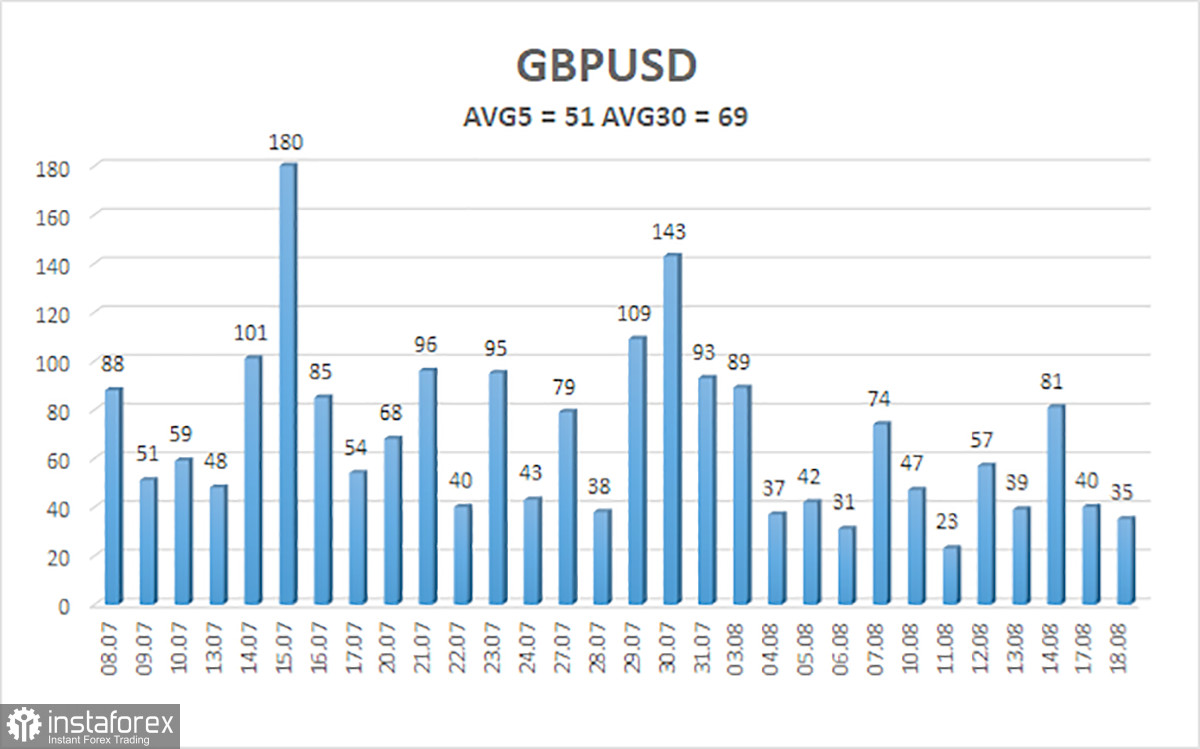
The average volatility of the GBP/USD pair over the past five trading days as of August 19 is 51 pips. For the pound/dollar pair, this value is considered "low." On Wednesday, August 19, we expect the pair to move within a range bounded by 1.3487 and 1.3589. The upper linear regression channel is oriented downward, indicating a downward trend. The CCI indicator has entered overbought territory for the third time, warning of a possible correction.
Nearest Support Levels:
- S1 – 1.3489
- S2 – 1.3428
- S3 – 1.3367
Nearest Resistance Levels:
- R1 – 1.3550
- R2 – 1.3611
- R3 – 1.3672
Trading Recommendations:
The GBP/USD currency pair maintains an upward trend. Trump's policies will continue to exert pressure on the U.S. economy, so we do not expect long-term growth for the U.S. dollar. The year 2026 has been super positive for the dollar due to geopolitics, but every fairy tale comes to an end. A flat market persists on the weekly timeframe between levels 1.3150 and 1.3780, within a four-year upward trend, supporting the expectation of continued medium-term growth for the British currency. Long positions with targets of 1.3589 and 1.3611 can be considered when the price is above the moving average. If the price is below the moving average line, bearish trading can be considered with targets at 1.3428 and 1.3367.
Explanations for the Illustrations:
- Linear regression channels help determine the current trend. If both are directed in the same direction, the trend is currently strong.
- The moving average line (settings 20, 0, smoothed) defines the short-term trend and the direction in which trading should currently be conducted.
- Murray levels are target levels for movements and corrections.
- Volatility levels (red lines) represent the probable price channel in which the pair will operate over the next day based on current volatility readings.
- The CCI indicator entering the oversold area (below -250) or overbought area (above +250) indicates that a trend reversal in the opposite direction is approaching.