 English
 Русский
 Bahasa Indonesia
 Bahasa Malay
 ไทย
ไทย Español
 Deutsch
 Български
 Français
 Tiếng Việt
 中文
中文 বাংলা
বাংলা हिन्दी
 Čeština
 Українська
 Română


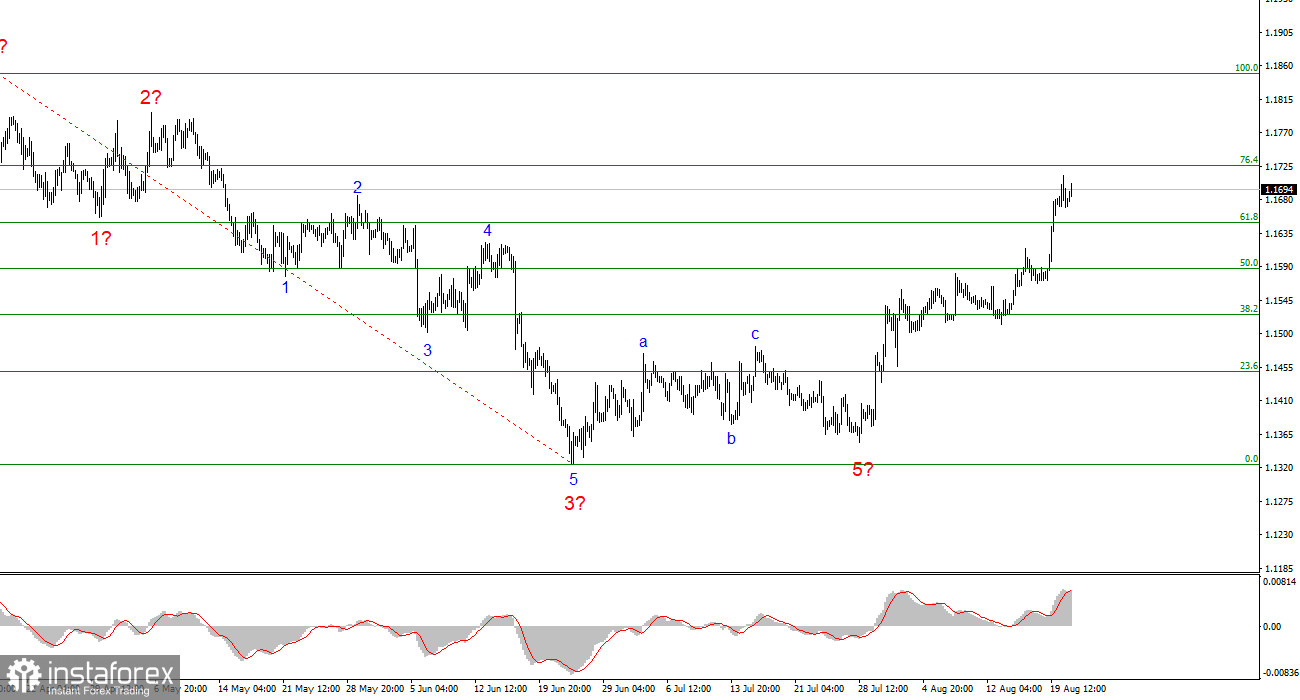
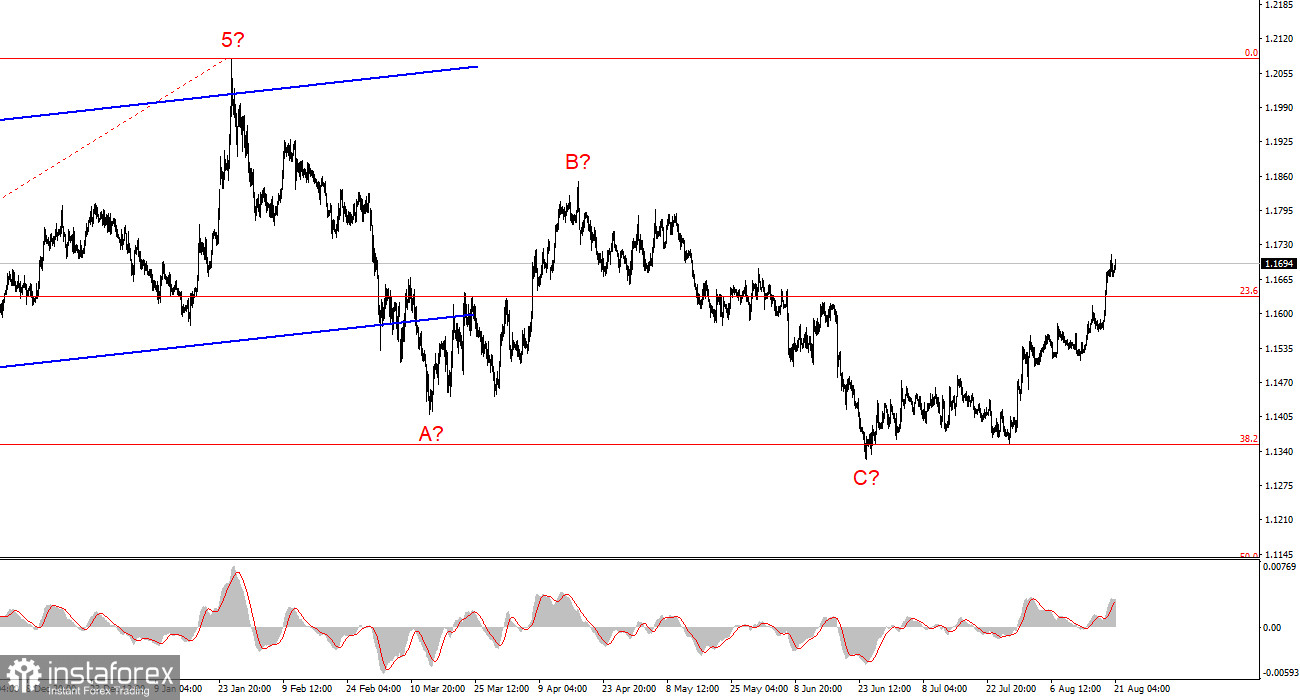
The wave count on the 4-hour chart for EUR/USD is becoming more complex. There is still no question of invalidating the upward trend segment (lower chart), which began in January last year. On the contrary, we have seen a complete A-B-C corrective structure that has most likely ended. We never saw a convincing wave 5 within C. This wave took a truncated form, which also happens from time to time. Let me remind you that classical wave structures are generally found only in textbooks. In real-world trading, traders and analysts should be more flexible in their analysis. That is why I have been saying in my reviews for a month now that traders should prepare for a rise in the European currency. If the current wave count is correct, the instrument is at the very beginning of a new upward trend segment.
On the lower time frame, I can identify a classic five-wave downward structure with a truncated wave 5. I expected the European currency to decline to the 13th level, but the news backdrop turned against the dollar, and sellers simply lacked the strength to form a convincing wave 5. Therefore, it can be considered that the formation of a new upward wave sequence began on July 28.
The Treasury Implemented Its Version of QE and Weakened the Dollar
The EUR/USD rate was once again virtually unchanged on Friday, but this week the European currency has already gained around 120 points. Looking at the lower time frame, we can clearly see a steady and fairly strong upward movement. The European currency may not be gaining 60–100 points every day, but it is rising steadily. And that is the most important thing. Even today, the European currency could have gained further. Germany's Manufacturing PMI rose more than the market expected, reaching 54.1 points. The European Union's Manufacturing PMI also rose more than expected, reaching 52.8 points. The EU Services PMI also came in above forecasts at 51.7 points. Only Germany's Services PMI was somewhat disappointing. Three against one. Demand for the euro could therefore have increased today as well.
But, as already mentioned, the euro is performing very well this week even without the business activity indices. The U.S. Treasury has provided the main support for the euro, as has already been discussed at length. I would add that, broadly speaking, the U.S. Treasury has effectively planned to implement a QE (quantitative easing) program. More precisely, it plans to double its scale. Yes, the U.S. Treasury is not going to print money in exchange for its own bonds. But the underlying mechanism remains the same. The Treasury provides money to the market, while the market provides bonds to the Treasury. Market participants receive liquidity, while the Treasury reduces the yields on government bonds. Many economists consider this an inefficient method of debt management, but it is nevertheless a significant step that the market could not ignore.
Overall Conclusions
Based on my EUR/USD analysis, I conclude that the pair remains within the upward trend segment (lower chart), while in the shorter term it has moved into a new upward wave sequence. In my view, now is an excellent time to build long positions. Unless the downward trend segment that began on January 28 develops into a more extended five-wave structure (which would require a strong news backdrop in favor of the dollar), EUR/USD is at the very beginning of a new, prolonged upward trend segment, with targets extending as high as the 25th level.
On the higher time frame, an upward trend segment can be seen, after which the formation of a corrective wave sequence began. The A-B-C structure is presumably complete. If this is the case, the formation of a new impulsive upward trend segment has begun.
The Main Principles of My Analysis:
- Wave structures should be simple and clear. Complex structures are difficult to trade and often involve changes.
- If there is no confidence in what is happening in the market, it is better not to enter the market.
- There can never be 100% certainty about the direction of a price movement. Do not forget about protective Stop Loss orders.
- Wave analysis can be combined with other types of analysis and trading strategies.