 English
 Русский
 Bahasa Indonesia
 Bahasa Malay
 ไทย
ไทย Español
 Deutsch
 Български
 Français
 Tiếng Việt
 中文
中文 বাংলা
বাংলা हिन्दी
 Čeština
 Українська
 Română


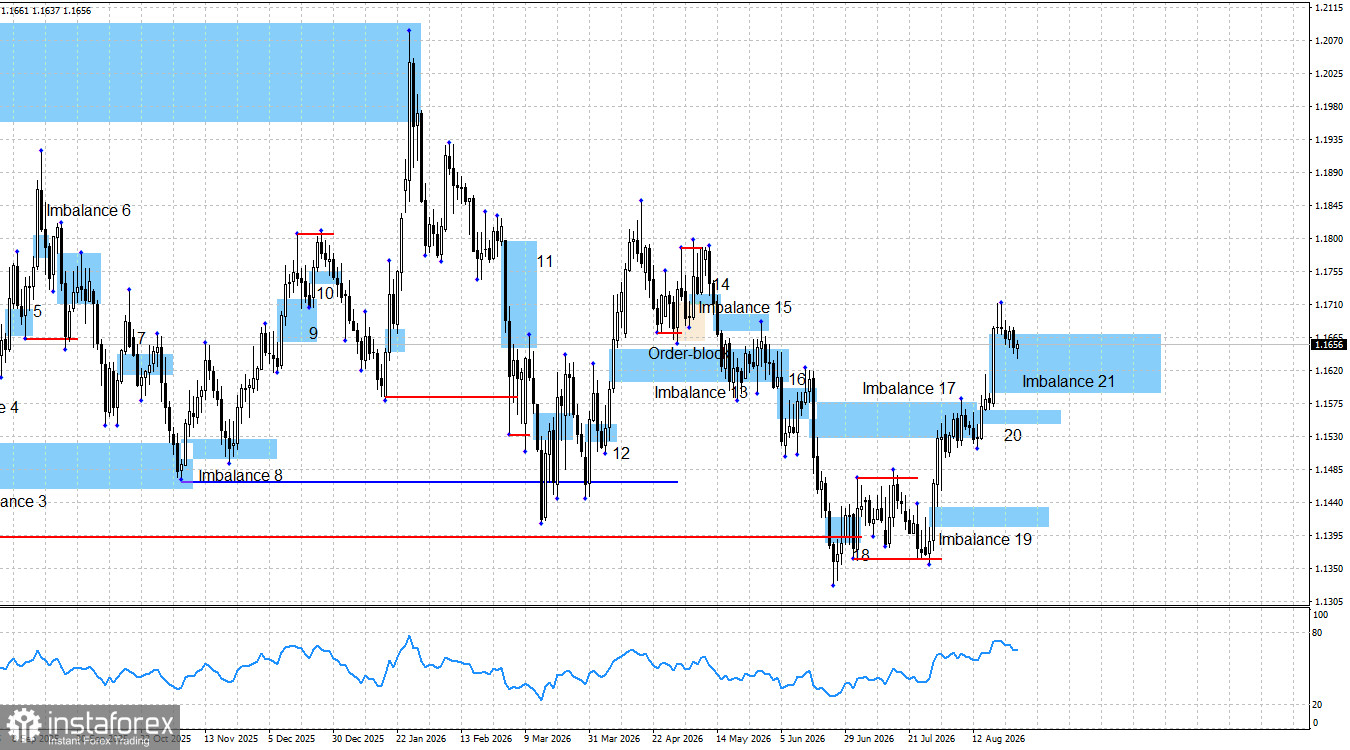
The EUR/USD pair has been rising for a month, with the move beginning after two liquidity grabs marked by red lines on the chart. Last week, two new imbalances—20 and 21—were formed. Both are "bullish." The nearest imbalance could produce a signal at any point this week. It has effectively already been tested; all that remains is to wait for a reaction to it or for its invalidation. Imbalance 21 is around 80 points wide, which is quite significant. Therefore, the price could enter the imbalance 21 zone and spend a considerable amount of time there. It could even decline to 1.1589 and only then begin a new upward move with the formation of a "bullish" signal. In any case, market sentiment remains "bullish," which means that buy signals should be expected.
In my view, the fundamental backdrop continues to fully support the bulls. First, any chart clearly shows that the European currency began its rise from relatively low levels compared with the average price over the past year. This means that there is still upward potential. Second, the market is no longer expecting FOMC monetary policy tightening in September. Third, the market has begun to question whether the Fed under Kevin Warsh can tighten monetary policy at all. Fourth, U.S. economic data have recently been a source of disappointment. Fifth, geopolitical developments are no longer supporting the bears or the dollar. Sixth, the ECB could implement another monetary policy tightening this autumn. Seventh, the U.S. Treasury has decided to increase its purchases of long-term bonds, reducing demand for the dollar. Eighth, a new trade war between the United States and Canada and between the United States and China could begin in the near future. Therefore, I see no reason for a "bearish" advance.
The latest U.S. labor-market data showed weak figures, inflation has slowed, and GDP growth has decelerated. These three factors have raised doubts about FOMC rate hikes not only in September but also in the foreseeable future. This is precisely the factor that supported the bears as recently as June but has now turned against them as well. In my view, the bears' only chance at this point lies in a new escalation in the Middle East. However, Donald Trump is not seeking military escalation. He now wants to put economic pressure on Iran.
The current chart structure points to a highly probable continuation of the "bullish" momentum. The "bearish" imbalance 17 was tested, the reaction to it was weak, and this pattern is now considered invalidated. The "bullish" imbalance 19 remained untested. The new "bullish" imbalance 20 also did not provide traders with a buy signal. Another "bullish" imbalance, 21, has now formed and could generate a signal this week. At present, the bulls have much stronger positions and prospects than the bears.
The economic backdrop was virtually absent on Thursday. In the morning, Germany released its consumer confidence report, which once again came in the red zone, although it was still slightly better than forecast. However, this "slight" improvement failed to impress bullish traders. In the second half of the day, the U.S. initial jobless claims report was released, attracting even less market attention than the consumer confidence index. As a result, the pair has now been moving very weakly for the sixth consecutive day. Trader activity is close to zero. The chart structure remains unchanged.
The bulls still have numerous reasons to attack in 2026, and even the outbreak of war in the Middle East has not reduced their number. Structurally and globally, Trump's policies, which led to a significant decline in the dollar last year, have not changed. At present, I see no significant factors supporting the U.S. currency, despite the FOMC's formally "hawkish" stance. Geopolitical developments, which supported demand for the U.S. currency for most of the first half of 2026, are no longer doing so. The conflict in the Middle East remains unresolved, but there have been no new hostilities from either Iran or the United States.
Economic Calendar for the United States and the European Union:
- Germany – Unemployment rate (07:55 UTC).
- United States – FOMC Chair Kevin Warsh's speech (14:00 UTC).
- United States – Annual revision of Nonfarm Payrolls (14:00 UTC).
The August 28 economic calendar contains three events, two of which are important. The economic backdrop will have a strong impact on market sentiment in the second half of the day on Friday.
EUR/USD Forecast and Trading Tips:
In my view, the pair remains in the process of forming a "bullish" trend. The fundamental backdrop shifted sharply in favor of the bears six months ago, but the trend itself cannot be considered canceled or complete. Therefore, the bulls could well continue their advance after two liquidity grabs from clearly defined lows. At present, bullish traders have an excellent support zone in the form of imbalance 21. A new buy signal could form this week. I see 1.1797 and 1.1850 as the upward targets for the European currency.