 English
 Русский
 Bahasa Indonesia
 Bahasa Malay
 ไทย
ไทย Español
 Deutsch
 Български
 Français
 Tiếng Việt
 中文
中文 বাংলা
বাংলা हिन्दी
 Čeština
 Українська
 Română


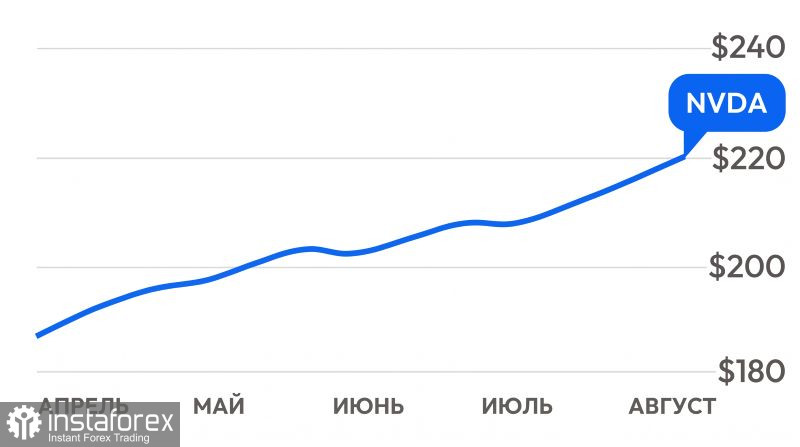
The company reported a record quarterly revenue of $96.2 billion, exceeding analysts' forecasts of $92.2 billion, marking a 106% year-over-year increase. The data center chips segment generated a record $89 billion, reflecting a 117% annual gain. Earnings per share came in at $2.22, surpassing expectations of $2.10.
The company's management provided strong guidance for the future, forecasting third-quarter revenue between $105.8 billion and $110.2 billion. Chief Financial Officer Colette Kress stated that revenue is expected to grow by 70% in the 2028 fiscal year, while market experts projected only 44% growth. CEO Jensen Huang noted that the infrastructure for artificial intelligence has entered a phase of direct profitability, with total spending by tech corporations on data centers set to rise from $800 billion this year to $1.3 trillion next year.
Additional support for the stock price came from new contracts and product launches. Nvidia entered into an agreement with Amazon to supply 2 million graphics processors by 2028. Analyst Ming-Chi Kuo announced the relaunch of the specialized Rubin CPX chip, designed for initial processing of user queries before generating responses. Production of the chip is set to begin in the first quarter of 2027, in the form of standalone server racks. Against this backdrop, investment banks have sharply raised their price targets for Nvidia shares: Raymond James expects $515, Evercore ISI forecasts $465, Bernstein sets a target of $400, and Morgan Stanley targets $300 per share.
Key pressures
Despite record profits and optimistic forecasts, the company's stock faces significant risks:
- September market decline: Historical data since 1971 indicates that the Nasdaq technology index declines in 48% of cases in September, with an average return of -1%. Fund managers returning from vacation typically close profitable positions and sell highly liquid stocks ahead of the financial year-end. Nvidia shares have risen more sharply than the market, leading investors to actively lock in profits, creating selling pressure on the stock.
- Memory shortage and declining profitability: The shortage of high-speed memory has driven up component costs and forced the company to increase prices on finished servers by 15%. Due to rising production expenses, the profit margin is expected to fall to 71-72% in the fourth quarter, down from the previous 73%, meaning the company will retain less net revenue from each server sold. The report from key memory supplier Micron Technology at the end of September will indicate how severe this shortage remains.
- Allegations of circular financing and regulatory scrutiny: Investor Michael Burry and other skeptics have highlighted Nvidia's $3.5 billion investment in MediaTek and guarantees on $105 billion in deals for OpenAI. Critics claim that the chipmaker invests money in third-party companies that then use those funds to purchase its products. The Wall Street Journal reported that Nvidia has suspended its revenue-sharing program with cloud partners due to antitrust investigations.
- Threat of new trade tariffs and loss of China's market: The Trump administration is preparing new tariffs on semiconductor imports, increasing the cost of building artificial intelligence infrastructure. Owing to current export restrictions, Nvidia's revenue from server chip shipments to China has dropped to zero, and the company is excluding the Chinese market from its forecasts.
- Rising Treasury yields and expensive oil: Federal Reserve Chair Kevin Warsh indicated that interest rates will remain high. The yield on 10-year US Treasury bonds has risen to 4.75%. Concurrently, escalating conflict in the Strait of Hormuz has pushed oil prices above $90 per barrel. High yields on government bonds make risk-free investments more attractive and dampen investor interest in buying expensive tech stocks.
Forecast
Nvidia's stock dynamics through the end of 2026 are expected to evolve in two phases influenced by seasonal factors and corporate reports.
In September 2026, stock prices will be pressured by profit-taking from large funds and overall market weakness. High interest rates and the risks of new tariffs will limit the influx of fresh capital. During this period, a decline in share prices from the current $220.78 to a support range of $200–$210 is likely. Investors should not expect a swift rise to analysts' targets of $300 until the market navigates through the seasonal wave of selling.
Recovery will begin in the fourth quarter of 2026. The demand for next-generation Vera Rubin and Rubin CPX chips is fully backed by the budgets of tech giants totaling $1.3 trillion. The agreement with Amazon and the stabilization of memory supplies will allow the company to maintain revenue growth rates above 70%. After completing the September correction, Nvidia shares are expected to return to growth, finishing 2026 in the $250–$270 range.