 English
 Русский
 Bahasa Indonesia
 Bahasa Malay
 ไทย
ไทย Español
 Deutsch
 Български
 Français
 Tiếng Việt
 中文
中文 বাংলা
বাংলা हिन्दी
 Čeština
 Українська
 Română


Today, Bitcoin broke $82,000, renewing the high since the start of its bull cycle amid dovish signals from the Federal Reserve, but in my view, the structure of the move raises noticeably more questions than answers. It is visible now that real demand from new buyers remains weak, and much of yesterday's rally was driven by short-covering in the futures market rather than organic accumulation. All this could seriously harm speculators counting on the continuation of the bull cycle.

Note that nearly $550 million of positions were liquidated from the market in the last 24 hours, of which $470 million were bearish stakes. At the same time, futures open interest jumped 7.79%, indicating that part of the inflow still comes from fresh money entering the derivatives market rather than from the closure of old positions. The behavior of big players on exchanges is also noteworthy: retail traders and whales reduced long exposure and shifted to net bearish positioning even as price rose.
Also, just yesterday, the total crypto market capitalization expanded by 4.49% to $2.72 trillion, and the Fear & Greed Index returned to greed, repeating the late-August picture before the sharp reversal after Warsh's Jackson Hole remarks. Given that a very important US labor market and unemployment report is due today, this situation could play a nasty trick on the crypto market, similar to Jackson Hole.
It is also worth noting that global net liquidity remains roughly $5 trillion below its peak, meaning the current rally can quickly end against a structurally thinner liquidity backdrop than in past bull cycles. The key level for bulls remains the 200-day moving average around $69,400; holding that level preserves a constructive technical picture even if a correction unfolds from current overheated values.
For short-term trading, the strategy and conditions are described below.
Bitcoin
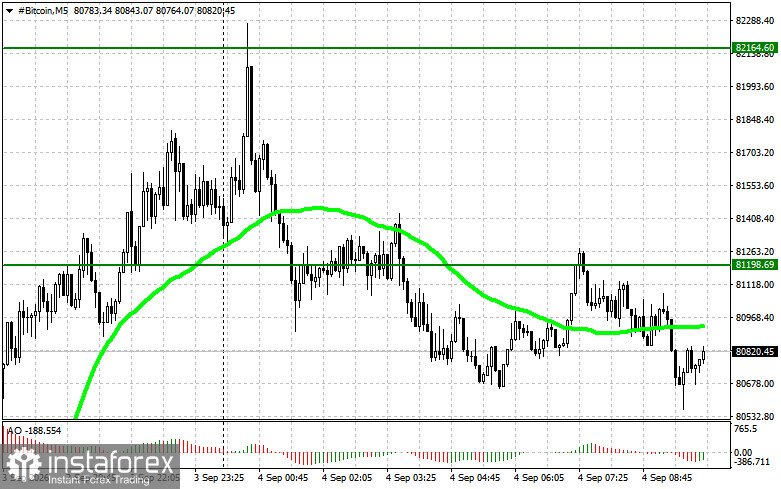
Buy scenario
Scenario No.1: I will buy Bitcoin today if the entry point around $81,200 is reached, with a target to rise to $82,200. Around $82,200, I will exit longs and sell immediately on the rebound. Before buying the breakout, ensure the 50-day moving average is below the current price and the Awesome indicator is above zero.
Scenario No.2: Bitcoin can be bought from the lower boundary of $80,500 if there is no market reaction to its downside breakout, aiming for $81,200 and $82,100.
Sell scenario
Scenario No.1: I will sell Bitcoin today if the entry point around $81,200 is reached, with a target to fall to $80,500. Around $80,500, I will exit shorts and buy immediately on the rebound. Before selling the breakout, ensure the 50-day moving average is above the current price and the Awesome indicator is below zero.
Scenario No.2: Bitcoin can be sold from the upper boundary of $81,200 if there is no market reaction to its upside breakout, targeting $80,500 and $79,700.
Ethereum
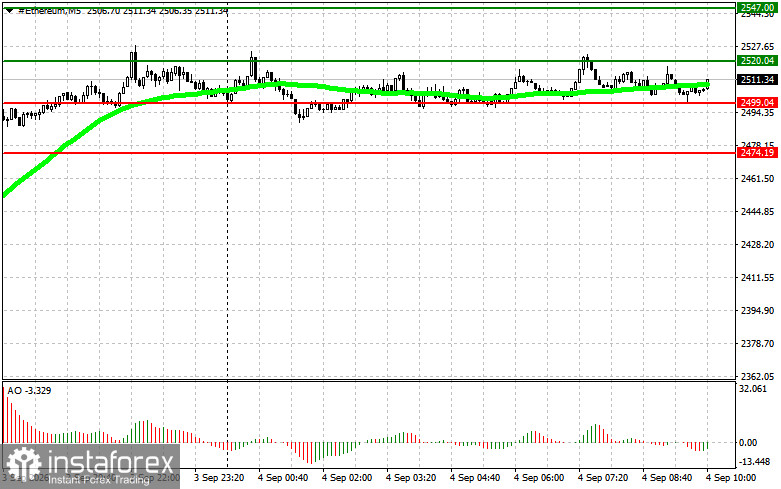
Buy scenario
Scenario No.1: I will buy Ether today if the entry point around $2,520 is reached, with a target to rise to $2,547. Around $2,547, I will exit longs and sell immediately on the rebound. Before buying the breakout, ensure the 50-day moving average is below the current price and the Awesome indicator is above zero.
Scenario No.2: Ether can be bought from the lower boundary of $2,499 if there is no market reaction to its downside breakout, aiming for $2,520 and $2,547.
Sell scenario
Scenario No.1: I will sell Ether today if the entry point around $2,499 is reached, with a target to fall to $2,474. Around $2,474, I will exit shorts and buy immediately on the rebound. Before selling the breakout, ensure the 50-day moving average is above the current price and the Awesome indicator is below zero.
Scenario No.2: Ether can be sold from the upper boundary of $2,520 if there is no market reaction to its upside breakout, targeting $2,499 and $2,474.